St John’s Church, Wissembourg: A Reformation-Era Protestant Church in France
Site at a Glance
- Rating
- 4.5
- Popularity
- Very Low
- Country
- France
- Primary era
- Medieval
- External website
- Open
- Eras represented
- Medieval, Early Modern, Modern
- Civilizations
- Carolingian, Holy Roman Empire
- Site type
- Religious
- Remains
- Church
On this page10 sections
History
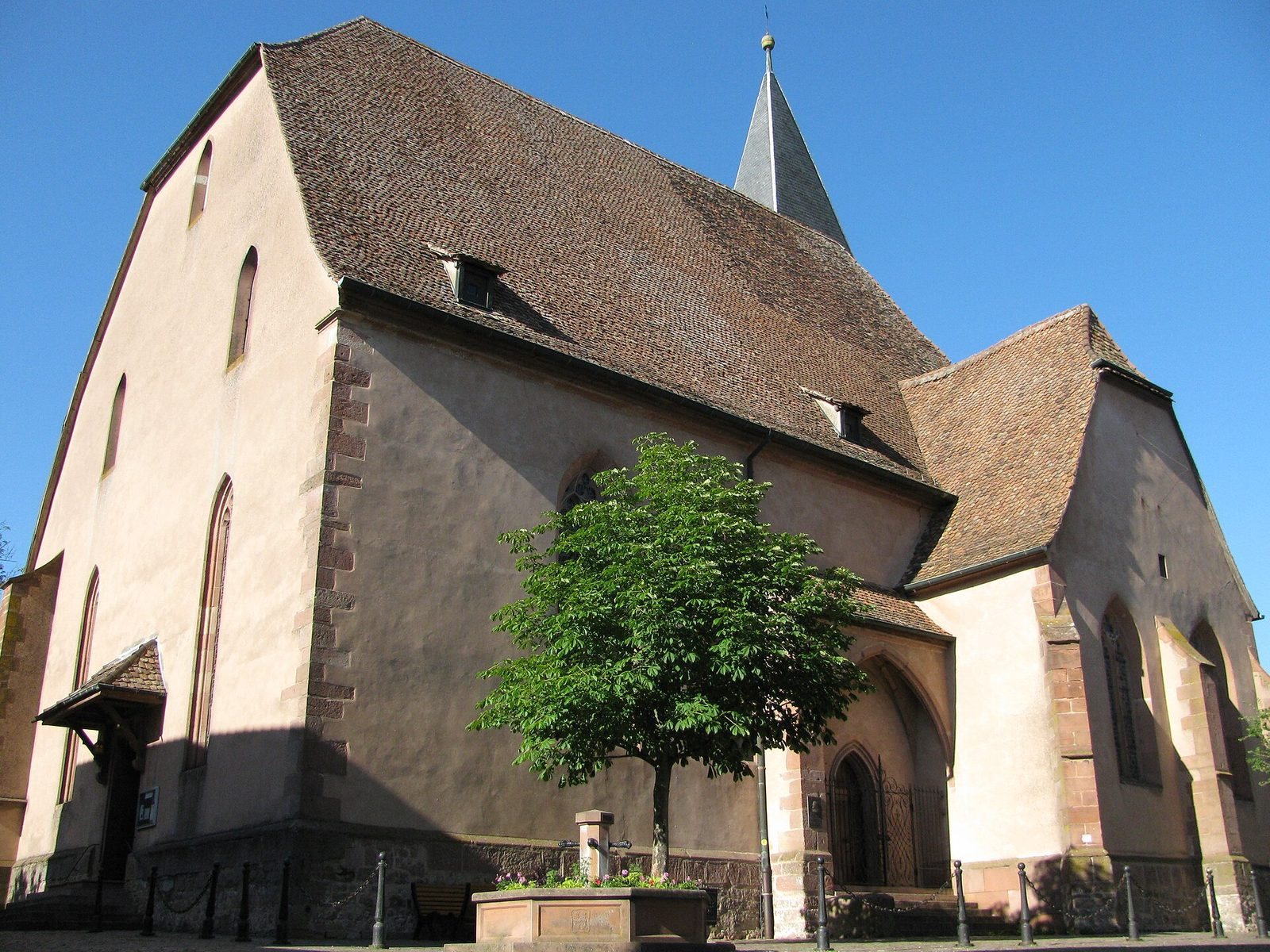
St John’s Church, Wissembourg, in France, is a medieval church built in several phases between the twelfth and sixteenth centuries, on a site already occupied by earlier churches. It began as Wissembourg’s Catholic parish church under the patronage of the abbot of Weissenburg Abbey. Its later history was shaped by the Reformation, a sixteenth-century movement that challenged aspects of Western Catholic doctrine and led to the formation of Protestant churches.
Parish Independence and the Reformation
Around 1520, the parish priest Henri Motherer obtained independence for the parish from the abbey. Motherer had adopted Reformation ideas and invited Martin Bucer, a leading Reformation theologian active in Strasbourg and Alsace, to preach at St John’s. Bucer preached there from November 1522 to April 1523. After a prolonged Catholic-Lutheran struggle, the church became Protestant by 1535.
St John’s remained Protestant for more than a century. In 1684 it became a simultaneum, a church used concurrently by more than one Christian confession, serving both Protestant and Catholic congregations. During the Napoleonic period, in 1803, it was returned to the Protestants. It has since remained a place of worship of the Protestant Church of the Augsburg Confession of Alsace and Lorraine, the Lutheran church body of Alsace and Lorraine named for the principal Lutheran confession presented in 1530.
War Damage and Restoration
France classified the church as a historic monument on 6 December 1898. St John’s suffered heavy damage during the Second World War and was subsequently restored. Bombing in 1945 destroyed the archive room north of the tower. The room was completely rebuilt in 1966 and 1967 under the direction of W. Peter.
The Organ
Andreas Silbermann built a relatively small organ for St John’s between 1717 and 1720. The instrument was altered several times and damaged during the Second World War. In 1961 it was replaced by an electro-pneumatic organ built by Ernest Mühleisen. Electro-pneumatic traction uses electrical control together with pneumatic mechanisms to operate the pipes. After a major revision in 1988, the instrument was still considered unsuitable, and a replacement was decided upon in 2005.
The new project brought together the parish, the Union of Protestant Churches of Alsace and Lorraine, the City of Wissembourg, the French state, regional cultural authorities, and the Association of Friends of the Organ of St John. The aim was to provide an instrument suited to Lutheran worship and able to contribute to the wider musical life of Wissembourg. Manufacture d’Orgues Thomas of Ster-Francorchamps received the contract after five bids had been considered. Its organ, conceived in the North German Baroque tradition while using modern technology, was inaugurated on 28 June 2015 with a dedication service and an afternoon concert by Bart Jacobs, organist of Brussels Cathedral.
Remains
The church brings together a Romanesque tower, Gothic and late-medieval additions, and later interior furnishings. Its plan reflects successive building phases, including an off-axis tower and a choir raised above the space beneath it. Medieval paintings, a historic baptismal font, and a Renaissance pulpit add further layers to the surviving interior.
Tower and Choir
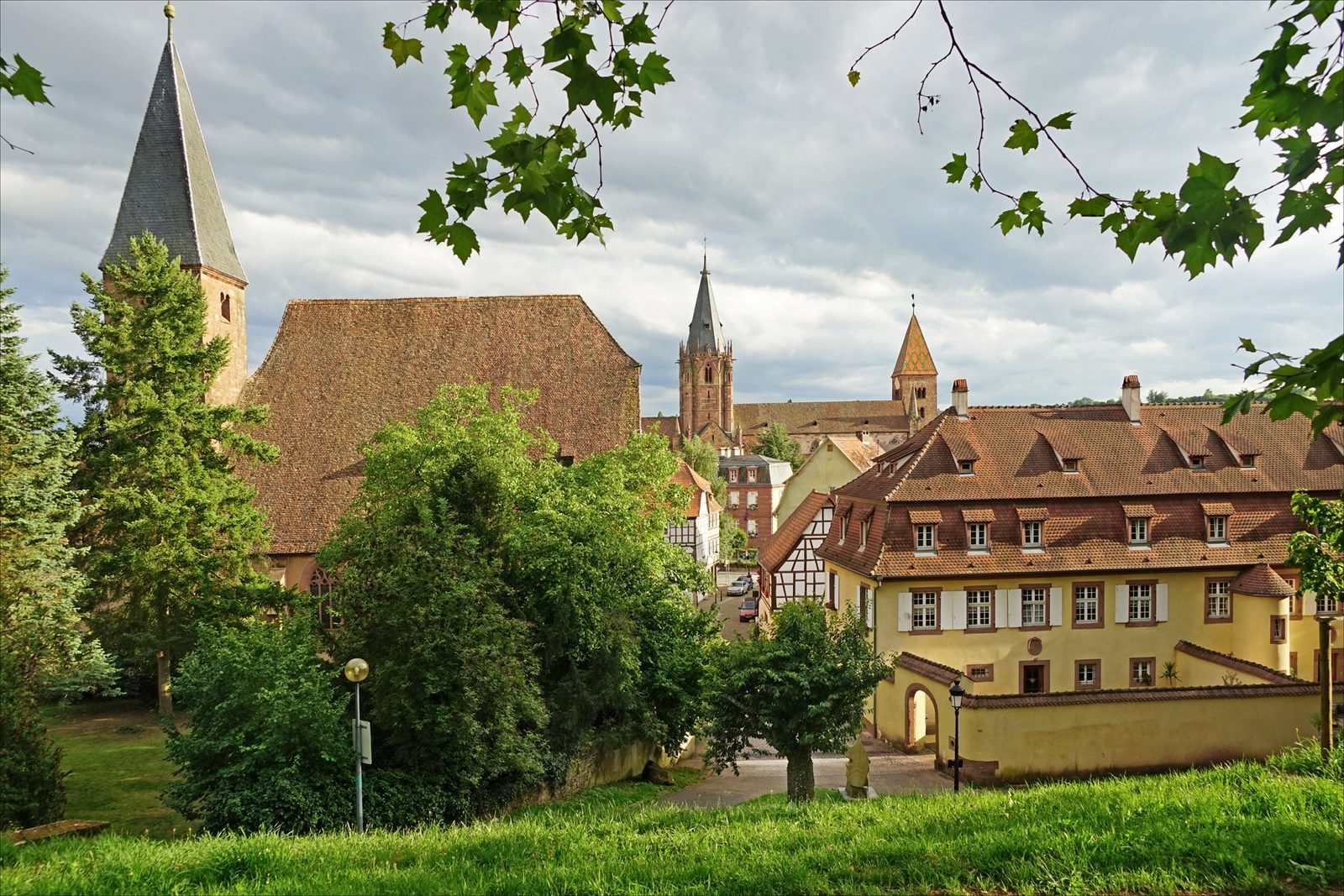
The oldest surviving part is the Romanesque tower, built in the early thirteenth century. Romanesque architecture is associated with massive construction and rounded arches. A lintel from an earlier pre-Romanesque church, possibly dating from the eighth century, was incorporated into the tower. The choir combines Romanesque and Gothic elements and contains two side chapels. Its floor stands approximately 35 centimetres above the floor beneath the tower. The tower is set off the main axis, probably because its alignment followed an earlier building.
Vestry and Nave
The vestry is attached to the north side of the choir. Its walls may be older, possibly dating from the fourteenth century, while its present openings may belong to the sixteenth century. A room above it probably served formerly as a chapel. The nave belongs to the late medieval period, and dendrochronology, the dating of wood through tree-ring sequences, places its timber structure around 1420. It is now unusually low because of a modern ceiling inspired by the ceiling of the vestry.
Gothic Chapels and Aisle
A chapel dedicated to Saint Stanislas was added south of the nave during the fifteenth and sixteenth centuries, probably during the nave’s early-sixteenth-century remodelling. It has two bays with Gothic vaults. The northern aisle is also Gothic. Its vaults carry an inscription dating them to 1513, and their decoration belongs to the Flamboyant Gothic style, a late Gothic tradition known for elaborate, flame-like tracery.
Murals and Interior Furnishings
Several fourteenth-century mural paintings survive in the church and were restored in 1990. Most are in the former chapel above the vestry. A mural in the vestry shows the Crucifixion of Christ with two angels catching his blood. Two paintings in the chapel depict Saint Erasmus of Formia, one showing him teaching and the other his torture. The largest mural is arranged as a rectangle divided into six horizontal bands. These show the Coronation of the Virgin; three angels, the Virgin, Christ holding a globe, and the Four Evangelists; thirteen saints or apostles; ten martyrs; the Crucifixion of Jesus with six unrecognizable figures; and ten further unrecognizable figures. Better-preserved paintings include Saint Catherine of Alexandria and a virgin, or possibly the Virgin, with a unicorn.
The seventeenth-century baptismal font has a basin that is older and may come from an earlier church. The seventeenth-century pulpit is Renaissance in style. A medallion of Martin Bucer stands in the south chapel, while a nineteenth-century bust of Martin Luther is located in the northern side aisle.
Thomas Organ
The present organ follows the North German Baroque tradition in its mechanical action, stop arrangement, and pipe materials. Mechanical action transmits the organist’s movements directly to the pipes, while a stop is a controllable set of pipes producing a particular sound. The case has a distinctly contemporary asymmetrical design, with horizontal resin strips containing LEDs that allow it to emit different colours. The instrument has three manuals with a range from C to G”’ and a pedal with a range from C to F’. Its tuning is modern, at A = 440 Hz, and its stops and combinations are selected electronically. Thirty-eight stops are distributed across the three keyboards and the pedalboard.