Château Saint-Paul: A Medieval Fortified Castle at Wissembourg
Site at a Glance
- Rating
- 4.1
- Popularity
- Very Low
- Country
- France
- Primary era
- Medieval
- Eras represented
- Medieval
- Civilizations
- Holy Roman Empire
- Site type
- Military
- Remains
- Castle
On this page11 sections
History
Château Saint-Paul is a medieval fortified castle in Wissembourg, France, developed from an earlier abbey farm and chapel associated with Saint Paul. The site formed part of the defensive system of the Imperial Abbey of Wissembourg, a monastery whose territory was held directly from the Holy Roman Emperor.
From abbey farm to fortified castle
An abbey farm occupied the site by 803, when its chapel was placed under the protection of the apostle Saint Paul. Tradition places the origins of the associated priory in the eighth century, while the castle itself is documented from the eleventh century. The religious foundation was gradually transformed into a priory and then into a fortified castle.
After the castle was destroyed in the thirteenth century, Abbot Edelin of Wissembourg ordered its rebuilding between 1262 and 1293. Saint-Paul then formed part of the abbey’s forward defensive line, alongside Saint-Germain and other fortified positions.
Fiefs, garrison, and regional conflict
From the end of the thirteenth century, Wissembourg was held as a fief by the Counts of Leiningen. A fief was land or authority granted in return for service, and the Lords of Fleckenstein held Wissembourg as a subordinate fief granted through another lord. In 1360, Abbot Edelin and the Count of Leiningen acquired the castle, while the Counts Palatine maintained an occupying garrison there. These powerful territorial princes of the Holy Roman Empire later became directly involved in the castle’s military history.
During the Weißenburg War, a regional conflict fought from 1469 to 1472, forces of the Electoral Palatinate seized Saint-Paul on 7 January 1469. They used the castle as a base for attacks against Wissembourg and its abbey. An alliance formed by the abbey and town with Louis I, Duke of Palatinate-Zweibrücken, and the Counts of Leiningen stormed the castle on 10 August 1470, drove out the Palatine garrison, and later rebuilt the damaged fortification.
Fire, legend, and later ownership
In 1480, the robber knight Hans von Trotha burned the castle. He is associated with the later legendary figure of Hans Trapp. A local tradition relates that the niece of the Count of Leiningen threw herself from the tower during the fire after brigands threatened her. Her alleged ghost, known as the White Lady, is traditionally said to haunt the vineyards around Wissembourg.
A small settlement stood beside the castle and had two taxable inhabitants before the Weißenburg War. During the French Revolution, Château Saint-Paul was sold as national property and passed into private ownership. It remains privately owned.
Surviving remains of Wissembourg’s former fortifications were placed on the supplementary inventory of historic monuments through orders dated 8 February 1933 and 3 November 1989. The later protection covers the entire Saint-Rémi castle site, including buried remains and its moat.
Remains
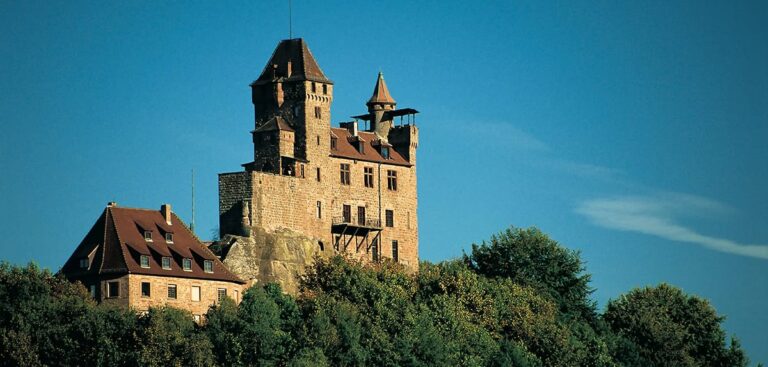
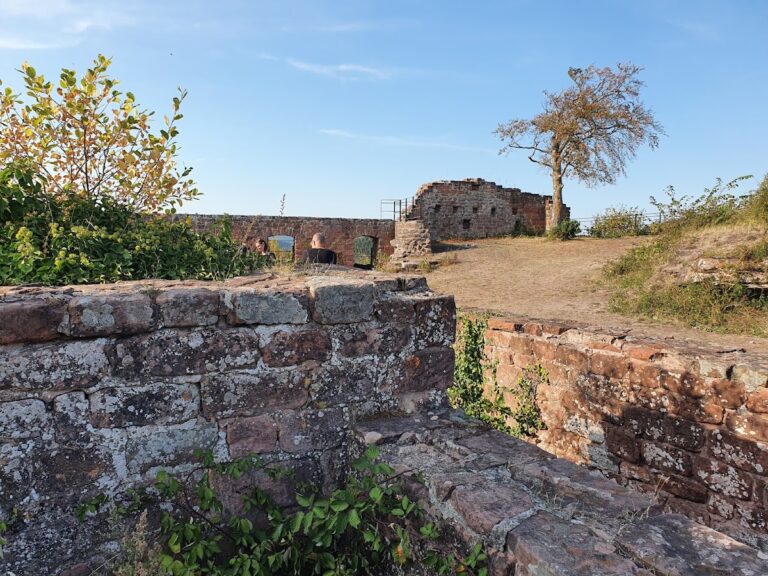
Château Saint-Paul stands north of Wissembourg, where the ground begins to rise toward the Palatinate Forest and the Northern Vosges, about 200 metres from the French-German border. The medieval complex was a donjon-palace, a castle organized around a principal fortified tower that combined defense, residence, and administration, and was flanked by a turret.
Surviving castle structures
Square tower
Only a square, three-storey tower survives from the medieval castle. It represents the central fortified element of the former donjon-palace and preserves the principal vertical mass of the complex.
Chapel
The castle always included a chapel, continuing the religious function established by the earlier chapel of the abbey farm. Its presence links the medieval fortified complex to the site’s earlier ecclesiastical use.
Wissembourg’s defensive network
Four fortified sites
Four fortified sites defended the abbey and settlement at the cardinal points. Saint-Germain stood to the west, Saint-Pantaléon, also called Vierthur, to the southwest, Saint-Rémi to the east, and Saint-Paul to the north. Saint-Paul is the only one of these four castles that survives.
Ramparts and moat
Four ramparts defended the agglomeration of Wissembourg. Surviving elements include buried fortification structures, while the Saint-Rémi site also retains a moat. Together, these remains express the wider defensive framework in which Château Saint-Paul operated.
Nearby sites