Castellvell de la Marca: A Romanesque Frontier Fortress in Spain


Site at a Glance
- Rating
- 4.6
- Popularity
- Low
- Country
- Spain
- Primary era
- Medieval
- Eras represented
- Medieval
- Civilizations
- Crown of Aragon
- Site type
- Military
- Remains
- Castle
On this page6 sections
History
Castellvell de la Marca is a Romanesque medieval fortress in Spain, situated above Castellví de la Marca in Barcelona province. First documented in 977, it occupied a strategic position on the castle frontier between Muslim-held lands around Tarragona and the frontier of the Gaià. Its position connected the castles of Marmellar and Montmell with inland strongholds such as Mediona, Font-rubí, Pontons, Torrelles, and Sant Martí de Sarroca, while routes through the coastal range linked it with Gelida, Subirats, and Olèrdola.
The Castellvell Barony
Castellvell de la Marca, also known as the Old Castle of the Marca, and the Old Castle of Rosanes formed the centre of the Castellvell feudal lineage, one of the important noble families of the Panadés frontier. In 977, Count Borrell of Barcelona sold the castle to Unifred. In 990, the brothers Calabuig and Guazamir were involved in another sale concerning the fortress, transferring it to Senfred.
By 1023, the castle belonged to Berenguer Ramon I, Count of Barcelona, and his wife Sancha. They sold it to Guillermo I de Castellvell, lord of the Old Castle of Rosanes and the castle of Guardia de Montserrat. The presence of two castles in the same barony, both associated with the Castellvell name, created confusion in medieval documents. The designation Castro vetula often appears to refer to Castellvell de la Marca.
The fortress was still called Castri Veteri Extremerii in 1213, while the name Castellvell del Panadés was in use by 1221. During the thirteenth century, the family concentrated its interests on Castellvell de la Marca. Guillema de Castellvell established her residence there and married Guillermo Ramón I de Montcada in 1228. Through their son Guillem de Montcada, Viscount of Bearn, the barony passed to the House of Montcada, a powerful medieval noble dynasty, and remained with that family for three generations.
Later Lords and Abandonment
When the Montcada line ended with another Guillema de Montcada in 1309, the barony passed to her nephew Gascó de Armañac, Viscount of Fesensaguet, and later to the Counts of Foix. In 1399, Martin the Humane, King of Aragon from 1396 to 1410, sought to transfer the castle and its jurisdiction to Barcelona. The castle and barony had been confiscated from the Foix family and transferred to the Crown of Aragon, the dynastic and political union ruled by the kings of Aragon and their associated territories. Martin ordered the veguer of Barcelona and the Vallés to put the property up for auction and proposed that Barcelona’s councillors buy it. A veguer was a royal or comital official responsible for district administration, justice, and government.
The final documentary notices date from 1481, when King Ferdinand the Catholic ordered the veguer of Vilafranca to restore the barony to the Princess of Viana, who was acting as tutor to the King of Navarre. The barony later passed to the Zúñiga family in 1549, the Fajardo family in 1618, and Cavero, Counts of Sobradiel, in 1856. Francisco de Borja Álvarez de Toledo y Osorio was its last jurisdictional lord. The castle had been abandoned long before the modern period. It was declared a monument on 8 November 1988 and is recorded under heritage code RI-51-0005367.
Remains
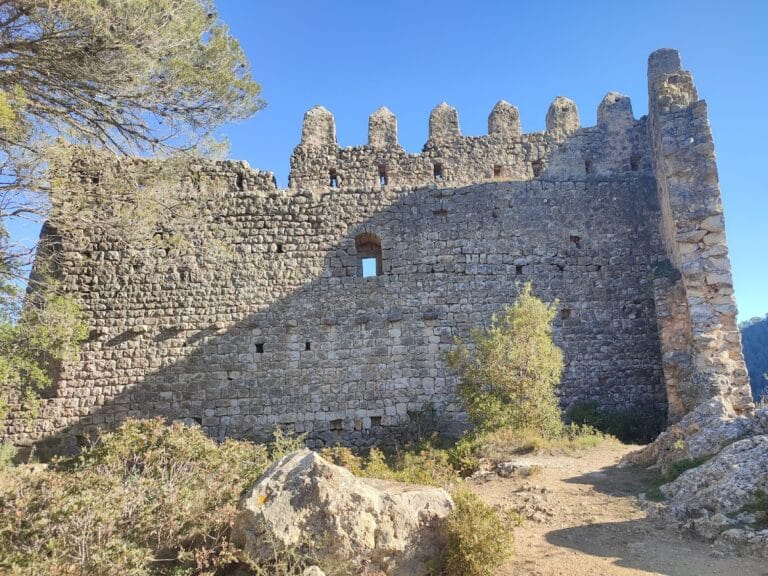
The surviving site occupies a steep rocky hill at 468 metres above sea level, on an eastern spur of the Montmell range. Casas Nuevas de la Riera lies below the outcrop, whose position gives the fortress an extensive outlook across the lower Panadés plain. The remains consist chiefly of the castle tower and other standing ruins, together with the Chapel of Saint Michael at the base of the rock.
Castle Tower and Ruins
The castle is represented by its surviving tower and associated standing remains. Its architecture is classified as Romanesque, the medieval tradition known for strong masonry, rounded arches, and heavy forms. The ruins occupy the rocky summit and preserve the physical presence of the former frontier fortress.
Chapel of Saint Michael
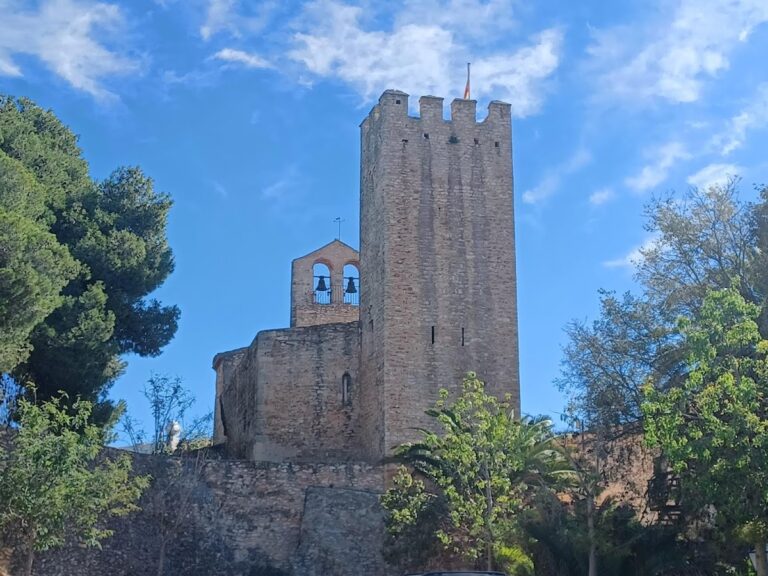
The Chapel of Saint Michael of Castellvell stands beside the castle tower at the base of the rocky outcrop. Its origin may reach back to the tenth century, while its earliest written reference dates from the eleventh century. The chapel was abandoned with the fortress in the thirteenth century and remains part of the surviving complex.