Alexandria Oxiana: A Hellenistic Royal and Military Centre in Uzbekistan
Site at a Glance
- Rating
- 4.5
- Popularity
- Very Low
- Country
- Uzbekistan
- Primary era
- Classical
- Eras represented
- Classical
- Civilizations
- Greco-Bactrian, Seleucid
- Site type
- City
On this page23 sections
History
Alexandria Oxiana, the name applied to the ancient Hellenistic city at Ai-Khanoum in Uzbekistan, was probably founded between 300 and 285 BC by an official acting for Seleucus I Nicator or his son Antiochus I Soter. The city belonged to the eastern world of the Seleucid dynasty, the ruling house established after the division of Alexander the Great’s empire, and developed as a royal, military, and economic centre in Central Asia. Its original ancient name remains unknown, and proposed identifications have included Alexandria in Sogdiana, Alexandria near Bactra, and Termez.
Foundation beside the Oxus
Ai-Khanoum stood at the meeting of the Amu Darya, known in antiquity as the Oxus, and the Kokcha. Fertile irrigable land supported settlement, while nearby mineral resources in Badakhshan added economic value. The city was not positioned on a major trade route, but it controlled approaches to the mining districts of the Hindu Kush, the Western Pamirs, Chinese Turkestan, and the strategically important northern routes.
The foundation may have followed an earlier Achaemenid fort in the vicinity, although the existence of a settlement at Ai-Khanoum before the arrival of the Greco-Macedonians remains unsettled. Royal patronage and the establishment of a mint probably encouraged early population growth. The city’s fortifications were maintained and improved repeatedly, reflecting its position within the eastern Seleucid provinces.
Seleucid investment
Several major structures were built during the reign of Antiochus I, including the heroön, northern fortifications, and a sanctuary. A heroön was a shrine dedicated to a deceased founder, hero, or exceptionally prominent person. The mint was probably established around 285 BC, and investment continued after Antiochus became sole ruler in 281 BC. Under Antiochus II, the mint remained active while the ramparts were strengthened.
Bricks from the heroön carry the same triangular monogram found on coins from Antiochus I’s reign. This supports the probability that Ai-Khanoum housed the principal Seleucid mint during Antiochus’s coregency and early period as sole ruler. The city’s administrative function, military defences, and royal architecture developed together, creating a planned centre of Seleucid authority in Bactria.
Greco-Bactrian transformation
Around 250 BC, Diodotus I, governor of the eastern Seleucid provinces, seceded and founded the Greco-Bactrian Kingdom, a Hellenistic state formed when Bactria and neighbouring eastern provinces broke away from Seleucid rule. Ai-Khanoum lost some of its earlier importance after the political change. Its temple and sanctuary were reconstructed, but most Seleucid building programmes ended, and the city may thereafter have served chiefly as a military stronghold with administrative responsibilities.
Antiochus III, a later Seleucid king, invaded the Greco-Bactrian Kingdom in 209 BC. Ai-Khanoum may have been involved in military operations in the surrounding region. Later conquests by Euthydemus I and Demetrius I toward the northwestern Indian subcontinent benefited the city. Its population grew, and public buildings were reconstructed during this period of renewed Greco-Bactrian expansion.
The city reached its zenith under Eucratides I in the mid-second century BC. Eucratides probably made Ai-Khanoum his capital and may have renamed it Eucratideia. Many of the surviving ruins belong to the extensive redevelopment associated with his rule. The palace, public buildings, religious complexes, and military installations together reflect the resources invested in the city during this phase.
Capture and abandonment
Eucratides was assassinated around 145 BC, after which the Greco-Bactrian Kingdom collapsed. Saka invaders captured Ai-Khanoum, and the city was largely abandoned. The treasury suggests that the settlement may have endured two assaults roughly fifteen years apart. A silver ingot marked with runic letters and tombs containing nomadic grave goods indicate Saka occupation.
Parts of Ai-Khanoum remained intermittently occupied until the second century AD. Public buildings were reused as residences, and the final phase of habitation ended after a major fire. The city therefore passed from royal foundation to military and administrative centre, then to a damaged settlement whose monumental buildings acquired more limited domestic uses.
Rediscovery and archaeological work
On 18 March 1838, the British soldier-explorer John Wood was told of an ancient city in the area, but he did not recover archaeological evidence. Ai-Khanoum was rediscovered in 1961 after King Mohammed Zahir Shah was shown a Corinthian capital found there. French excavations began in 1964 under Daniel Schlumberger and later continued under Paul Bernard until 1978.
Archaeologists investigated the palace, gymnasium, theatre, arsenal, sanctuaries, houses, inscriptions, coins, ceramics, and other remains. The city’s large size, difficult acropolis, and rough terrain limited the extent of excavation. Work stopped in 1978 after the Saur Revolution and the outbreak of the Soviet-Afghan War.
During the subsequent conflicts, Ai-Khanoum was extensively looted. Artefacts entered the antiquities market, hundreds of looters’ holes perforated the northern lower town, and the site’s archaeological integrity was severely compromised. Military activity also affected the ruins, including the installation of a Northern Alliance gun battery on the acropolis, which further destabilized the remains.
The discovery of Ai-Khanoum transformed the study of the Greco-Bactrian Kingdom by providing archaeological evidence for Hellenistic culture in Central Asia. Its buildings, inscriptions, coins, and artworks reveal the combination of Greek traditions with Central Asian and Oriental techniques, and the site helped stimulate investigation of other Hellenistic settlements in the region.
Remains
Setting and defensive layout
Ai-Khanoum occupied the southwestern corner of a triangular plain covering about 300 square kilometres. The Amu Darya, the Kokcha, and the eastern Hindu Kush bounded this landscape, and the city stood approximately 10 kilometres downstream from the confluence of the Amu Darya and the Qizilsu. Its layout combined a lower town with an acropolis rising about 60 metres above it. The acropolis extended roughly 2 kilometres north from the Kokcha and contained a citadel at its southeastern corner.
Citadel and ramparts
The citadel measured about 150 by 100 metres. Cliffs approximately 80 metres high protected two sides, while a small moat guarded the third. More than 20-metre-high river cliffs formed natural defences along the southern and western edges of the city. Walls enclosing the city and acropolis supplemented these barriers.
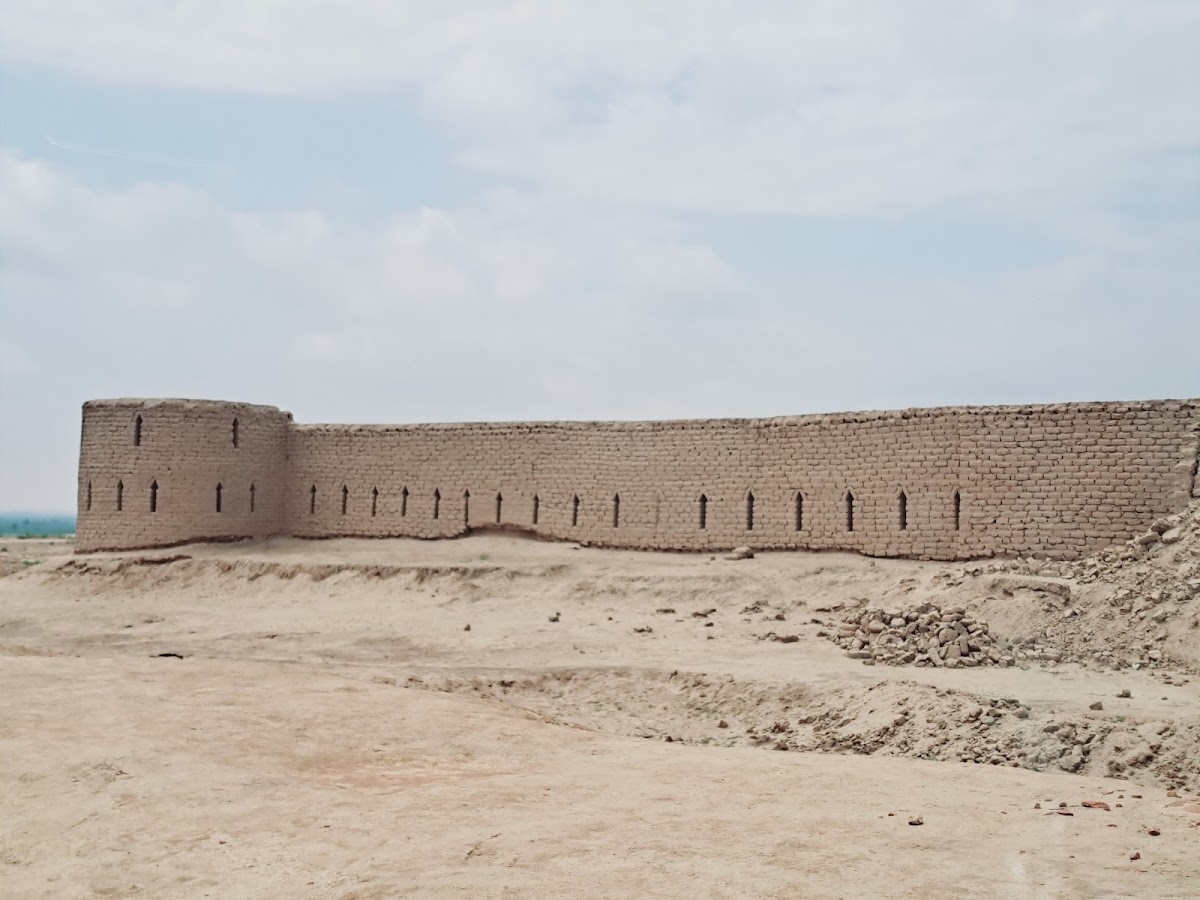
The northern ramparts were built mainly from solid mud brick. They rose about 10 metres and were approximately 6 metres thick, with large towers and a steep ditch providing additional protection. The main gate was set into this northern line and also guarded the canal that carried water toward the city centre. From the gate, a straight street ran south along the foot of the acropolis, crossed the lower town, and reached the southern riverbank after about 1.5 kilometres.
Urban fabric and royal complex
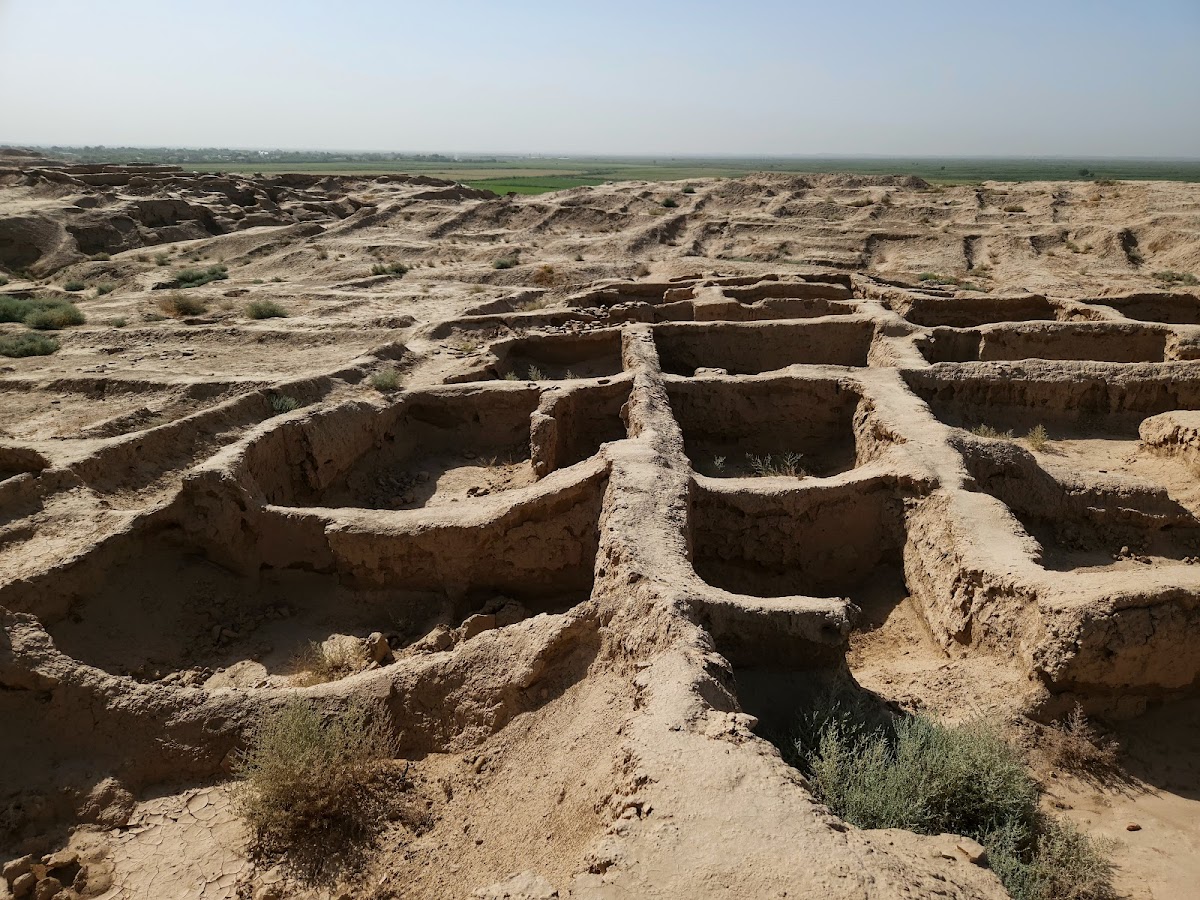
Most buildings were made of unbaked brick, while baked brick and stone were used less often. Much of the lower town followed an irregular plan. In the southern residential quarter, however, large houses were arranged in three blocks. A major rebuilding programme in the early second century BC altered the orientation of some principal structures. The palace, for example, stood at an angle to the older main street.
Palace and ceremonial approach
The palace complex occupied about one-third of the lower town and measured approximately 350 by 250 metres. Built on the order of Eucratides I, it served as a state building, royal residence, and treasury. A plaza of about 27,000 square metres extended south of the palace and may have accommodated military parades, training exercises, or garrison quarters.
The palace was reached from the main street through the Main Propylaea, a monumental entrance reconstructed under Eucratides. Its broad portico lay between two porches and carried palmette-shaped roof ornaments. A curved road led from the gateway to the palace courtyard. The rectangular courtyard measured about 137 by 108 metres and was surrounded by 118 Corinthian columns. Those in the northern, eastern, and western colonnades stood about 5.7 metres high, while the southern colonnade approached 10 metres and formed a Rhodian peristyle, a colonnaded court with one side substantially taller than the others.
Behind the southern portico stood a column-supported vestibule with eighteen columns. This hypostyle space, meaning a hall whose roof rests on columns, led to a large reception room decorated with wooden sconces, painted lion protomes, and geometric designs. The room was probably enclosed. Administrative, residential, and treasury areas were linked by courtyards and long corridors.
Administrative and residential quarters
The administrative quarter contained two pairs of units. The eastern pair were audience halls, while the western pair may have served as chancelleries. Southwest of this area were two residential units. Their bathrooms had limestone paving and pebble mosaics showing palmettes and marine animals.
The larger western residence included a small iwan and may have been intended for the ruler’s family. The eastern unit may have accommodated the monarch and close companions. These residential spaces formed part of a palace designed to combine domestic life with court administration and ceremonial activity.
Treasury and library
The treasury occupied the western side of the palace courtyard. In its final form, twenty-one rooms surrounded a square courtyard about 30 metres on each side. Greek-labelled vases held palace inventories that included gemstones, Badakhshan lapis lazuli, ivory, olive oil, incense, cash reserves, and other valuables.
Inscriptions recorded payments and the movement of luxury goods. One inscription describes an official named Zenon transferring 500 drachmas to two employees, Oxeboakes and Oxybazos, for deposit and sealing in a vase. The names in the treasury records include both Greek and Bactrian-Iranian forms, reflecting the mixed cultural environment of the city.
Other treasury materials included Indian agates and jewellery, offerings from Buddhist stupas, and a mother-of-pearl disc decorated with coloured glass paste and gold thread. The disc most probably represents the meeting of Dushyanta and Shakuntala. South of the treasury, near the residential quarters, a library produced two literary fragments preserved as impressions in decomposed writing materials. One, on papyrus, concerned Plato’s theory of forms; the other, on parchment, was probably a theatrical work, possibly a tragedy involving Dionysus.
Residential buildings
An excavated urban residence measured about 66 by 35 metres and contained three architectural stages dating back to approximately 200 BC. Its plan included a large northern courtyard, a two-column porch, a central reception room, corridors, bathrooms, a kitchen, and other rooms.
A larger residence outside the northern rampart measured approximately 108 by 72 metres. Its northern courtyard and southern buildings resembled those of the urban house. An east-west corridor divided the main building into living quarters to the north and service rooms and baths to the south. Fragments indicate that some of its columns were nearly 8 metres high.
Sanctuaries and memorial architecture
Temple with Indented Niches
The large central sanctuary stood on the main street between the palace and the street itself. Often called the Temple with Indented Niches, it was a square building raised on a podium about 1.5 metres high and surrounded by an open area. Its walls reached about 6 metres and contained fourteen recessed niches, with two beside the entrance and four on each remaining side.
Buildings enclosed the sanctuary courtyard on three sides. A wooden colonnade with Oriental-style pedestals stood to the southwest, while rooms and porticoes occupied the southeast. An altar was set into the northeastern wall. The approach from the main street passed through a columned porch arranged in the distyle-in-antis form, with two columns between projecting wall ends.
The sanctuary combined Greek, Persian, Achaemenid, and Mesopotamian elements. Its three-stepped platform and recessed wall niches belonged to Mesopotamian and related architectural traditions. Finds included libation vessels, ivory furniture, figurines, terracottas, and a gilded-silver medallion showing Cybele, an Anatolian mother goddess adopted into the Greek and wider Hellenistic religious world, accompanied by Nike in a lion-drawn chariot approaching a priest at an altar.
The medallion joined Greek clothing and solar imagery with Oriental dress, chariot design, and crescent-moon motifs. Fragments of the central cult statue followed Greek sculptural traditions. A surviving part of its left foot displays a thunderbolt, while the deity’s precise identity remains uncertain.
Northern temple and acropolis podium
A smaller temple outside the northern wall replaced an earlier and simpler structure. It resembled the main sanctuary in its use of wall niches, but its interior contained three chapels rather than a central cult image.
An open-air podium on the acropolis faced east. It may have served as a sacrificial platform connected with worship of the rising sun, although that interpretation remains uncertain.
Heroön of Kineas
The heroön stood north of the palace in the lower town on a three-stepped platform. Its entrance porch had two columns between projecting walls, and a narrow inner chamber lay behind it. Four coffins, two wooden and two stone, were placed beneath the platform.
The earliest and most prominent coffin was linked to the upper temple by an opening and conduit through which offerings could be poured. An inscription names the honoured individual as Kineas, probably the Seleucid epistates, an appointed governor or supervisor, or the oikistes, a founder or founding leader who governed the city’s first settlers.
A stele in the entrance porch preserved the final five lines of moral maxims originally displayed at the Temple of Apollo at Delphi. It also carried an epigram commemorating Klearchos, who copied and installed the maxims in Kineas’s sanctuary. Identifying Klearchos with the philosopher Clearchus of Soli is now considered improbable, but the stele demonstrates Ai-Khanoum’s connections with the wider Greek world and the cultural identity of its first Bactrian-born generation.
Public, military, and theatrical buildings
Gymnasium
The gymnasium extended along the western ramparts. In its final phase it measured approximately 390 by 100 metres and consisted of a southern courtyard and a northern complex. Both the palace district and a street behind the riverside fortifications provided access to the complex.
Long rectangular rooms surrounded a square courtyard entered through four recessed seating spaces, or exedrae. The northern exedra contained a small inscribed plinth and a statue about 77 centimetres high. A dedication honoured Hermes and Heracles, the gymnasium’s two patron deities. Two brothers, Triballos and Straton, made it on behalf of their father, also named Straton.
Arsenal
The incompletely excavated arsenal stood against the acropolis, east of the southern main street. Slag in its courtyard indicates that blacksmiths worked there. Excavated equipment included arrowheads, spears, javelins, a caltrop, uniform ornaments, and iron cataphract armour, heavy protective armour used by mounted soldiers and sometimes their horses. The armour is the earliest example of its kind yet found.
Theatre
The theatre was built into the northern side of the acropolis beside the main street. It measured approximately 85 metres across and could seat between 5,000 and 6,000 spectators. Three loggia, gallery-like architectural spaces, lay below the main division of the seating area and probably accommodated dignitaries.
The excavators found the bones of about 120 individuals in the orchestra. They probably date to the city’s fall around 145 BC, linking the theatre to the violence and upheaval that accompanied the end of Greco-Bactrian rule at Ai-Khanoum.
Coins, inscriptions, and artistic exchange
Excavations produced three coin hoards and 274 stray coins, of which 224 were legible. The groups included punch-marked coins, silver drachmas, and Greco-Bactrian and Seleucid silver issues. A palace hoard contained 677 punch-marked coins and six silver drachmas bearing the name of Agathocles of Bactria.
The Agathocles drachmas carried Greek and Brahmi inscriptions and show the earliest unambiguous images of Balarama and Vasudeva, identified through their attributes. Another hoard from the kitchen of the residence outside the northern wall contained 63 silver tetradrachms, including 49 Greco-Bactrian coins, most associated with Euthydemus I. A third hoard found near the site in 1973 and 1974 entered the antiquities market and no longer retains its original composition.
Ai-Khanoum’s artistic and architectural remains combine Greek traditions with Central Asian and Oriental techniques. The site produced what is described as the largest faience sculpture found in the Hellenistic world, as well as a Heracles statuette that demonstrates artistic continuity with later Indo-Greek representations of Vajrapani. Together with the buildings, inscriptions, and coinage, these works show how Hellenistic forms were adapted within the cultural landscape of ancient Bactria.