Bazira Ruins: The Ancient Settlement of Barikot, Pakistan
Site at a Glance
- Rating
- 4.6
- Popularity
- Very Low
- Country
- Pakistan
- Primary era
- Classical
- Eras represented
- Bronze Age, Iron Age, Classical, Medieval
- Civilizations
- Indo-Greek, Mauryan, Parthian, Scythian
- Site type
- City
On this page18 sections
History
Bazira, beneath present-day Barikot in Pakistan, was an ancient settlement occupied from the Copper Age through the Ghaznavid period. Its history includes early urban development, Achaemenid cultural influence, the siege by Macedonian forces in 327 BC, Mauryan and Indo-Greek phases, Kushan rule, and later Shahi occupation. Excavations by the Italian Archaeological Mission, founded by Giuseppe Tucci and later renamed ISMEO, have taken place at Bazira since 1984.
Early settlement and the first urban phases
The earliest known occupation includes Chalcolithic, or Copper Age, remains dating to about 1700 BC. Pit structures from approximately 1700 to 1400 BC belong to this prehistoric settlement. During the transitional Late Bronze Age and Iron Age, roughly 1200 to 800 BC, Bazira grew into a large settlement of about 15 hectares. It had a hilltop acropolis, an inner stronghold, an earthen rampart, and an extensive outer graveyard.
The settlement’s early Iron Age layers, dating from the eleventh to the eighth centuries BC, are described as proto-urban. This term refers to a settlement that shows some features of urban life without necessarily possessing the full organization of a city. Residential buildings and workshops from this period have been excavated, together with objects associated with domestic and craft activity. After the earthen rampart collapsed, the settlement was abandoned and covered by alluvium, sediment deposited by flowing water, between about 800 and 600 BC.
A later city began to develop around 600 to 500 BC, before Achaemenid influence reached Bazira. This poorly preserved phase includes a stretch of wall and a passageway marked by wheel traces. During the Achaemenid acculturation phase, approximately 500 to 400 BC, local potters made tulip bowls that reflected the adoption and adaptation of Persian cultural forms by the Swat elite. Achaemenid luxury pottery appeared alongside non-luxury Indic vessels and locally produced glass objects.
Regional rule and the Macedonian siege
Between about 400 and 250 BC, Swat and Gandhara were no longer governed by the Achaemenid Empire, the ancient Persian imperial state that was conquered by Alexander the Great. Bazira came under the Assakenoi, an ancient people or tribal polity associated with the Swat region, in alliance with other Indian tribes. Achaemenid ceramic forms disappeared from the settlement during this period, while Indic household vessels continued to be used.
In autumn 327 BC, Macedonian forces besieged Bazira during Alexander the Great’s campaigns in the region. A 2024 interpretation proposes that an earlier non-Buddhist shrine was later adapted into the apsidal Buddhist temple at the site, and that the shrine belonged to the period of the siege. The proposal connects a religious structure at Bazira with one of the settlement’s most important political and military episodes, while retaining the distinction between the earlier shrine and the later Buddhist building.
Mauryan and Indo-Greek Bazira
By the mid-third century BC, Bazira formed part of a political and commercial network linking the Mauryan and Greco-Bactrian kingdoms. Greco-Bactrian and Hellenistic pottery forms reached the settlement through connections with northern Afghanistan and Central Asia. A Mauryan coin from trench BKG 11 was found in a layer dated by radiocarbon to 349 to 282 BC, with a central estimate of about 315 BC.
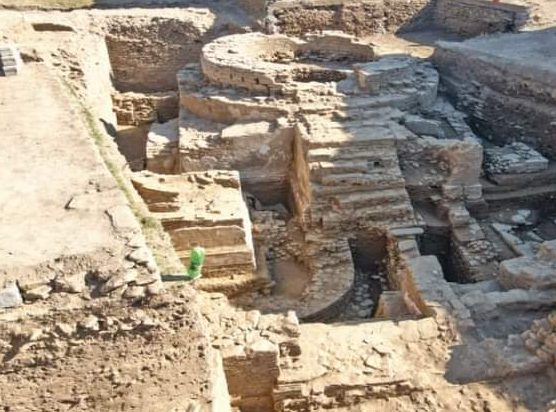
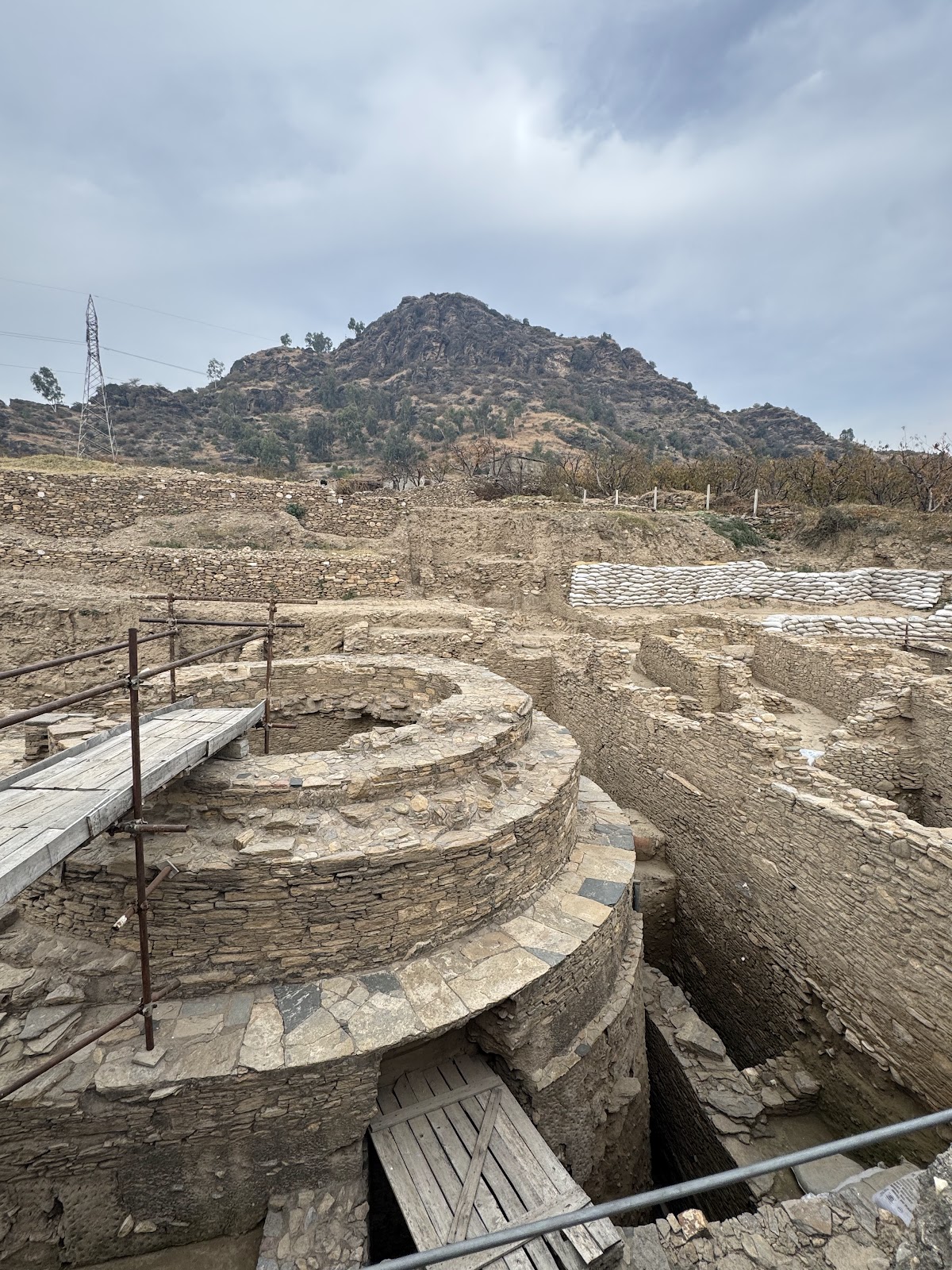
During the reign of the Mauryan emperor Ashoka in the third century BC, an apsidal Buddhist temple was constructed at Bazira around 250 BC. An apsidal temple has a rounded or semicircular end, while the associated stupa was a Buddhist commemorative monument linked with worship, relics, or remembrance. The temple continued to function during the reign of Menander I, the Indo-Greek king also known in early Buddhist literature as Milinda, in the mid-second century BC, and was later enlarged or otherwise enhanced.
From approximately 200 to 100 BC, Bazira developed into a town covering about 12 hectares at its greatest extent when the acropolis is included, or about 7 hectares without it. A massive defensive wall with rectangular bastions was built after 200 BC around the town and acropolis. A burial connected with the wall’s construction dates to approximately 130 to 115 BC, between the end of Menander I’s reign and the beginning of the reign of Antalkidas, an Indo-Greek ruler associated with the Hellenistic kingdoms of northwestern South Asia.
Later ancient and medieval phases
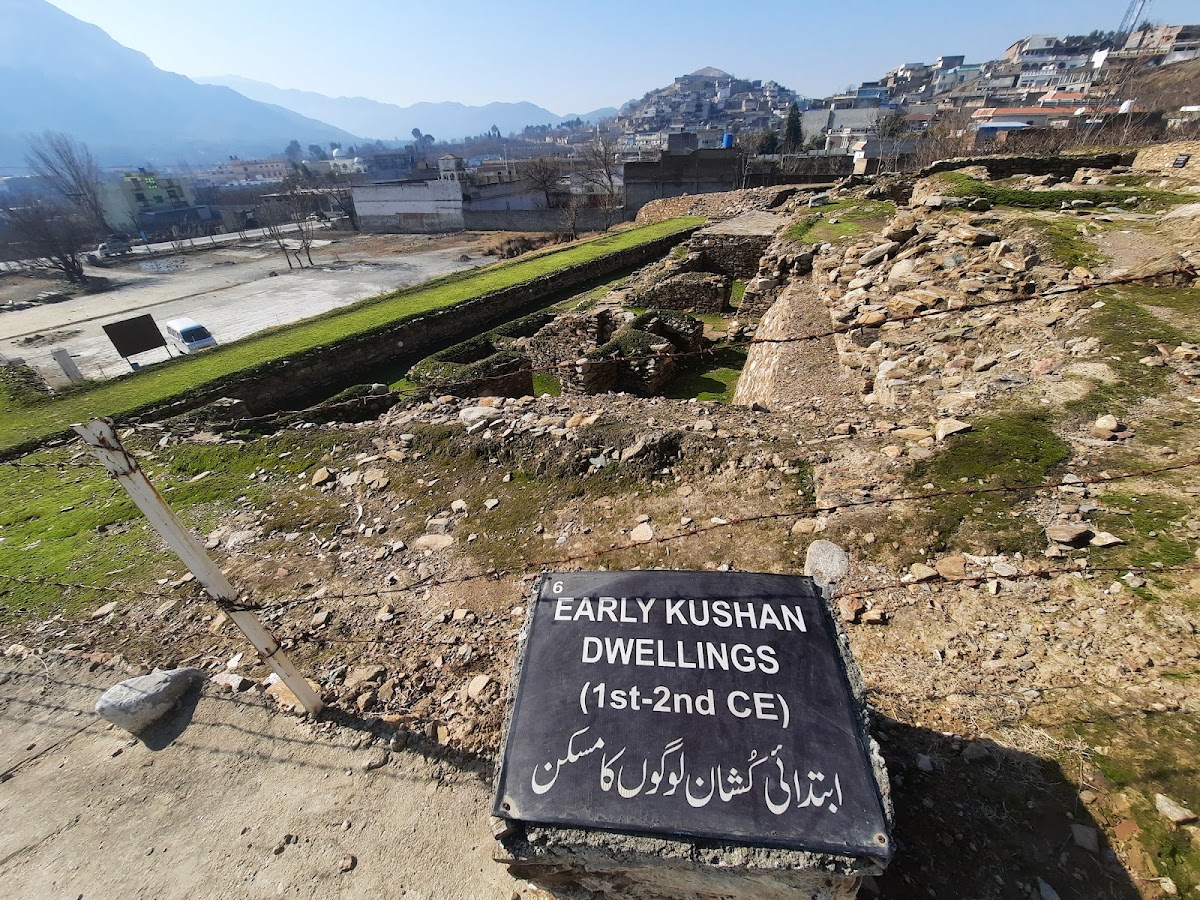
During the Saka and Parthian phase, approximately 50 BC to AD 70, Swat was annexed by the Sakas and Parthians. Bazira’s defensive wall had been reinforced before AD 80. In the Early Kushan phase, approximately AD 70 to 200, the town’s society included the Buddhist sangha, the Buddhist monastic community, communities described archaeologically as Dardic, and urban elites.
Under the Kushan Empire, a major Central and South Asian power that supported wide commercial and cultural exchange, Bazira became a major town. Earthquakes in the third century AD devastated the settlement. Earthquake damage combined with the decline of Kushan power probably contributed to its abandonment by the end of that century. The late Kushan, sub-Kushan, and Kushano-Sasanian phases lasted approximately from AD 250 to 400. During the following abandonment phase, about AD 400 to 550, a sacred building was constructed despite the broader decline of the settlement.
In the Shahi phase, approximately AD 680 to 1000, a temple was built on the summit of Ghwandai mound around AD 700. It was re-established and maintained into the Hindu Shahi period around AD 1000. The temple is mentioned in a Hindu Shahi inscription found at Barikot in the late nineteenth century and now conserved in the Lahore Museum. Bazira subsequently entered a Ghaznavid phase dated approximately to AD 1000 to 1100.
Excavations begun in 2011 and discoveries reported from 2015 onward revealed urban phases earlier than the foundation date previously accepted for the city. The Italian Archaeological Mission and Ca’ Foscari University, working with Pakistan’s provincial archaeology and museums department under Luca Maria Olivieri, announced the discovery of the apsidal Buddhist temple in 2021. Its identification provided evidence for Buddhism in Swat from the third century BC and has been interpreted as evidence that Menander I supported the Buddhist cult.
Remains
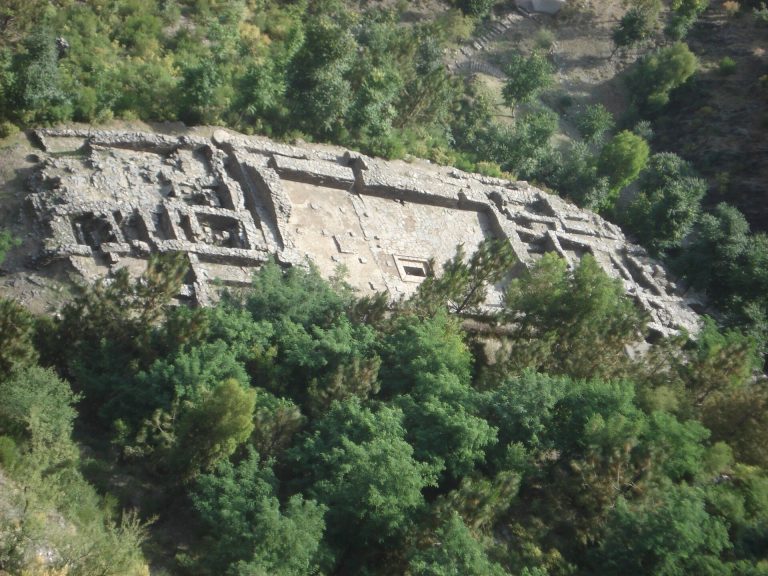
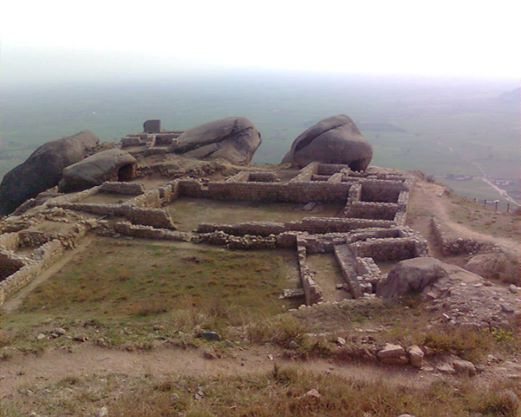
Bazira’s physical remains occupy an archaeological settlement whose successive layers preserve prehistoric habitation, Iron Age urban development, later fortifications, religious buildings, workshops, residences, burials, and objects associated with daily life. The early settlement extended across about 15 hectares and included an acropolis, an inner stronghold, and an outer graveyard. The later Indo-Greek town covered about 12 hectares with the acropolis, or about 7 hectares without it, and was enclosed by a substantial defensive wall.
Prehistoric and Iron Age settlement
Pit structures
The prehistoric settlement includes pit structures dating to about 1700 to 1400 BC. These remains belong to the Chalcolithic occupation, a period when copper was used alongside stone tools before bronze technology became widespread.
Residences and workshops
Trench BKG 12 W exposed residential structures and workshops from the transitional Late Bronze Age and Iron Age phase, approximately 1200 to 800 BC. Finds from this area include a toy cart, bi-carinated pottery, miniature vessels, stone tools, and incised pottery. Radiocarbon dating places the associated materials between 1196 and 1021 BC with a 95.4 percent probability. Together, the structures and objects show a settlement combining domestic occupation with craft activity.
Rampart and early city wall
The Iron Age settlement was protected by an earthen rampart, which collapsed before the site was abandoned and buried by alluvium between about 800 and 600 BC. The earliest identified later urban phase, dating to about 600 to 500 BC, survives in a poorly preserved wall stretch and a passageway bearing wheel traces.
Fortifications and urban life
Indo-Greek defensive wall
After 200 BC, a massive defensive wall was built around the town and its acropolis. Rectangular bastions strengthened the wall, which formed the principal fortified boundary of the Indo-Greek settlement. A burial associated with its construction dates to about 130 to 115 BC, providing a chronological connection between the defensive works and the later Indo-Greek phases.
Domestic and craft remains
Coins, pottery, and weapons illuminate the daily life of Bazira’s inhabitants across its later occupations. The settlement also preserves evidence of cultural connections beyond Swat, including Greco-Bactrian and Hellenistic pottery forms, locally made glass objects, and pottery influenced by Achaemenid and Indic traditions.
Religious buildings and sculpture
Apsidal Buddhist temple
The apsidal Buddhist temple dates to approximately 250 BC and was associated with an Indian-style stupa. Its rounded-ended plan belongs to an early phase of Buddhist religious architecture at Bazira. The building remained in use during the reign of Menander I and continued until sometime around the third or fourth century AD, after which its religious use ended.
Objects associated with the temple include coins, among them a silver coin issued by Menander, and an onyx seal bearing a Hellenistic intaglio. An intaglio is a design cut into a gem or seal to produce a raised impression when pressed. The seal shows a youth in Greek clothing and carries a Kharosthi inscription. A monumental Kharosthi inscription, further inscriptions on pots, fish plates, and polished black pottery imitating Attic models were also found in association with the temple. Kharosthi was an ancient script used chiefly in the northwestern Indian subcontinent and nearby Central Asian regions.
Buddhist sculpture
Buddhist material from Bazira includes a large green-schist statue of Siddhartha Buddha riding his horse Kanthaka. Kanthaka is the horse associated with Siddhartha Gautama in Buddhist accounts of his life before enlightenment. Another carving shows a stupa accompanied by two lions, linking the site’s sculptural remains with Buddhist commemorative imagery.
Seated deity
A separate statue depicts an unidentified deity seated on a throne. The figure has long curled hair and holds a wine goblet and a severed goat head. It may represent Dionysus or another local deity, but the identification remains uncertain.
Shahi temple
A temple was built on the summit of Ghwandai mound around AD 700 during the Shahi period. The structure was later re-established and maintained into the Hindu Shahi period around AD 1000. Its association with the Hindu Shahi inscription found at Barikot connects the surviving architectural remains with the later religious and political history of Bazira.