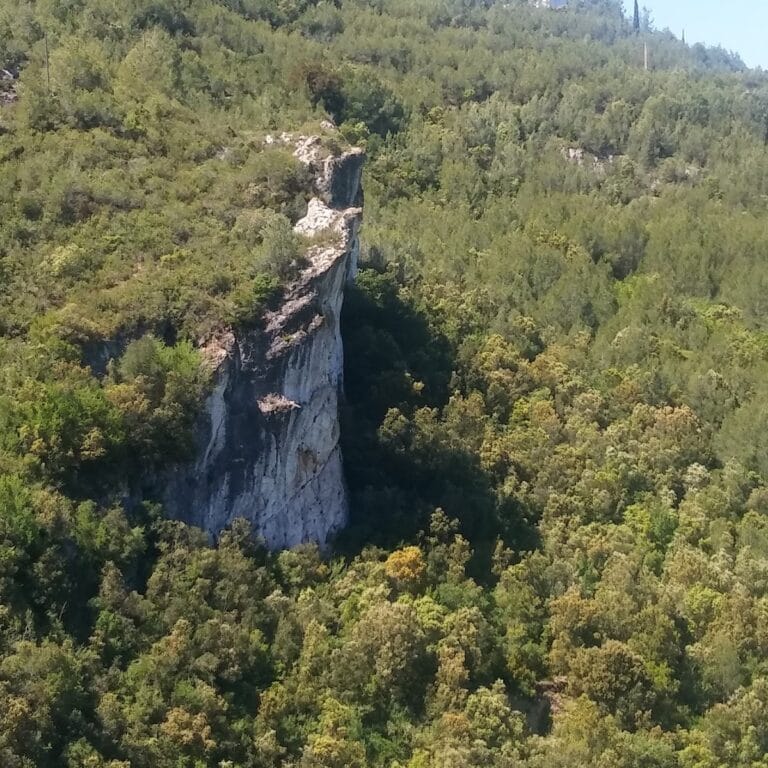
Castell d’Orpí: A Medieval Castle in Catalonia


Site at a Glance
- Rating
- 4.8
- Popularity
- Very Low
- Country
- Spain
- Primary era
- Medieval
- Eras represented
- Medieval
- Civilizations
- Crown of Aragon
- Site type
- Military
- Remains
- Castle
On this page9 sections
History
Castell d’Orpí is a medieval castle in Spain, in the town of Orpí in Catalonia, whose origins are first recorded in January 987. Known then as castro Auripini, a name probably derived from the personal name Orpino, it formed part of the network of fortified lordships that structured the Anoia district during the Middle Ages.
Early Medieval Lordship
In 1005, the viscountess Geriberga gave the monastery of Sant Cugat properties that she held in the territories of Claramunt and Orpí. The castle also appeared in a transfer of land to the monastery of Santes Creus, signed by Guillelmi de Orpi. During the second half of the eleventh century, Guillem Amat of the Claramunt lineage swore fidelity to Arsendis for the castle. By the late twelfth century, Castell d’Orpí marked one of the boundaries of the territory controlled from Miralles Castle.
From 1199 to 1252, the Castellar family held the castellany, the castle administration and the rights attached to it. After the Claramunt and Cardona families were united, superior feudal authority passed to the viscountly lineage of Cardona. The castle subsequently appeared in the wills of Bernat Amat I of Cardona, Ramon Folc III, and Guillem I.
Divided Jurisdiction
In 1280, Pere de Cervera and his wife, Gueraula, sold the superior castellany to Arnau Tort of Claramunt. One half remained held from the viscount of Cardona, while the other was free property, or an allod, owing no service or rent to a feudal lord. An agreement made in 1312 between Ramon Folc VI of Cardona, baron of the Conca d’Òdena, and Ramon Tort defined their respective powers. Cardona retained high criminal jurisdiction, meaning authority over the gravest offences, while Tort received the revenues, seigneurial rights, and ordinary civil jurisdiction.
Further castellanies were established within the lordship. Arnau de Montfalcó sold the castellany known as Montfalcó to Berenguer Sallent in 1376 under the same division of powers. In 1447, Melcior Sapera sold a third castellany, called that of Albert d’Orpí, to Bernat de Sallent. Bernat had acquired the superior castellany in 1423 through his marriage to Violant Tort, a descendant of Arnau Tort. These holdings combined to create the lordship of Orpí.
Cardona and Padró Claims
In 1375, King Peter IV of Aragon incorporated Castell d’Orpí into the County of Cardona. The lordship later passed by inheritance to the Ortal family of Zaragoza, which sold it in 1677 to Joan Serrals, a cloth maker from Igualada. In 1688, Serrals’s granddaughter, Anna Maria Serrals i Muntaner, married the jurist Francesc Padró i Bas, bringing the castle into the Padró family.
Cardona and Padró interests then came into conflict over jurisdiction and seigneurial rights. In 1691, the Cardona family brought Joan Padró i Serrals before the Royal Audience, Catalonia’s highest royal court, after the bailiff of Orpí judged a violent dispute between two peasants. The case concerned whether that matter belonged instead to the jurisdiction of the Conca d’Òdena. A judgment in 1701 favoured the Padró family, although Cardona appealed, and the registration of the peasants’ obligations was delayed until 1707.
The Padró family retained the lordship until the abolition of seigneurial rights in 1837 and continued to collect its revenues until 1848. In 1867, the dukes of Medinaceli, heirs of the Cardona family, brought a case defending their rights over the Barony of the Conca d’Òdena. The Spanish Supreme Court dismissed the claim in 1898.
War and Legal Protection
Castell d’Orpí was involved in the War of the Spanish Succession, the European conflict over the Spanish monarchy that lasted from 1701 to 1714. In 1714, the Marquis of Poal arranged for troops to be quartered at the castle, while Bourbon forces bombarded Orpí.
The castle is protected as a Cultural Asset of National Interest and as a Spanish Asset of Cultural Interest in the category of historic monument. The designation dates from 8 November 1988, and the site is also listed in the Catalan architectural heritage inventory under code 1272.
Remains
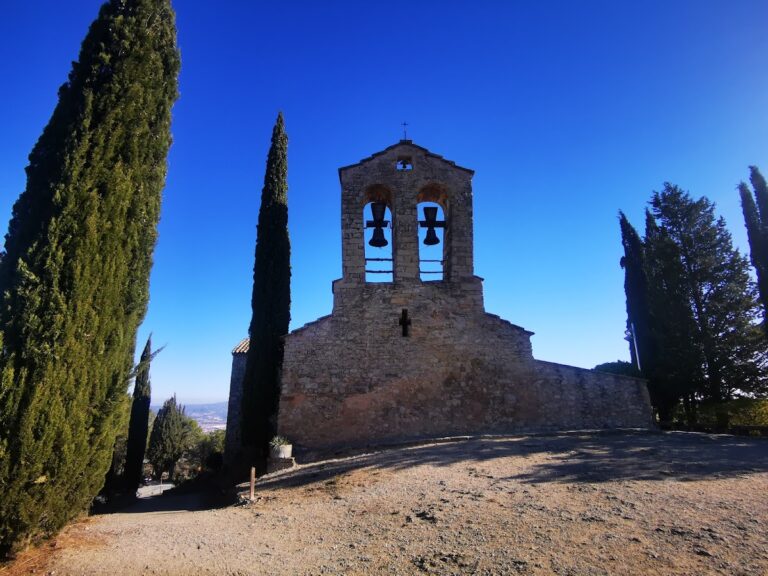
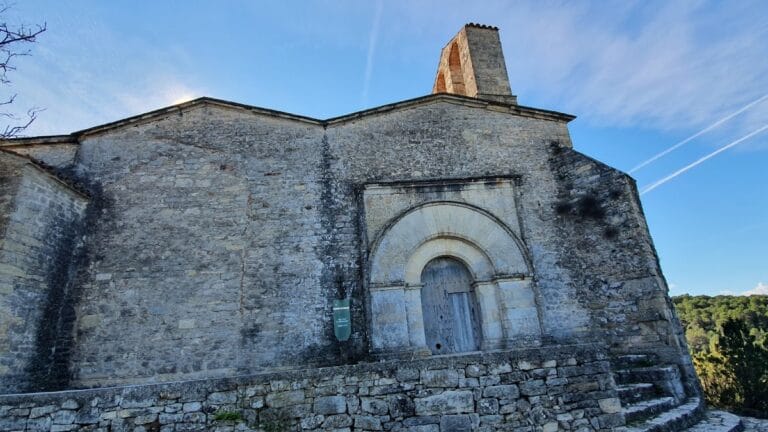
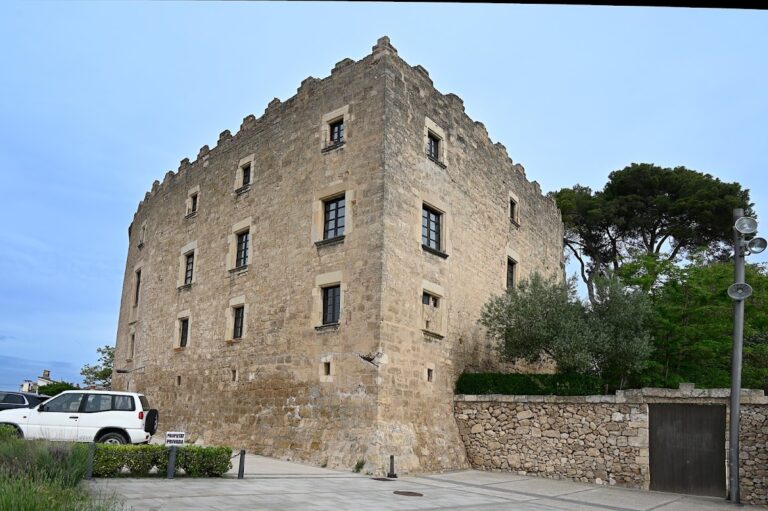
The castle stands on a cliff above the Morei stream, beside Sant Miquel d’Orpí, the building that formerly served as its chapel. The complex has been incorporated into a farmhouse, while a six-sided keep remains within the structure. Its masonry preserves evidence of more than one building phase and places the fortification broadly at the transition from the Romanesque to the Gothic period.
Keep and Masonry
Polygonal Keep
The surviving keep is a six-sided tower incorporated into the farmhouse. Its northeast and northwest sides almost merge and bend into a rounded form. These curved faces, together with the connecting section, use masonry that differs from the stonework on the other sides, suggesting a separate phase in the tower’s construction. The rounded walls may belong to an earlier stage of the fortification.
Doorway and Wall Construction
An entrance remains in the north face of the tower. Its opening is framed by wedge-shaped stones arranged to form an arch, a construction known as a voussoired doorway. The southern polygonal half is built from medium-sized blocks, carefully fitted and laid in horizontal courses. By contrast, the northern curved half uses smaller, lightly dressed stones set in a less regular pattern.