Castell de la Torre de Claramunt: A Fortified Manor House in Catalonia


Site at a Glance
- Rating
- 4.7
- Popularity
- Very Low
- Country
- Spain
- Primary era
- Early Modern
- External website
- Open
- Eras represented
- Medieval, Early Modern
- Civilizations
- Crown of Aragon, Spanish
- Site type
- Domestic
- Remains
- Castle
On this page11 sections
History
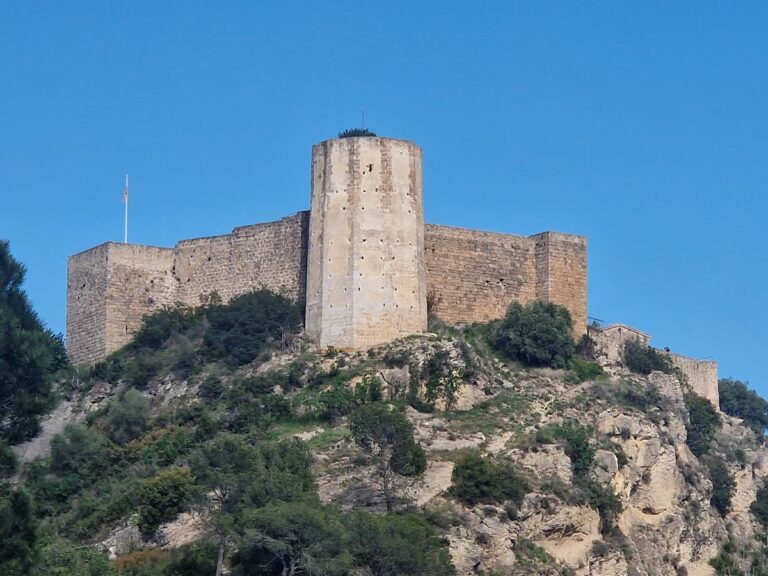
Castell de la Torre de Claramunt is a fortified historic site in La Torre de Claramunt, Spain, built by the Claramunt lineage from a defensive tower probably erected in the eleventh century. It served as an advanced outpost of Castell de Claramunt, watching the valley of the Carme stream and the route toward the Penedès, a historical region of Catalonia. The building is now protected as a cultural asset of national interest, classified as a historical monument and castle.
Origins and the Claramunt lordship
From the tenth to the twelfth centuries, members of the Claramunt family lived at Castell de Claramunt. The tower west of the municipal area functioned as a forward defensive and surveillance position connected with that larger castle. Its location allowed the family to oversee movement through the valley and along the route toward the Penedès.
In 1306, Castell de Claramunt was sold to Ramón Folc VI, Viscount of Cardona. A viscount was a high-ranking feudal lord who could exercise territorial authority under or alongside a count. After the sale, the Claramunt family moved permanently to the Torre de Claramunt, while Berenguer de Claramunt retained its lordship and permission to continue living there.
In 1318, the Torre de Claramunt became part of Ramón Folc VI’s feudal domain and lordship in a transaction valued at 10,000 ducats. After his death in 1320, his son Ramón Folc VII also listed the tower among his father’s possessions. In 1344, Asbert de Claramunt, married to Beatriz de Pallars and head of the lineage, held the castle. Hugo II, Viscount of Cardona, appointed him governor of the Òdena basin, an inland basin in the wider region. Asbert’s son Ramón de Claramunt succeeded him in 1386.
Conflict and succession in the fifteenth century
Ownership passed to Lluís de Claramunt in 1410. His son Pau de Claramunt became involved in violent disputes with the lords and inhabitants of Igualada. In 1443, he attacked and wounded several lords of the town, and Igualada’s general council accused him of repeated raids and robberies. In 1447, the people of Igualada appealed to the queen for help against Pau and his father. During one attack, the veguer, a royal or territorial judicial officer, captured four prisoners, including Joan de Claramunt. Joan Ramon Folc II, Duke of Cardona, intervened temporarily in the dispute.
Pau Lluís de Claramunt, heir to the family, received temporary full control of the castle in 1456. The succession later continued through Artal de Claramunt, Joan de Claramunt, and Miquel Joan de Claramunt. Artal became judicial bailiff of the kingdom by appointment of Alfonso V in 1441. Joan was summoned by Ferdinand II to the Barcelona Cortes in 1503, representative assemblies of the Principality of Catalonia.
Transformation into a fortified residence
In 1549, Miquel Joan de Claramunt ordered a new feudal land and rights survey of the Torre de Claramunt under the supervision of the notary Martí Joan Franquesa. Such a survey was a formal record of a lord’s properties, tenants, dues, and jurisdictional rights. After Miquel Joan died in 1561, his heir Joan de Claramunt commissioned an inventory of his possessions.
Joan also transformed the former defensive tower and its associated buildings into a large fortified residence in 1561. This conversion created the essential form of the building that survives today. The change reflects the continued importance of the estate as a noble seat while adapting an earlier military outpost to residential use.
In 1566, Francisco Ramón I of Aragón y Folc de Cardona, Duke of Cardona, granted Joan de Claramunt perpetual jurisdiction over the Torre de Claramunt in recognition of his services and those of his ancestors. Joan served as governor of the Òdena basin from 1591 to 1607, and Philip III ennobled him during a royal visit to Barcelona in 1599.
Inheritance and the War of the Spanish Succession
Fulgencia de Claramunt succeeded Joan. Her sister Jerónima inherited the estate in 1611 after marrying Josep Espuny, bringing the castle into the Espuny family. Later inheritance carried it into the Ribera, Sentmenat, and Agulló families. Ramón Espuny y Claramunt died without descendants in 1672, and the castle passed to his sister María de Espuny y Claramunt, Baroness of Rivert. She married Francisco de Ribera, Baron of Florejacs and a judge of the Royal Audience. María renewed the feudal land and rights survey in 1704.
José Antonio de Ribera y de Espuny-Claramunt held the lordship of the Torre de Claramunt and several other castles. In 1707, he became captain of the Barcelona Coronela, the city’s organized urban militia, which was mobilized to defend Barcelona during the War of the Spanish Succession. He supported Archduke Charles of Austria, who granted him a comital title in 1708 that he chose to associate with Claramunt.
In 1713, José Antonio advocated resistance to Philip V. After the Bourbon occupation in 1714, he was accused of attending revolutionary meetings, exiled to Burgos, and confined in the convent of the Trinity. His properties and annual revenues exceeding 1,000 pounds were confiscated, and the title of Count of Claramunt was revoked. He remained imprisoned until 1721. His property and revenues were restored in 1725.
Later inheritance continued through the Ribera, Sentmenat, Agulló, Calvo-Encalada, and Febrer families. Menna de Sentmenat inherited the baronies of Florejacs, Rivert, and the Torre de Claramunt after becoming Marquis of Gironella in 1784. His son Pere Nolasco de Agulló became the seventh Marquis of Gironella and a Knight of Malta in 1785.
Twentieth-century use and the Claramunt title
José Antonio de Febrer y Monforte, who lived from 1922 to 1977, inherited the castle and was regarded as a continuator of the Claramunt lineage. Between 1963 and 1969, he operated a successful restaurant on the ground floor, and the space also served as a sociocultural center. In 1965, the radio network SER used the restaurant’s rooms for the presentation of the Ondas Awards. José Antonio died at the castle in 1977.
In 1985, José Maria de Febrer y de los Ríos, identified as the head of the Claramunt house, began proceedings to rehabilitate the title of Count of Claramunt. The Ministry of Justice and the Council of State supported the claim twice, but the required royal charter was never signed, leaving the rehabilitation suspended.
Remains
Fortified tower and residential complex
Original defensive tower
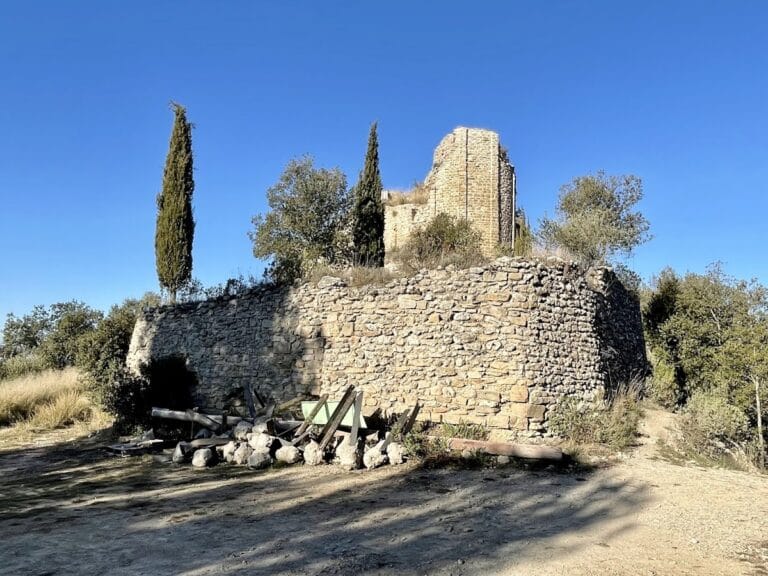
The site began as a fortified tower west of the municipal area. Its position made it an advanced defensive and surveillance post associated with Castell de Claramunt, with a role in controlling the Carme valley and the route toward the Penedès. The original military function established the site’s basic purpose before the later expansion into a noble residence.
Fortified manor house
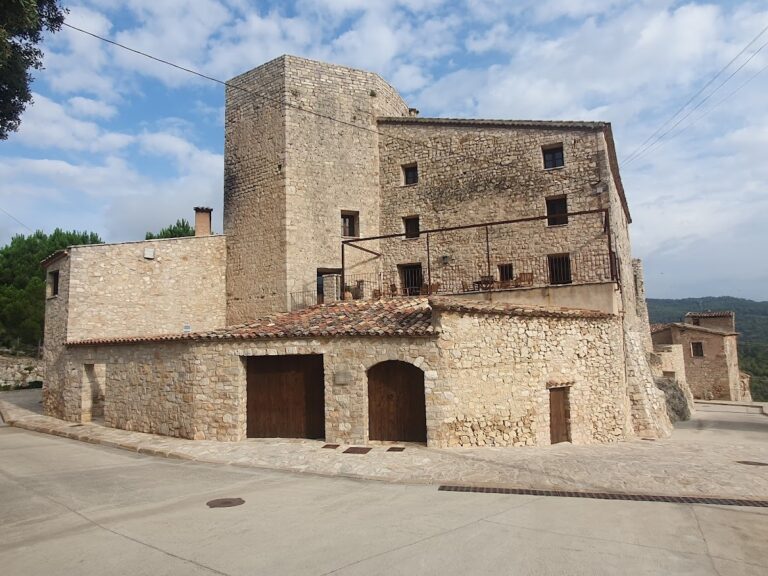
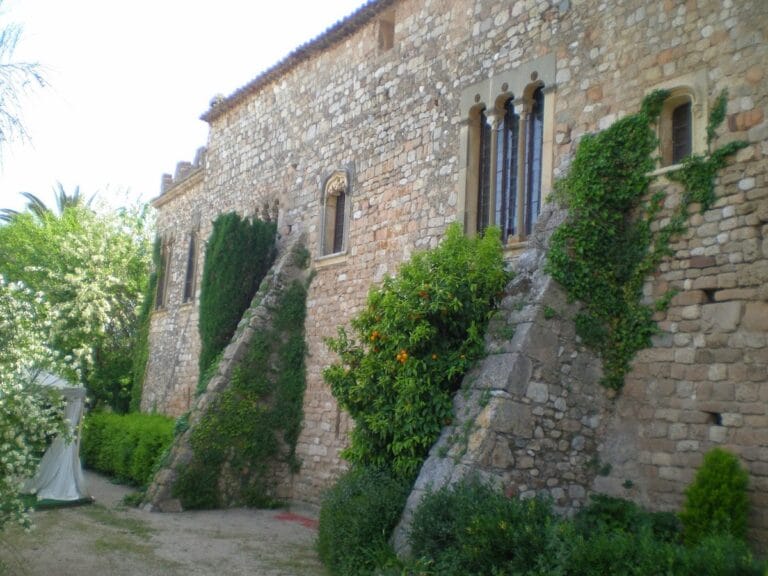
By the fifteenth century, the tower had expanded into a complex containing a prison, stable, kitchen, cellar, small room, three chambers, a bedchamber, and upper attic spaces. The present structure is a fortified stone manor house described as a seventeenth-century building. It has a ground floor and three upper floors, with rectangular windows fitted with stone lintels and a principal entrance formed by a lintelled portal.
The sixteenth-century conversion ordered by Joan de Claramunt gave the earlier defensive site a residential arrangement. The courtyard contains a portal built with wedge-shaped stones, known as voussoirs, whose central keystone carries the date 1561. The portal also bears the Claramunt emblem, a mountain surmounted by a fleur-de-lis. The building is crowned by a saw-toothed parapet resembling battlements, retaining a visibly defensive feature within the manor-house form.
Heraldic features
The Claramunt coat of arms is carved above the principal residential portal and appears again on the exterior southeastern angle. It displays a gold field with a mountain bearing a red fleur-de-lis. Additional coats of arms in the courtyard and great hall bring together the heraldic devices of later lordly families, including the Espuny, Ribera, Agulló, Pinós, Cardona, Pallars, and Sentmenat families. These carved emblems reflect the succession of noble houses connected with the castle through inheritance and lordship.