Schloss Ebenfurth: A Medieval Water Castle in Austria
Site at a Glance
- Rating
- 5
- Popularity
- Very Low
- Country
- Austria
- Primary era
- Medieval
- External website
- Open
- Eras represented
- Medieval, Early Modern
- Civilizations
- Habsburg, Holy Roman Empire
- Site type
- Domestic
- Remains
- Castle
On this page8 sections
History
Schloss Ebenfurth is a former water castle in Austria, located in Ebenfurth near Wiener Neustadt. Its medieval core began as a small Romanesque fortified residence surrounded by a moat and was substantially transformed in the Renaissance and Baroque periods. The castle’s later history includes Habsburg conflicts, Ottoman damage, wartime destruction, and the discovery of Jewish gravestones that has deepened understanding of the Jewish history of Lower Austria and Burgenland.
Medieval origins and expansion
The site may have been mentioned in 1160 as a fief of the Diocese of Passau, a major medieval ecclesiastical principality that held feudal rights over territories beyond Passau itself. A second reference appears about a century later. At that time, the fortification probably consisted of a single tower and may have been among Austria’s oldest fortified sites.
In 1250, the complex belonged to the Feldsberg and Seefelder nobles. Around 1270, it passed to the Pottendorf family. Toward the end of the thirteenth century, the Pottendorfs received permission from Albert I of Habsburg, Duke of Austria and later King of the Romans, to enlarge and rebuild the castle after it had been damaged in conflict. The resulting complex was a small Romanesque castle protected by a moat.
Habsburg and Ottoman conflicts
Schloss Ebenfurth became involved in the fifteenth-century struggle between Matthias Corvinus, King of Hungary, and Frederick III of Habsburg. Corvinus captured the castle and is said to have used it as the place from which he planned the siege of Wiener Neustadt. After the Hungarian king’s death, imperial Austrian troops defeated the garrison and returned the fortress to Austrian control.
Ownership changed repeatedly in the following centuries, and the estate was often pledged. The castle was also strengthened as a defense against Ottoman incursions. The Ottoman advance of 1529, conducted during the siege of Vienna, caused considerable damage to the complex.
Renaissance and Baroque transformation
Hans Saphoy, the imperial builder of the Austrian lands, is documented at Ebenfurth from 1571. By the beginning of the seventeenth century, the medieval castle had acquired a Renaissance appearance. After the Ottoman army withdrew, the building was extensively remodeled in Baroque form, changing the character of the earlier fortress while retaining its fortified origins.
The Suttner family owned Schloss Ebenfurth from 1747 into the twentieth century. During the Second World War, the castle housed displaced inhabitants and suffered serious damage. Further destruction followed during the Russian occupation, and vandalism in the 1950s and 1960s left the building increasingly derelict.
Decline, restoration, and renewed use
Carl Suttner sold the castle in 1973, while retaining the surrounding castle park outside the sale. The large building proved unsuitable for its new owners as a private residence and remained seriously endangered. From 2000, the psychotherapist Bärbel Langer worked intensively toward its preservation and secured substantial roof repairs, although more than 200 windows and doors were still missing.
In February 2010, the Serbian folk singer Dragana Mirković and her husband, a television network director-general, purchased Schloss Ebenfurth. A complete renovation followed in 2017 and 2018, after which the couple moved into the castle. The property is privately owned, renovated, and used for civil purposes.
Restoration work in 2020 revealed 28 seventeenth-century Jewish gravestones and fragments within the fortification. The find provides evidence about the Jewish community of Ebenfurth and is regarded as important for the Jewish history of Lower Austria and Burgenland.
Remains
Fortified form and later rebuilding
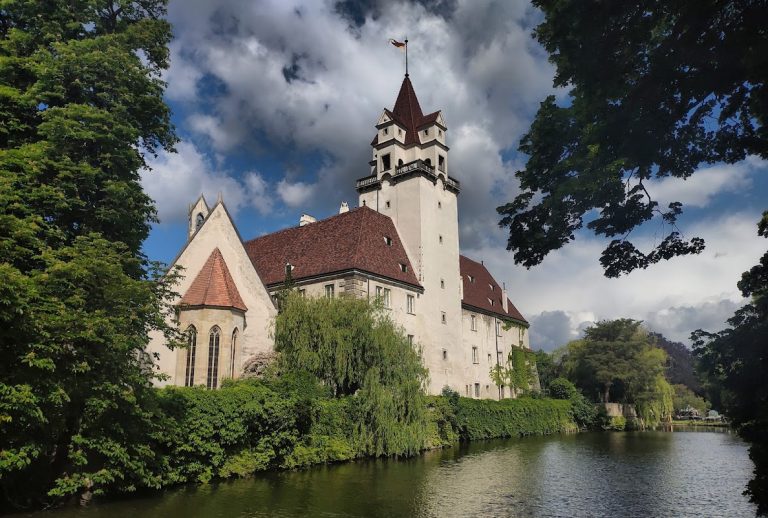
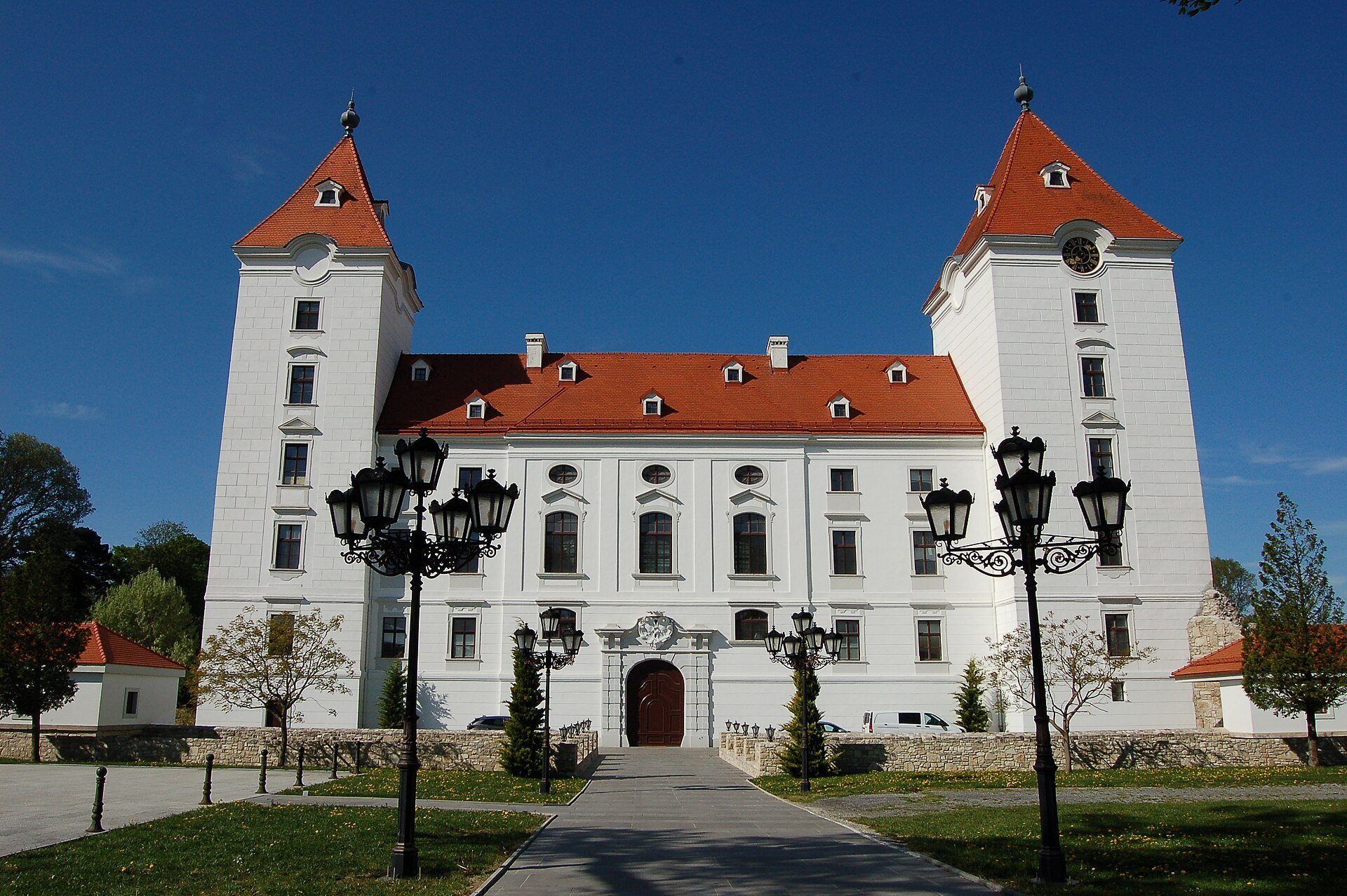
The former water castle is a large, approximately square building whose medieval core survives within a form greatly reshaped during the Baroque period. Its earliest described fortified phase was a small Romanesque castle enclosed by a moat, while the broader complex originally had the character of a fortress.
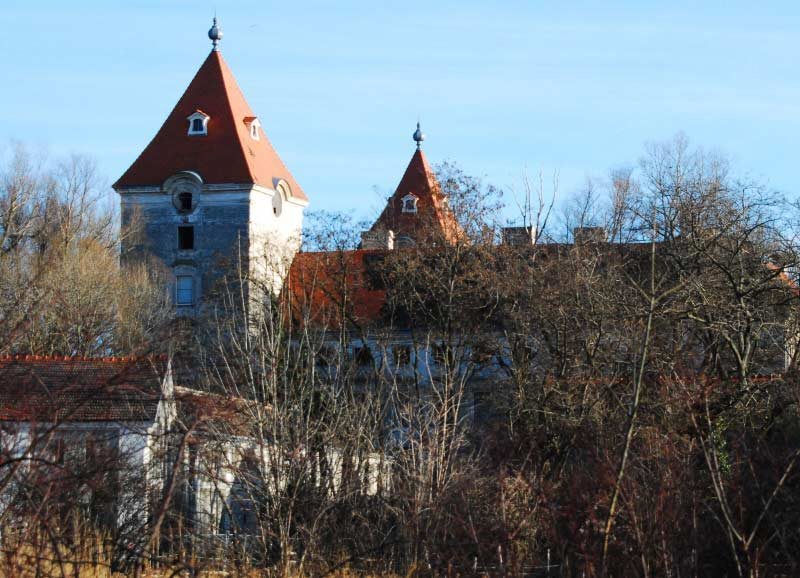
Despite its conversion to civil use and its later architectural changes, Schloss Ebenfurth still presents the appearance of a medieval stronghold. Two prominent towers flank the principal facade, giving the building a clearly fortified external form.
Frescoes and Jewish gravestones
The interior contains eighteenth-century frescoes by Franz Anton Maulbertsch, an Austrian painter known for large-scale fresco decoration in churches and aristocratic buildings. These works remain preserved within the castle.
The 2020 restoration uncovered 28 seventeenth-century Jewish gravestones and gravestone fragments inside the fortification. Their presence connects the surviving building to the history of Ebenfurth’s Jewish community and to the wider Jewish history of Lower Austria and Burgenland.