Castle Vlčtejn: A Medieval Aristocratic Castle Ruin in Czechia
Site at a Glance
- Rating
- 3.9
- Popularity
- Very Low
- Country
- Czechia
- Primary era
- Medieval
- Eras represented
- Medieval
- Civilizations
- Holy Roman Empire, Kingdom of Bohemia
- Site type
- Military
- Remains
- Castle
On this page9 sections
History
Castle Vlčtejn is a medieval castle ruin in Czechia, located in the municipality of Vlčtejn northwest of Blovice. Its recorded history reaches back to the late thirteenth century, and its later development was closely connected with the Rosenberg family and the administration of their estates. In the fifteenth century, the castle also became the setting for negotiations that produced the Vlčtejn Agreement.
Medieval origins and Rosenberg administration
Vlčtejn was indirectly documented in 1284 through Holenus de Wilenstayn. By the end of the thirteenth century, its owner was Holen of Vlčtejn, who supported Záviš of Falkenstein, a powerful Bohemian nobleman and political figure of the period.
During the first half of the fourteenth century, the castle passed to the Rosenbergs, a powerful noble family that controlled extensive territories and estates in medieval Bohemia and southern Bohemia. They rebuilt the earlier wooden castle and gave Vlčtejn the form associated with the surviving ruin. A castellan, the officer responsible for administering a castle and often the surrounding lord’s estate, managed Rosenberg property from Vlčtejn.
Hussite and Poděbrady-era events
In 1421, a Hussite army captured Vlčtejn while advancing toward the Plzeň region. The Hussites were a religious and political movement rooted in the reforming teachings of Jan Hus, and Jan Žižka was one of their principal military commanders during the Hussite Wars. Vilém Kostka of Postupice became castellan after the capture. Following the Battle of Lipany in 1434, the office was held by Svojše of Zahrádka.
Bedřich of Donín owned the castle from 1446. During this period, Vlčtejn became involved in the political conflict between the Poděbrady Union and the Strakonice Union. The Poděbrady Union supported George of Poděbrady, a fifteenth-century Bohemian nobleman who later became king of Bohemia, while the Strakonice Union opposed his faction. After the Strakonice Union lost the Battle of Rokycany on 4 June 1450, George of Poděbrady selected Vlčtejn for negotiations. Delegates met there on 9 June and concluded the agreement known as the Vlčtejn or Vildštejn Agreement on 11 June.
Changing ownership and decline
Between 1514 and 1525, Jan Varlejch of Bubna acquired Vlčtejn together with the town of Blovice. Jan of Roupov is also recorded as an owner during this period, after acquiring Spálené Poříčí and Žákava from Bedřich of Donín. Jan’s son, Kryštof of Roupov, later sold Vlčtejn to Jan Hradišťský of Hořovice.
Jan’s daughter, Markéta Karlova of Hořovice, also owned nearby Hradiště near Blovice and united the two estates. Her husband, Petr Tobiáš Karel of Svárov, voted for Frederick V of the Palatinate as king of Bohemia. After the Battle of White Mountain, the defeat that ended Frederick’s rule in Bohemia, the Hradiště estate was confiscated, although it was subsequently returned to their sons.
After the sons died, the estate passed to Maxmilián Rudolf of Gutštejn, the husband of Kryštof Rudolf’s deceased daughter. Maxmilián Rudolf had no children, so his widow, Polyxena Kateřina Vratislavová of Mitrovice, received the estates and later married Jan Josef of Újezd. After that family died out, Hradiště and Vlčtejn passed to the Krakovský family of Krakov. The property came into the possession of the Pálffy family in 1872.
The castle remained inhabited until the seventeenth century and fell into decay toward the end of that century. Its palace was reroofed in 1822, but the building soon deteriorated again. In 1824, the outer bailey was dismantled for building material. Vlčtejn has been protected as a cultural monument of the Czech Republic since 1963.
Remains
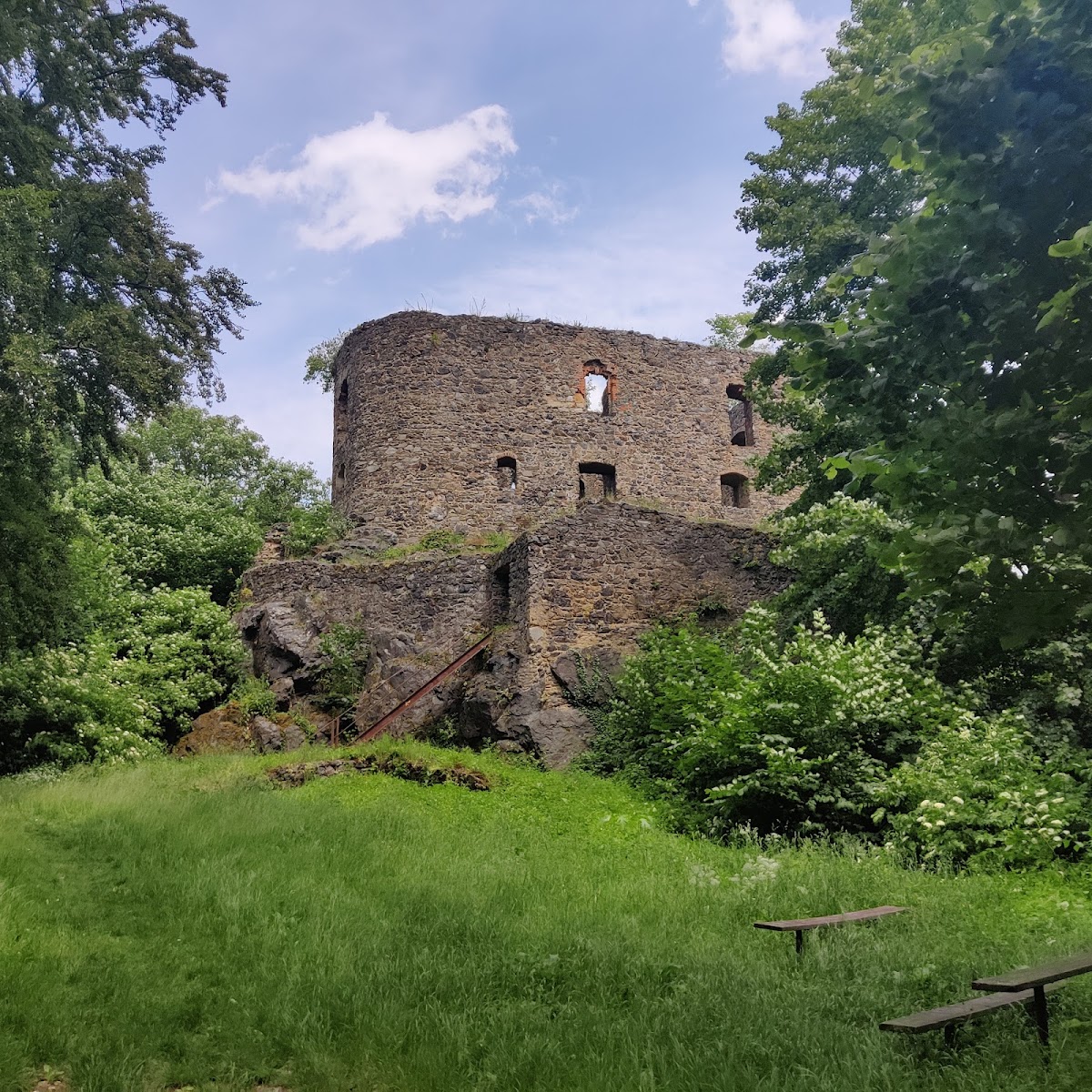
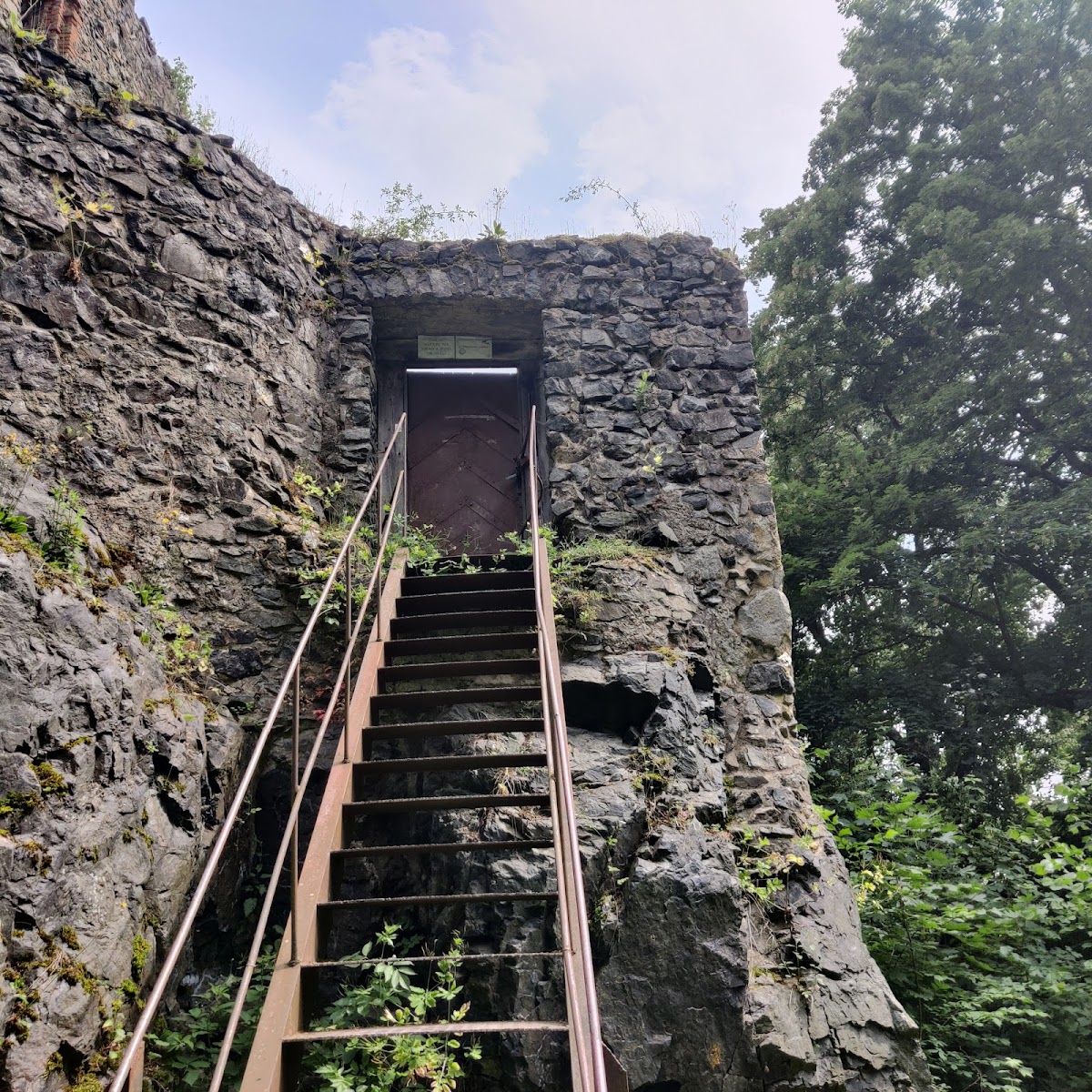
Vlčtejn is a small aristocratic castle ruin built on a rocky spur. Its principal residential building is a small palace, or palas, approached through a tower-like gate building. The castle was enclosed by two lines of fortifications and ditches, while the outer bailey formed an enclosed area beyond the main residential and defensive core.
Main castle buildings and defenses
Palace and gate building
The palace was the castle’s principal residential structure, containing the lord’s living and representational rooms. It was reached through a tower-like gate building, which formed the approach to the central part of the castle. The palace was reroofed in 1822, but its condition later declined again, leaving it within the surviving ruin.
Fortifications and ditches
The castle occupied a rocky spur and was protected by a double system of fortifications and ditches. These defenses enclosed the palace and gate building and formed the principal physical boundary of the castle complex.
Outer bailey
The outer bailey probably contained only one larger building. Its structures stood outside the castle’s main residential and defensive core, within an enclosed area used for ancillary purposes. The outer bailey was dismantled in 1824, and its material was reused in construction.