Elsdon Castle: A Medieval Motte-and-Bailey Castle in England


Site at a Glance
- Rating
- 4.2
- Popularity
- Very Low
- Country
- United Kingdom
- Primary era
- Medieval
- External website
- Open
- Eras represented
- Medieval
- Civilizations
- English, Norman
- Site type
- Military
- Remains
- Castle
On this page7 sections
History
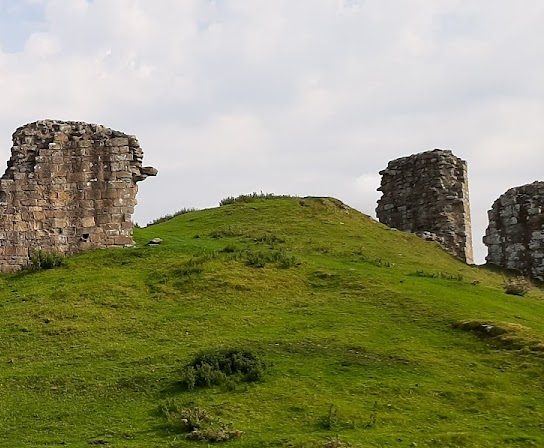
Elsdon Castle, also known as Mote Hills, is a medieval motte-and-bailey castle in Elsdon, England, United Kingdom. Built by the Norman-era landholder Robert de Umfraville in 1076, it consisted of a raised earth mound, or motte, beside an enclosed area, or bailey, for settlement and supporting buildings. The castle formed part of the network of fortifications established by Norman rulers and landholders after the Norman Conquest, the takeover of England begun by William, Duke of Normandy, in 1066.
Foundation and abandonment
Robert de Umfraville built the castle on a natural hill spur shortly after the Norman Conquest. Its position and earthwork design reflect the defensive purposes of an early medieval motte-and-bailey castle.
The castle was probably superseded by nearby Harbottle Castle around 1160. By the middle of the thirteenth century, Elsdon Castle had been abandoned, and it was not included among the estates of Gilbert de Umfraville when he died in 1245.
Legends and later investigation
A local legend tells of a Danish giant who lived on the hill and terrorized the surrounding area. The story may preserve a memory of Siward the Dane, an eleventh-century Earl of Northumberland who served under Edward the Confessor, the English king who ruled before the Norman Conquest.
Eighteenth-century excavation uncovered a Roman stone that may have come from the fort at High Rochester and been reused in construction at Elsdon. A pottery vessel is also believed to have been found at the site during the nineteenth century. Elsdon Castle is a Scheduled Ancient Monument, a legally protected archaeological or historic monument of national importance in England, and is regarded as the best-preserved medieval motte-and-bailey castle site in Northumberland.
Remains
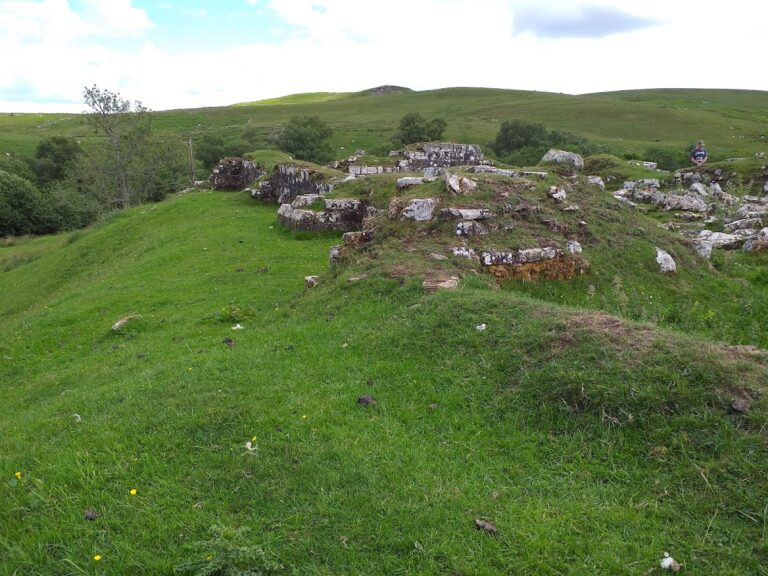
Elsdon Castle occupies a natural hill spur at approximately 181 metres above sea level. The surviving earthworks are arranged with a large motte to the south and a crescent-shaped bailey to the north. The motte rises about 15 metres and measures roughly 80 metres across, while the bailey is defined by an embankment.
Castle earthworks
The motte and bailey preserve the principal elements of the castle’s medieval plan. The substantial southern mound formed the raised defensive and building platform, while the northern enclosed area provided space for settlement and associated structures. Together, these earthworks retain the basic spatial arrangement established after the castle’s construction in 1076.
Elsdon Tower
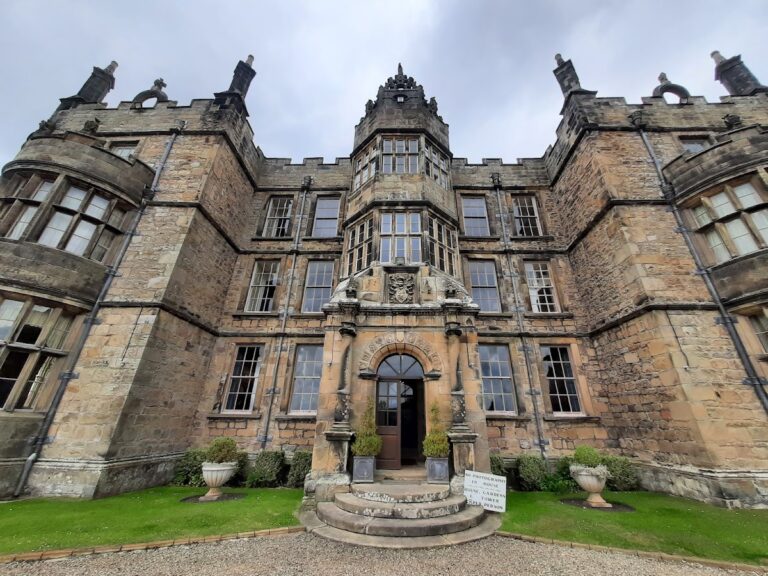
Nearby Elsdon Tower is a pele tower, a fortified residential tower built for defence in the border regions of northern England. It dates from the late fourteenth or early fifteenth century and may also have been built by the de Umfraville family. The tower served as Elsdon Rectory until 1961 before being converted into private buildings.
Archaeological finds
The Roman stone found during eighteenth-century excavation may have originated at High Rochester and was reused as building material. A pottery vessel believed to have been discovered at the castle in the nineteenth century provides a further recorded find associated with the site.