Burg Ruppertsecken: A Hilltop Castle in Germany


Site at a Glance
- Rating
- 4.3
- Popularity
- Very Low
- Country
- Germany
- Primary era
- Medieval
- Eras represented
- Medieval, Modern
- Civilizations
- Holy Roman Empire
- Site type
- Military
- Remains
- Castle
On this page8 sections
History
Burg Ruppertsecken is a hilltop castle in Germany, built between about 1100 and 1200 on the Schlossberg above Ruppertsecken. It is also known as Raubschloss Ruprechtseck. The castle first appears in written records on 17 July 1344, when it was held by Ruprecht I and Ruprecht II, members of the Palatine ruling dynasty.
Early ownership and transfers
The charter of 1344 also granted nearby Frauenstein Castle to the knight Hermann of Hohenfels as an hereditary fief. Burg Ruppertsecken changed hands through a series of financial and dynastic arrangements. On 1 June 1401, it was pledged for 4,600 gold gulden to Dieter Landschad of Steinach and his wife, Irmgard. A gold gulden was a medieval currency used for substantial transactions. On 30 March 1406, the castle was sold for 3,000 gulden to Johann of Worms, a chamberlain of Worms.
An inheritance division transferred the castle to Duke Stephan of Palatinate-Simmern-Zweibrücken on 3 October 1410. On 16 September 1444, it passed to Ludwig of Palatinate-Zweibrücken-Veldenz. These transfers placed Burg Ruppertsecken within the network of territories ruled by branches of the Palatine dynasty.
The siege of 1470
On 2 October 1470, Count Palatine Friedrich I began a fourteen-day siege of the castle. A count palatine was a high-ranking territorial ruler of the Palatinate. The attack was directed by Martin Merz, the artillery master of the Electoral Palatinate, a major territory of the Holy Roman Empire ruled by an elector. After the bombardment, Burg Ruppertsecken was plundered and demolished, and its reconstruction was prohibited.
A local legend connects the siege with the castle’s defenders. It says that Friedrich, angered by the length of the attack, offered the countess safe departure with everything she could carry. She left carrying her husband on her back. The Count Palatine kept his promise and spared the remaining defenders in recognition of their loyalty.
Later history and reuse of the masonry
In 1794, the castle remains and the village came under the Electoral Palatinate. Masonry was still standing in 1825, but residents later removed stones from the castle for house building. The material was also used for the village bell tower, erected in 1869.
Remains
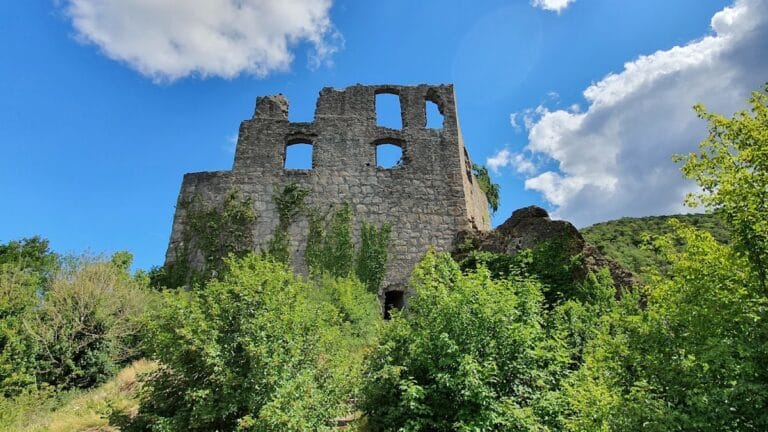
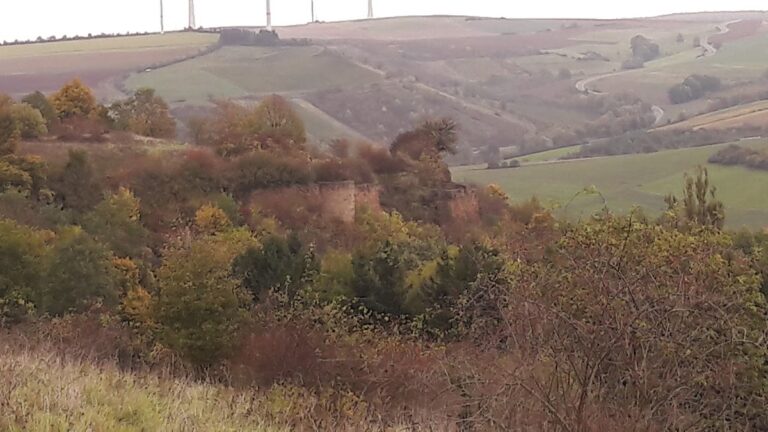
Burg Ruppertsecken stands on the Schlossberg at an elevation of 498 metres above sea level. The surviving physical evidence consists of castle masonry and remnants of the castle tower. A later water reservoir on the grounds was built in the form of a medieval donjon, the principal fortified tower of a castle.
Surviving castle structures
Masonry and tower remains
The remaining masonry preserves part of the hilltop castle’s built fabric, together with remnants of its tower. These remains belong to the medieval castle whose construction began between about 1100 and 1200 and which was demolished after the siege of 1470. Stones were later taken for buildings in Ruppertsecken, including the village bell tower, giving some of the castle’s material a secondary use.
Water reservoir
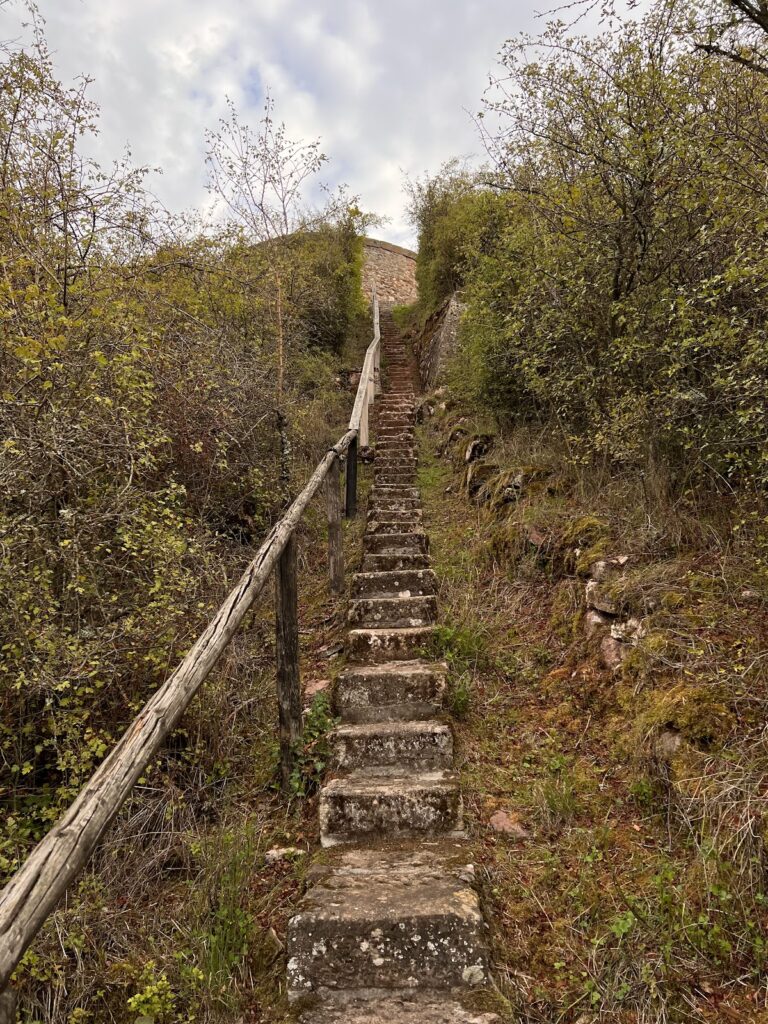
A water reservoir was constructed on the castle grounds in 1889. Its design took the form of a medieval donjon, linking a modern infrastructure project to the appearance of the former fortified site. The reservoir was remodeled and renovated in 1963.
Nearby sites