Tannenfels Castle: A Medieval Motte Castle in Germany


Site at a Glance
- Rating
- 4.3
- Popularity
- Very Low
- Country
- Germany
- Primary era
- Medieval
- External website
- Open
- Eras represented
- Medieval
- Civilizations
- Holy Roman Empire
- Site type
- Military
- Remains
- Castle
On this page7 sections
History
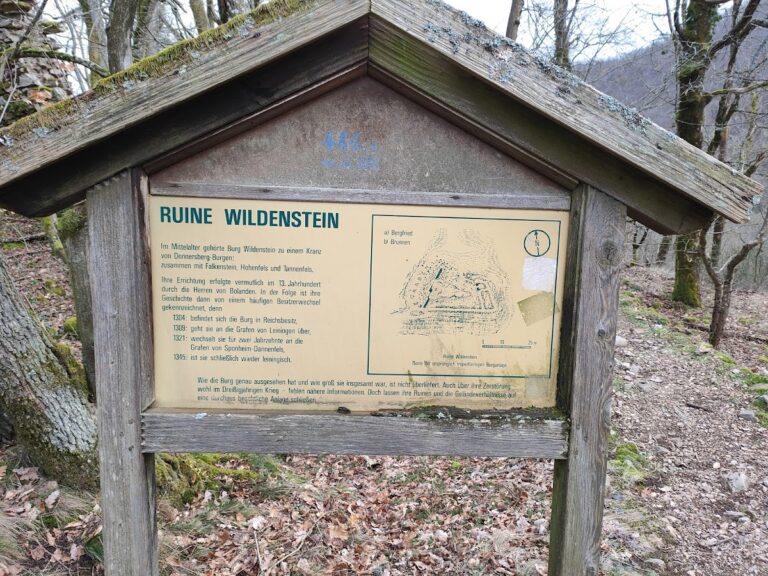
Tannenfels Castle is a ruined medieval hill castle in Germany, built around 1300 above Dannenfels on the Donnersberg. Designed as a motte castle, it formed part of an estate that included the Lordship of Kirchheim and belonged to the lords of Bolanden.
The Sponheim-Bolanden residence
In the late thirteenth century, inheritance transferred most of the territory to the counts of Sponheim. They established the resident family line of Sponheim-Bolanden-Dannenfels at Tannenfels, making the castle a seat of this branch of the comital family.
The castle first appears in a record from 1330, when Count Philip of Sponheim-Bolanden and his wife, Lisa of Katzenelnbogen, endowed a chapel there. In 1364, Bechtholf of Beckingen was appointed castellan, an official who resided at or served the castle and commonly held defensive or administrative duties.
The chapel and changing ownership
The castle chapel was dedicated to Saint Mary. On 20 December 1354, Archbishop Gerlach of Mainz confirmed a benefice, an endowed ecclesiastical income supporting religious service, that Philip of Sponheim-Bolanden had established for the chapel. On 4 January 1449, Siegfried Piscator, the vicar general of Mainz, transferred responsibility for pastoral care to the nearby Abbey of Saint James, a Christian monastic institution.
The chapel apparently also served the people of Dannenfels. A description of the Lordship of Kirchheim from 1657 states that a Protestant priest lived in the village but preached in the parsonage because Dannenfels had no church. It added that a church had formerly stood at the top of the castle but had been ruined many years earlier.
Around 1368, Henry II of Sponheim-Bolanden moved his family seat to nearby Kirchheimbolanden. After his death in 1393, Tannenfels passed through his granddaughter to the counts of Nassau-Saarbrücken, a ruling comital dynasty. In 1431, part of the castle passed to the counts palatine, high-ranking territorial rulers in the Holy Roman Empire.
Destruction and later history
During the Palatine Peasants’ War in 1525, rebellious peasants completely destroyed Tannenfels Castle. The ruins were later demolished, while the remains and estate continued in the possession of the House of Nassau-Saarbrücken until 1797.
Remains
Earthworks and surviving structures
Tannenfels occupied an artificially constructed system of banks and mounds at approximately 460 metres above sea level above Dannenfels, on the Donnersberg in what is now Rhineland-Palatinate. Its defensive core was a motte, a raised artificial mound, combined with an adjoining enclosed area in a motte-and-bailey arrangement.
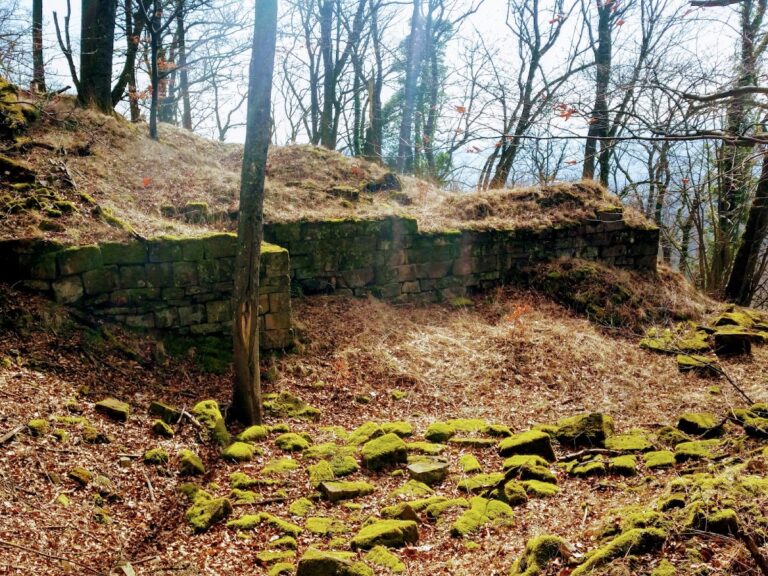
Only slight remains of the former complex survive. They include traces of a tower, a supporting wall, and a castle well, set among the banks and mounds that formed the castle site.
Castle chapel
The chapel of Saint Mary stood within the castle at the top of the site. Its role as a place of worship is reflected in the medieval benefice and later pastoral arrangements, while the 1657 description places the ruined former church directly on the castle summit.
Nearby sites