Falkenstein Castle: A Medieval Imperial Hill Fortress in Germany

Site at a Glance
- Rating
- 4.5
- Popularity
- Low
- Country
- Germany
- Primary era
- Medieval
- External website
- Open
- Eras represented
- Medieval, Early Modern
- Civilizations
- Holy Roman Empire
- Site type
- Military
- Remains
- Castle
On this page10 sections
History
Falkenstein Castle is a medieval imperial hill castle in Germany, above the village of Falkenstein on the Donnersberg in present-day Rhineland-Palatinate. Its origins are associated with 1135, and it belonged to a fortress held directly for the Holy Roman Emperor rather than solely as a local lord’s possession. The castle’s history is closely connected with the Falkenstein, Bolanden-Falkenstein, and Daun-Falkenstein families, as well as with the shifting political control of the surrounding county.
Origins and imperial service
The earliest reference from 1135 names Sigbold of Falkenstein, rather than explicitly describing the castle itself. The Falkensteins probably belonged to the imperial ministerial class, a group of officials and nobles serving the emperor, and may have been related to the lords of Bolanden.
In 1233, Philip of Bolanden adopted the name Philip of Falkenstein after a division of the family’s possessions. This established the Bolanden-Falkenstein line. After the imperial chamberlains of Münzenberg became extinct, Philip I of Falkenstein became Imperial Chamberlain in 1255. This was a senior office in the empire, and he also inherited the Wetterau, an imperial territorial jurisdiction administered on the emperor’s behalf. Lich later became the centre of his territory. Philip additionally served as castellan and administrator of Trifels Castle, where the Imperial Regalia, ceremonial objects representing the authority of the Holy Roman Empire, were guarded.
Dynastic changes and rebuilding
During the mid-fourteenth century, the family built New Falkenstein in the Taunus. Later family chronicles consequently became uncertain about which castle they were describing, although a Falkenstein Castle in the Palatinate is clearly mentioned in 1368.
When the counts of Bolanden-Falkenstein died out in 1418, their possessions passed to Count Ruprecht IV of Virneburg. Wirich IV of Daun-Oberstein purchased the county in 1456, while Emperor Frederick III granted the feudal lordship to Duke John II of Lorraine in 1458. The counts of Daun-Oberstein then held the castle and county as a fief of Lorraine, and their branch later became known as Daun-Falkenstein.
Around 1500, Uhland I regained the rights to the castle and enlarged or rebuilt it. His descendants later acquired Bertholdstein Castle near Fehring in Styria and eventually settled there.
War, destruction, and ruin
During the Thirty Years’ War, the major European conflict fought from 1618 to 1648, French troops surprised the castle garrison in February 1644. Lorraine and Spanish forces expelled them in April. Parts of the castle were probably blown up in 1647, likely by French troops.
A garrison of the Duke of Lorraine remained at Falkenstein after 1648 because the duke’s possessions were not covered by the Peace of Westphalia, the treaties that ended the Thirty Years’ War. Count Wilhelm Wirich of Daun-Falkenstein expelled the garrison in 1654 and sold the castle and county to Duke Charles IV of Lorraine in 1667.
In 1736, Falkenstein Castle and its county passed to the imperial House of Habsburg, which assigned the county to Further Austria, the Habsburg name for territories west of the main Austrian lands. French forces destroyed the castle again in 1794 during the Coalition Wars, the European wars against revolutionary and Napoleonic France. It has remained a ruin since that destruction, although partial restoration began in 1979.
Remains
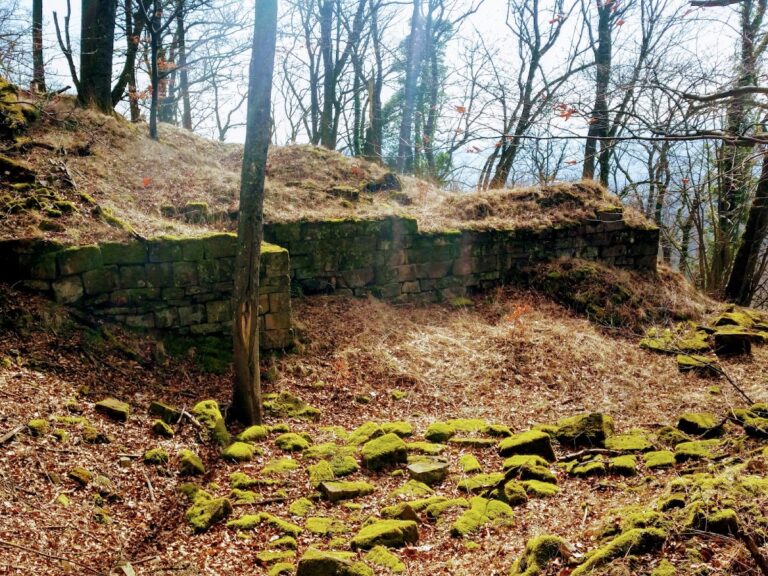
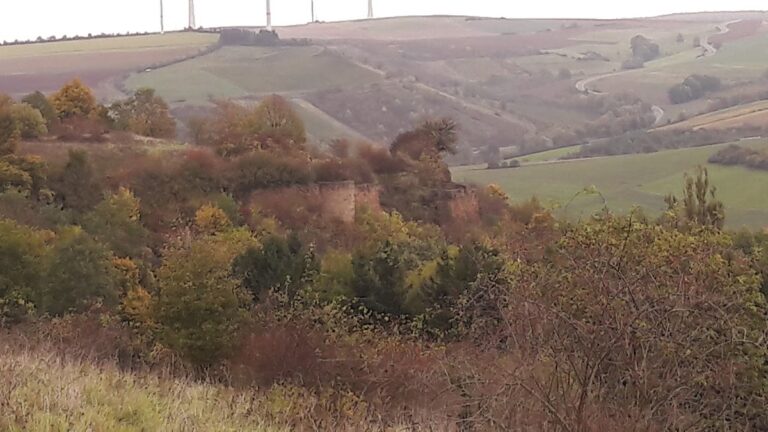
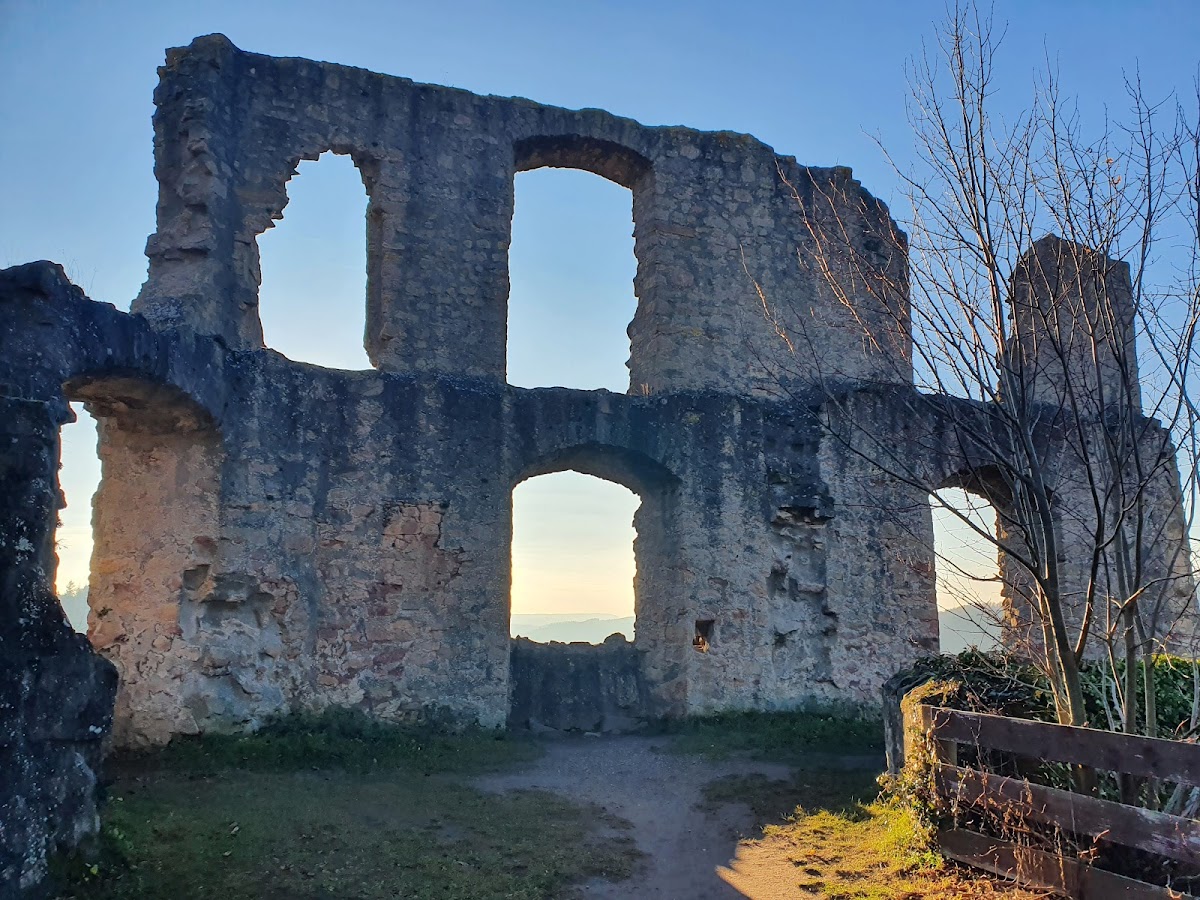
Falkenstein Castle stands as a hilltop fortress at approximately 425 metres above sea level above the village of Falkenstein on the Donnersberg. The surviving ruins preserve portions of the medieval defensive and residential complex, including sections of the enclosing walls, the great hall, the shield wall, a water cistern, and a small surviving fragment of the keep.
Defensive and residential structures
Great hall
Partial remains of the great hall, or main residential building, survive within the ruined complex. This structure formed part of the castle’s residential fabric, while portions of its outer walls remain visible after restoration work carried out from 1979 onward.
Shield wall and enclosing wall
The castle retains sections of its shield wall, a particularly strong defensive wall facing the most vulnerable direction. Parts of the enceinte, the wall enclosing the fortress, also survive. Together, these fragments preserve elements of the castle’s medieval defensive perimeter in a ruined and partly restored condition.
Cistern
A cistern, a tank for collecting or storing water, remains within the site. Its presence represents part of the practical infrastructure that supported the hilltop fortress.
Keep
The keep, or principal defensive tower, has almost entirely disappeared. Only a small section of wall survives, but the tower, including its rock base, is thought to have reached approximately 37 metres in height. The remaining fragment forms one of the clearest indications of the scale of the castle’s former vertical structure.
Nearby sites