New Bolanden Castle: A Medieval Fortress and Dynastic Residence


Site at a Glance
- Rating
- 4.4
- Popularity
- Very Low
- Country
- Germany
- Primary era
- Medieval
- External website
- Open
- Eras represented
- Medieval
- Civilizations
- Holy Roman Empire
- Site type
- Military
- Remains
- Castle
On this page6 sections
History
New Bolanden Castle, also called Neubolanden, is a thirteenth-century hilltop fortress in Bolanden, Germany, built by the imperial ministeriales of the House of Bolanden. Imperial ministeriales were dependent officials who became a powerful hereditary lower-noble group during the High Middle Ages. The castle is first recorded between 1258 and 1262, and its construction reduced the importance of the nearby older castle of Altenbolanden. Both fortresses were also known as Bolanden Castle.
The Bolanden inheritance
The Bolanden family also held Sterrenberg Castle on the Middle Rhine as a fief, meaning property or jurisdiction granted by a superior lord in return for service and allegiance. After the Lordship of Bolanden was divided around 1268, both male lines of the secular Bolanden lords died out around 1288. The family’s surviving ecclesiastical representatives were Friedrich of Bolanden, Prince-Bishop of Speyer, who died in 1302, and his nephew Werner of Bolanden, provost of the collegiate church of St. Victor outside Mainz, who died in 1324.
The Philippian half of the lordship, named for the branch associated with Philipp, was divided between the husbands of the heiresses, Count Henry I of Sponheim and Count Albrecht of Löwenstein. Albrecht apparently later sold his quarter to Henry I. The Wernerian half, associated with Werner’s branch, passed through female inheritance to Werner’s grandson Otto I of Bruchsal. During the fourteenth century, these heirs disputed their shares in the jointly held castle and its associated lordship. A jointly held castle was divided among several heirs or ruling families, often creating disputes over rights, income, and administration.
The portion that passed to the Bruchsal-Bolanden line became a fief of Electoral Palatinate in the mid-fourteenth century. Electoral Palatinate was the territory ruled by the Count Palatine of the Rhine, one of the prince-electors of the Holy Roman Empire. The last representative of the Sponheim-Bolanden line, Henry II of Sponheim-Bolanden, died in 1393. His half of the Lordship of Bolanden was united with the Lordship of Stauf to create the Lordship of Kirchheim and Stauf.
Palatine administration and residence
Through Henry II’s only daughter Elisabeth, her daughter Anna, and their husbands Kraft IV of Hohenlohe-Weikersheim and Count Philipp of Nassau-Saarbrücken-Weilburg, this half of the castle and lordship eventually came into the possession of the House of Nassau. Nassau successors jointly administered the lordships around the Donnersberg. New Bolanden was expanded in the early fifteenth century. Its administrative office passed in 1410 to Palatinate-Simmern-Zweibrücken, and from 1444 to 1598 it belonged to Palatinate-Simmern before returning to the Electorate.
The castle served as the retirement residence of three dowager duchesses of the House of Palatinate-Simmern. Margaret, daughter of Arnold of Egmond, Duke of Guelders, and widow of Duke Frederick I, lived there from 1480 to 1486. Johanna, daughter of Count John III of Saarbrücken and widow of Duke John I, occupied the residence from 1515 to 1521. Anne Margareta, daughter of Count Palatine George John I of Palatinate-Veldenz and widow of Duke Reichard, lived there from 1598 to 1621. A dowager duchess was a duke’s widow who retained her title and received a residence and income suited to her rank. Arnold Weickard, an author of medical works who later became city physician of Frankfurt, served Anne Margareta as her personal physician at New Bolanden.
War, destruction, and later history
During the German Peasants’ War in 1525, the castle was plundered and burned. It was rebuilt afterward as a more comfortable residential palace, while continuing to serve as an administrative seat and a residence for dowager duchesses. Spanish forces occupied it from 1620 to 1625 during the Thirty Years’ War, the major European conflict of 1618 to 1648.
French forces destroyed New Bolanden in 1689 during the War of the Palatine Succession, a wider conflict from 1688 to 1697 in which French forces attacked territories including the Palatinate. The complex was largely dismantled around 1822. New Bolanden is now a cultural monument.
Remains
Hilltop fortress layout
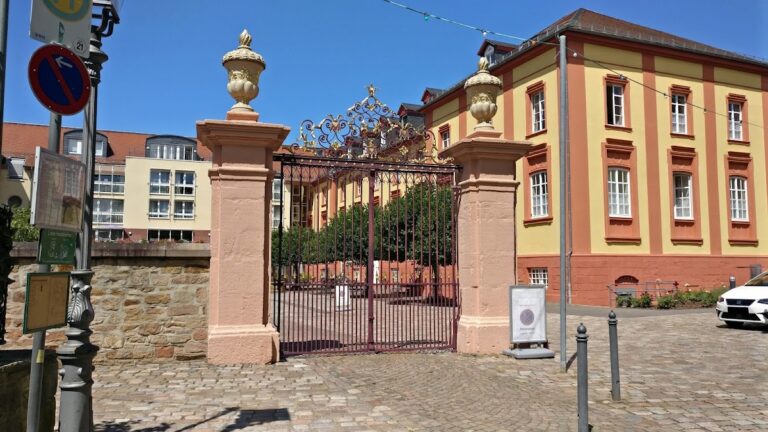
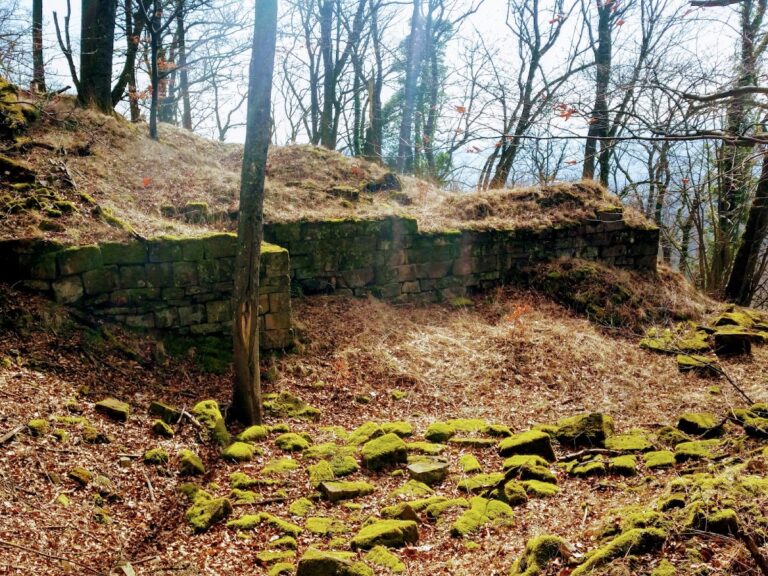
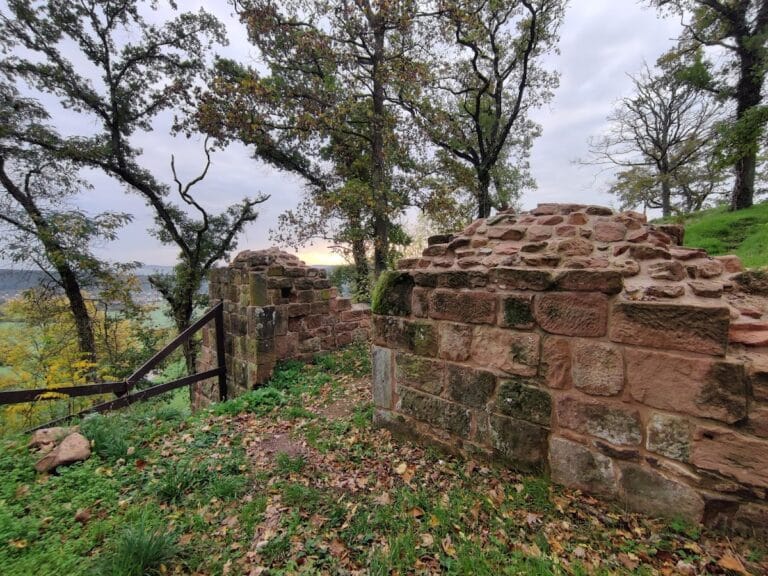
New Bolanden was a rectangular spur castle positioned immediately east of Bolanden on the Schlossberg. A spur castle is a fortification built on a projecting ridge, usually protected by a ditch across the approach from higher ground. The site lies at about 260 metres above sea level on a hill recorded as 276 metres high. Its rectangular complex occupied the projecting hill spur, with a neck ditch separating the fortified area from the adjoining high ground. Only a few wall remains survive, while the line of the neck ditch remains visible. Large parts of the castle were demolished in the early nineteenth century, leaving the limited remains seen today. A seventeenth-century painting gives an impression of the complex before much of its fabric was lost.
Nearby sites