Hohenfels Castle: A Ruined Hill Castle in Germany


Site at a Glance
- Rating
- 3.8
- Popularity
- Very Low
- Country
- Germany
- Primary era
- Medieval
- Eras represented
- Medieval
- Civilizations
- Holy Roman Empire
- Site type
- Military
- Remains
- Castle
On this page9 sections
History
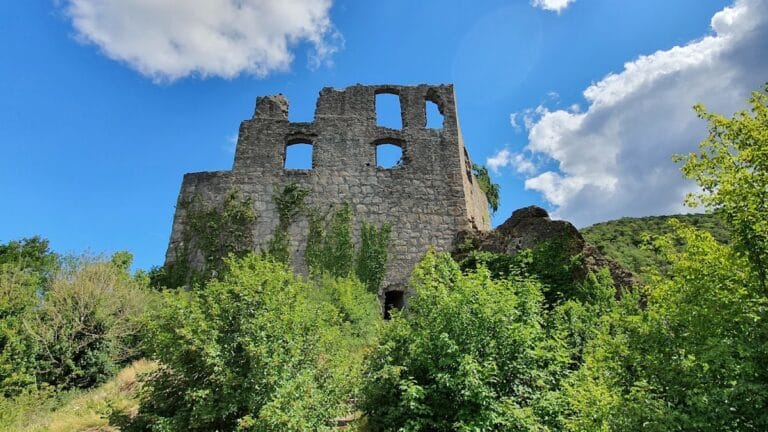
Hohenfels Castle is a ruined hill castle in Germany, near Imsbach in Rhineland-Palatinate, built around 1200 for the medieval nobility. Its history is connected with the Bolanden family and its branches, the castle’s control of a landscape associated with Prüm Abbey, and its destruction after a prolonged siege in 1351.
Roman-period activity and medieval origins
The Old Rockenhausen Road ran from the Hahnweilerhof area past Hohenfels toward Falkenstein, Rockenhausen, and Bad Kreuznach. It may have existed since Roman times. In 1820, 28 Roman coins dating to about AD 340 were found in the castle area. Along with evidence of Roman mining in the Langental valley, the discovery has led to the probable interpretation that a Roman fortification or road station occupied the wider area during the Late Roman period.
The Imsbach mining district had belonged to Prüm Abbey, a major medieval Benedictine abbey in the Eifel, since the ninth century. Twelfth-century fief records, which listed lands and castles held by vassals, name the brothers Werner and Philip of Bolanden as holders of a castle. In 1222, Caesarius of Milendonk, a former abbot of Prüm, called it bonum castrum quod Hoviles appelatur, meaning “the good castle called Hoviles.”
The Bolanden and Hohenfels families
During the first decades of the thirteenth century, the Bolanden family divided into the Bolanden, Falkenstein, and Hohenfels lines. Philip III of Bolanden-Hohenfels owned Hohenfels until 1277. He also served as imperial chamberlain and procurator on the Middle Rhine. His sons, Philip III the Younger, also known as Philip of Isenburg, and Dietrich of Hohenfels, inherited the castle and held it jointly until 1290.
Later ownership passed to Hermann II the Elder and Werner of Hohenfels. In 1333, the brothers became involved in a feud with the Imperial City of Speyer. A separate document dated 11 July 1287 records the sale of parts of estates in the Laumersheim district by Wildgrave Frederick, the Templar provincial master, Henry of Hohenfels, commander of the Templar house at Kirchheim an der Weinstraße, and other Templars to the Collegiate Church of Saint Martin in Worms. The Templars were a medieval military religious order, and these offices governed the order at provincial and local levels.
Siege, destruction, and later ownership
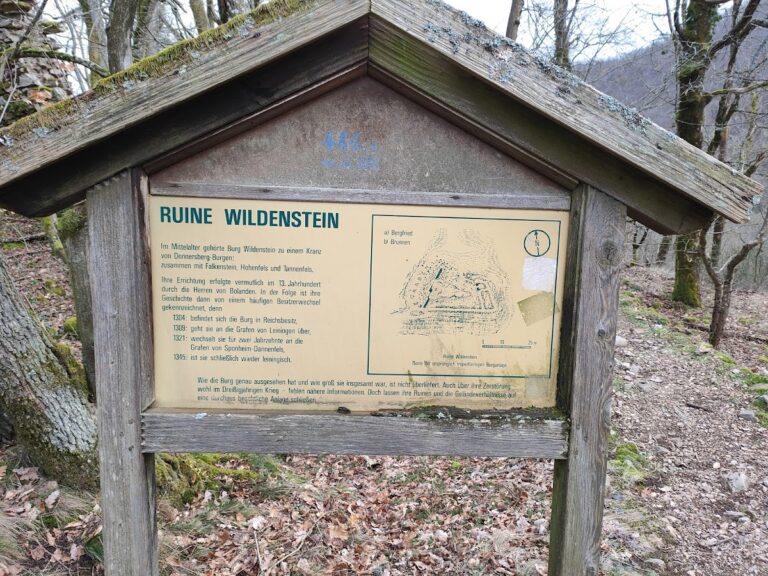
In October 1350, Speyer and Worms formed an alliance against the Hohenfels family because of its robber-knight activities. In spring 1351, Walram of Sponheim and Henry of Veldenz, supported by the two cities, destroyed Hohenfels Castle after a prolonged siege. A subsequent agreement prohibited its reconstruction, leaving the stronghold as a ruin.
Count Palatine Rupert I bought half of the ruins in 1355, while Hermann III of Hohenfels, the son of Hermann II, retained the other half until selling it in 1386. Raugraf Philip II of Alten- and Neuenbaumburg acquired Hermann’s share and sold it ten years later to Elector Rupert II of the Palatinate. Count Palatine John II of Simmern became the sole owner of the ruins in 1531. In 1537, the castle site passed by exchange to the County of Falkenstein. The Bolanden line descended from the lords of Hohenfels continued until 1602.
Excavation and modern interpretation
Friedrich Sprater, director of the Speyer Museum, led excavations at Hohenfels in 1932 and 1933. The work produced architectural fragments, weapons parts, floor and stove tiles, and numerous stone sling balls. The sling balls were kept in the ruin area until the 1960s, after which they gradually disappeared; some later appeared built into private walls in Imsbach. Parts of the other finds are held by the Historical Museum of the Palatinate in Speyer. The castle lies within the Beutelfels Nature Reserve in the Donnersberg district.
Remains
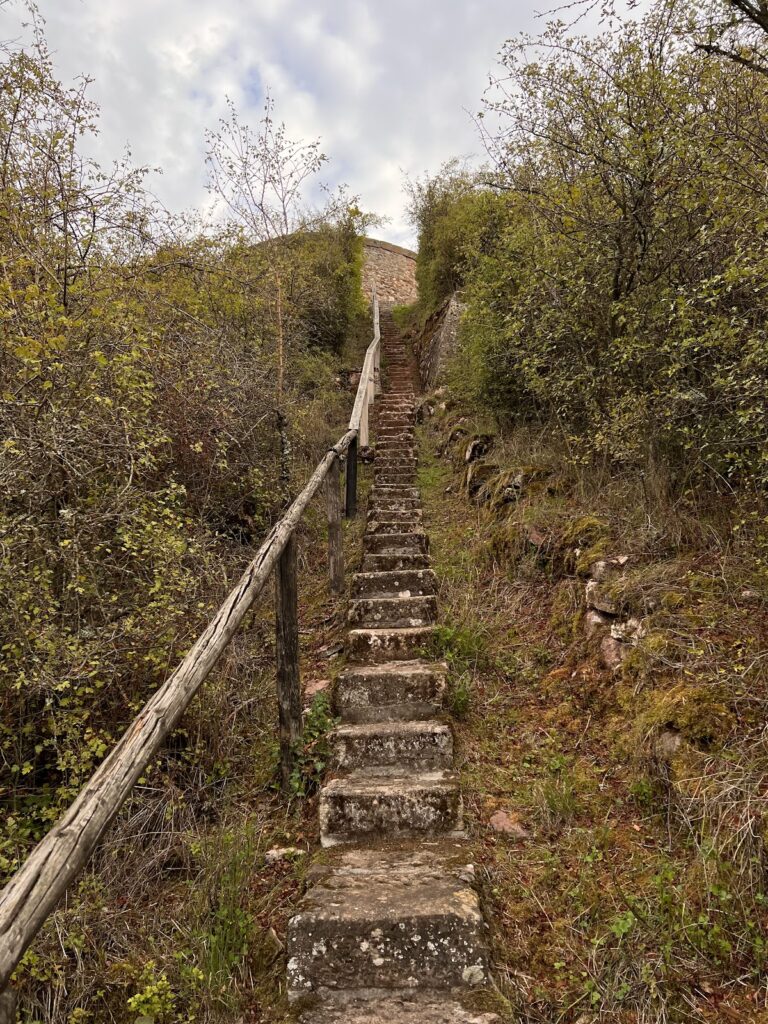
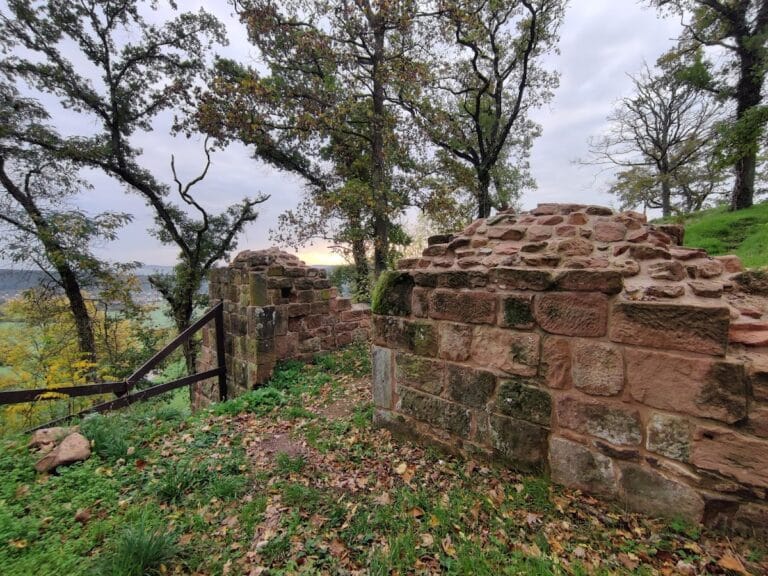
Hohenfels occupies a hilltop at approximately 545 metres above sea level. The surviving castle is a ruin whose visible remains consist mainly of fragments of masonry. Excavated architectural material helps indicate the character of the former buildings, while two nearby earthwork enclosures preserve evidence of defensive activity connected either with the siege or with a later period.
Surviving masonry and architectural fragments
The castle’s physical remains are limited chiefly to wall fragments, but the excavations recovered several types of worked stone. These include rusticated ashlar, masonry made from cut blocks with deliberately rough, projecting faces, as well as cornice stones, a Romanesque capital, saddle stones, and ashlar blocks with drafted margins. A drafted margin is a smooth border worked around the edge of a roughly finished stone face. Together, these pieces represent parts of the castle’s former architectural fabric and provide evidence for the construction of its buildings.
Weapons and siege evidence
Weapons parts and stone projectiles were found among the excavation material. A sandstone ball indicates that a small stone gun, an early gunpowder firearm designed to propel a stone projectile, was used during the 1351 siege. This has been regarded as one of the earliest known indications of such a weapon being used to besiege a castle in Germany. The numerous sling balls recovered during the excavations also connect the ruin with medieval military activity.
Earthwork enclosures
Two almost square earthwork enclosures lie near the ruins, one about 150 metres to the north and the other about 250 metres to the southeast. Each measures approximately 25 metres by 25 metres, and their surviving rampart areas remain visible. They may have served as simple counter-fortifications or siege works, although they could instead represent defensive earthworks from the early modern period.
Nearby sites