Dosrius Castle: A Territorial Stronghold in Catalonia


Site at a Glance
- Rating
- 4.1
- Popularity
- Very Low
- Country
- Spain
- Primary era
- Medieval
- External website
- Open
- Eras represented
- Medieval
- Civilizations
- Unclassified
- Site type
- Military
- Remains
- Castle
On this page6 sections
History
Dosrius Castle is a ruined territorial castle in Spain, first recorded in 1114 under the name Duos Rivos. A territorial castle was a fortified centre governing a surrounding district and its settlements. The castle stood within the medieval territory of Dosrius, in the Maresme, and its jurisdiction included Canyamars.
Territorial Formation and Early Lordship
In the mid-eleventh century, the lands of the ephemeral Castle of Sant Vicenç de Montalt were divided between Dosrius Castle and Mataró Castle. Dosrius consequently became the centre of a distinct territorial jurisdiction. Its name appears again in 1128 as Duorum Rivium.
In 1114, jurisdiction over the castle passed to Sant Pere de Casserres, an eleventh-century Benedictine monastery in Catalonia. The Dosrius family held the castle from the monastery as a feudal possession. Through marriage, the holding passed to the Cartellà family in 1277.
Cartellà and Sentmenat Lordship
In 1453, the Cartellà family purchased the castle’s direct ownership and the barony of Dosrius from Sant Pere de Casserres. An allodial lordship was direct ownership rather than land held from a superior feudal lord. The Cartellà family then adopted the title barons of Dosrius and Canyamars, and their lineage later merged with that of Sentmenat.
The Sentmenat lineage retained jurisdiction over the castle until the end of the ancien régime, the traditional pre-modern system of monarchical and feudal government. The succession of proprietors extended from the Dosrius family in the twelfth and thirteenth centuries, to the Cartellà family from the thirteenth to the fifteenth century, and then to Sentmenat from the fifteenth century onward. The Sentmenat family remains the owner of the ruins.
Marquisate and Heritage Status
In 1690, more than a century after the community of Sant Pere de Casserres had been suppressed, King Charles II of Spain created the marquisate of Castelldosrius for Manuel de Sentmenat Oms de Santa Pau. Charles II was the last Habsburg king of Spain. The ruined castle was designated a Cultural Asset of National Interest as a historic monument in Catalonia on 22 April 1949, followed by its designation as a Spanish Bien de Interés Cultural on 8 November 1988.
Remains
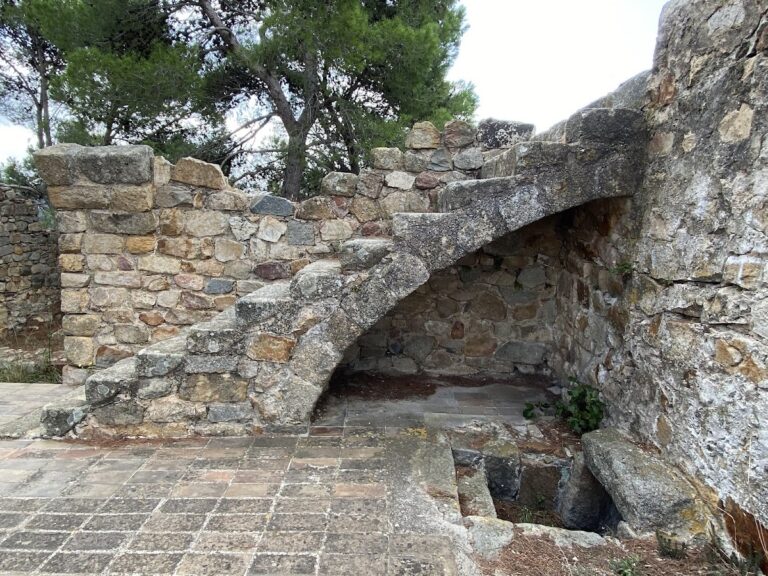
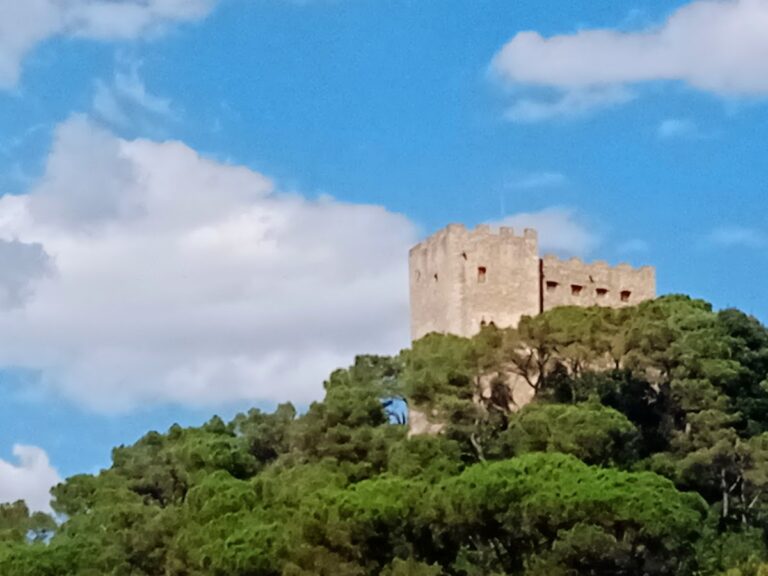
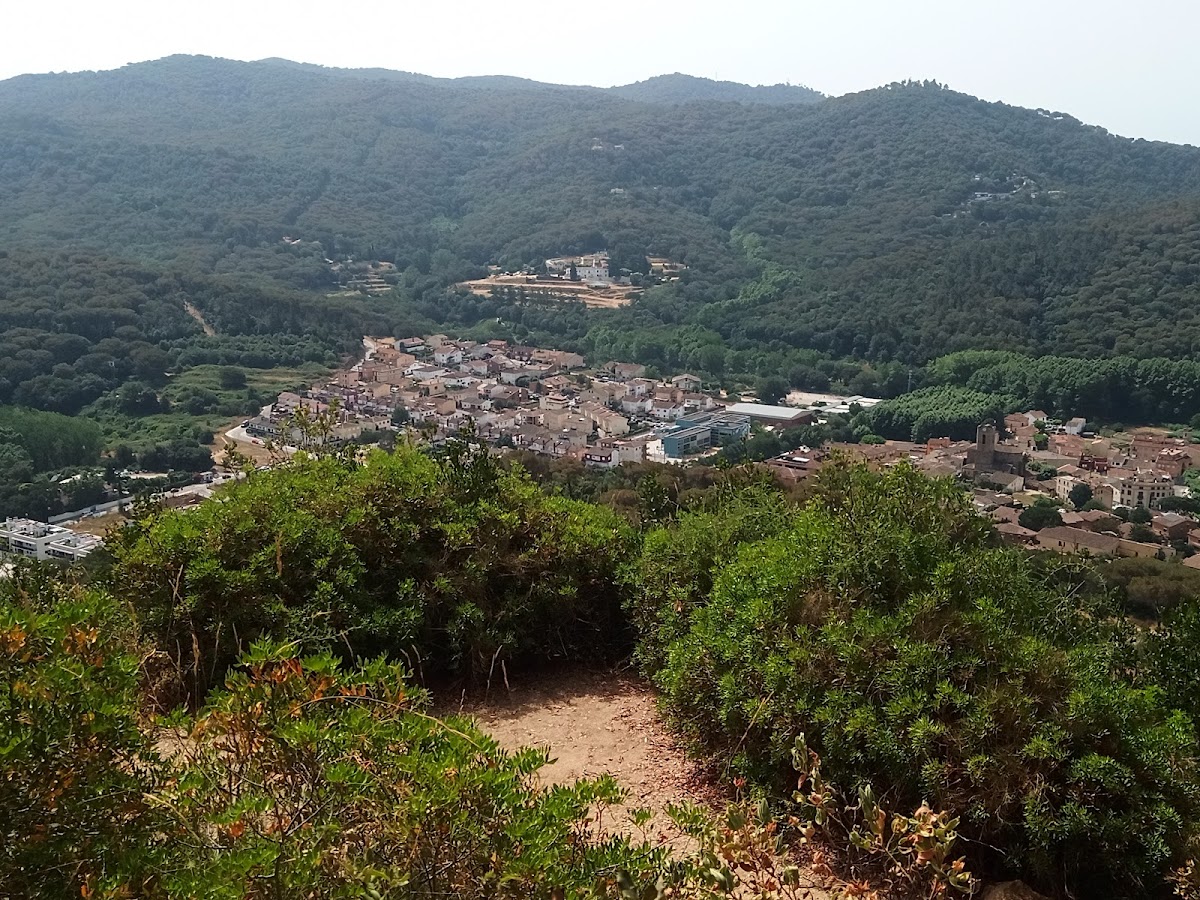
The remains occupy the summit of a 246-metre hill north of Dosrius. Vegetation partly conceals the surviving wall fragments, which define the plan of a relatively small rectangular tower set on an east-west orientation. The structure measures approximately 16.5 by 10.7 metres, and its walls are about one metre thick.
Tower and Defensive Walls
A substantial section of the north wall survives. It consists of stones of markedly varied sizes, arranged in fairly irregular but generally horizontal courses. The masonry is bonded with a greyish, weak lime mortar containing a large amount of sand. At least part of the exterior surface retains evidence of whitewashing.
Narrow defensive openings, or loopholes, remain in the structure. A series of holes also survives in the masonry, indicating that the building had at least two storeys above the ground floor. Together, the wall fragments, openings, and surviving plan provide the principal evidence for the castle’s compact tower form.
Nearby sites