Burg Schlosseck: A Staufer-Era Castle Ruin in Germany
Site at a Glance
- Rating
- 4.4
- Popularity
- Very Low
- Country
- Germany
- Primary era
- Medieval
- External website
- Open
- Eras represented
- Medieval
- Civilizations
- Holy Roman Empire
- Site type
- Military
- Remains
- Castle
On this page10 sections
History
Early Fortification
Burg Schlosseck is a Staufer-era castle ruin in Germany, above the Isenach Valley near Bad Dürkheim. The high-medieval castle was built in the early thirteenth century during the Staufer period, the era of the Hohenstaufen dynasty in the medieval German kingdom. It stands on the site of an earlier fortification from the ninth or tenth century, probably an early medieval refuge intended to protect against Norman raids.
The original name of the stronghold is unknown, and no medieval records of it have survived. The name Schlosseck, also written Schloßeck, belongs to the post-medieval period and was preserved through oral tradition. In the territorial circumstances of the early thirteenth century, the Counts of Leiningen, a medieval noble dynasty with interests in the Palatinate and nearby regions, are considered the probable builders of the later castle.
High-Medieval Castle
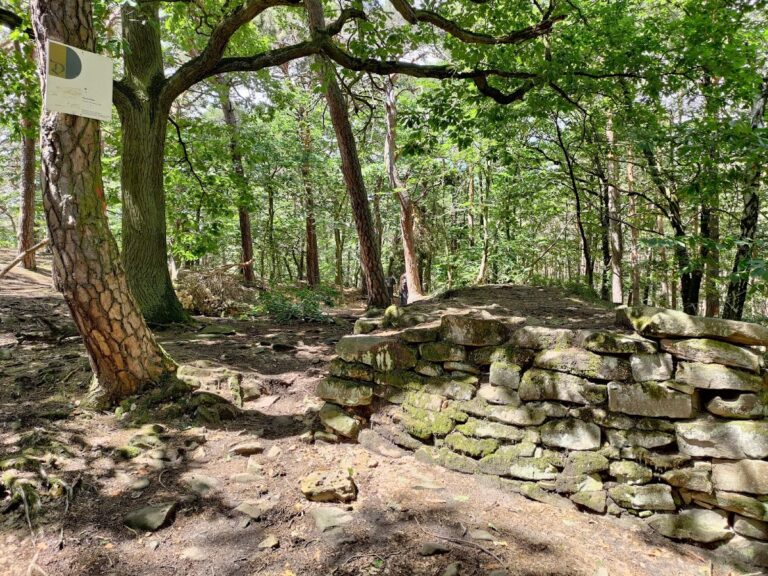
Excavations indicate that the thirteenth-century castle probably suffered a fire during that same century. The site nevertheless remained inhabited in the fourteenth century. Its low surviving walls and the limited building material found among the ruins suggest that construction may have stopped before the castle was completed. Occupation appears to have been temporary and carried out in a provisional state.
Excavation and Conservation
The first excavations were conducted by Christian Mehlis in 1879. Mehlis was a nineteenth-century historian and archaeologist who investigated historical sites in the Palatinate. Architectural fragments recovered at Burg Schlosseck were used to reconstruct the castle portal in 1883 and 1884. Further conservation work took place in 1988 and 1989. Since 1963, the ruin has belonged to the State Castle Administration of Rhineland-Palatinate.
Remains
Fortified Spur and Defensive Structures
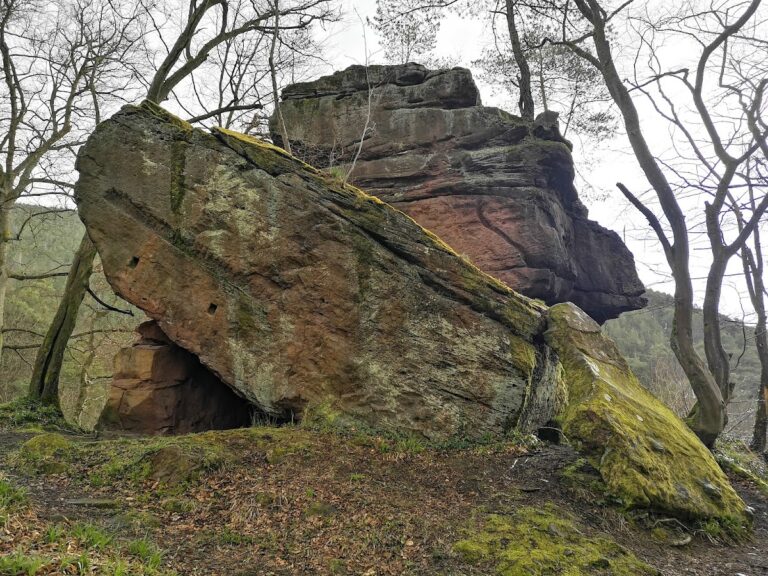
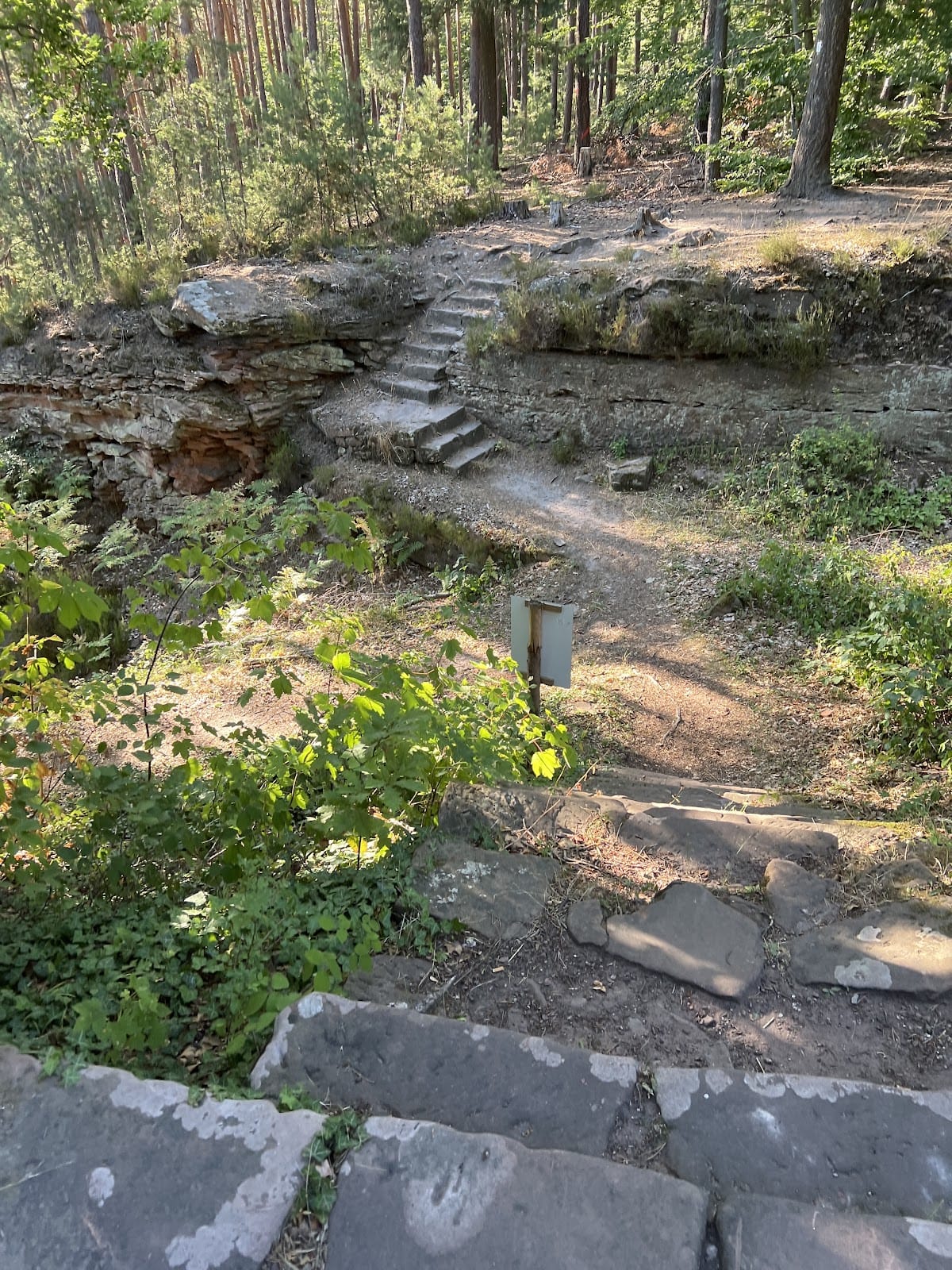
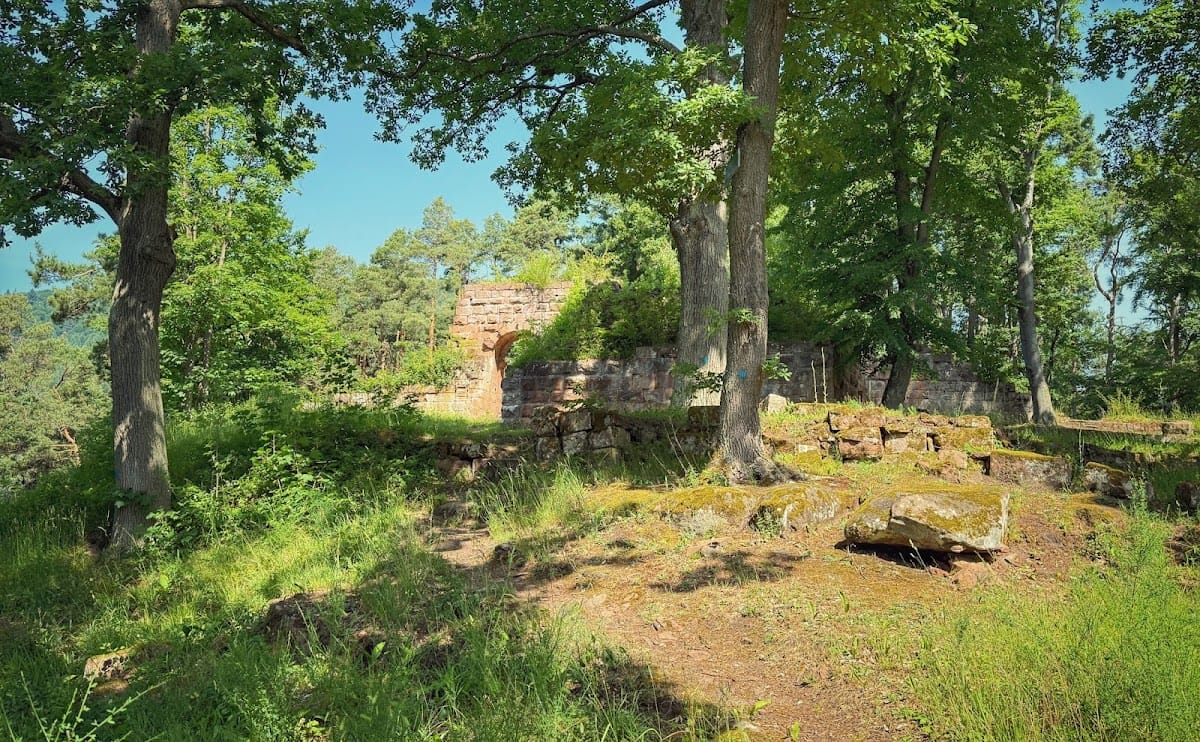
The ruin occupies a spur of Rahnfels at 303 metres above sea level, overlooking the Isenach Valley near Hardenburg, a district of Bad Dürkheim in Rhineland-Palatinate. The Staufer-era castle followed the probably elongated oval plan of the earlier refuge fortification. On the side facing the mountain, a straight neck ditch, a defensive cut across the narrow connection of a spur, reduced the approach to the enclosure.
Shield Wall
The neck ditch meets the foundations of a shield wall, a particularly strong defensive wall placed toward the most vulnerable approach. This wall was approximately 3 metres thick and formed the principal defensive barrier on the mountain-facing side of the castle.
Pentagonal Keep
The lower storey of a pentagonal keep cuts into the shield wall. A keep was the principal fortified tower of a medieval castle. The tower measures 8.5 metres across and 11.5 metres in length, with walls 2.5 metres thick. Sections of its carefully cut bossaged ashlar masonry survive, retaining the raised, roughly projecting outer faces characteristic of this construction technique.
Portal and Architectural Decoration
Reconstructed Castle Portal
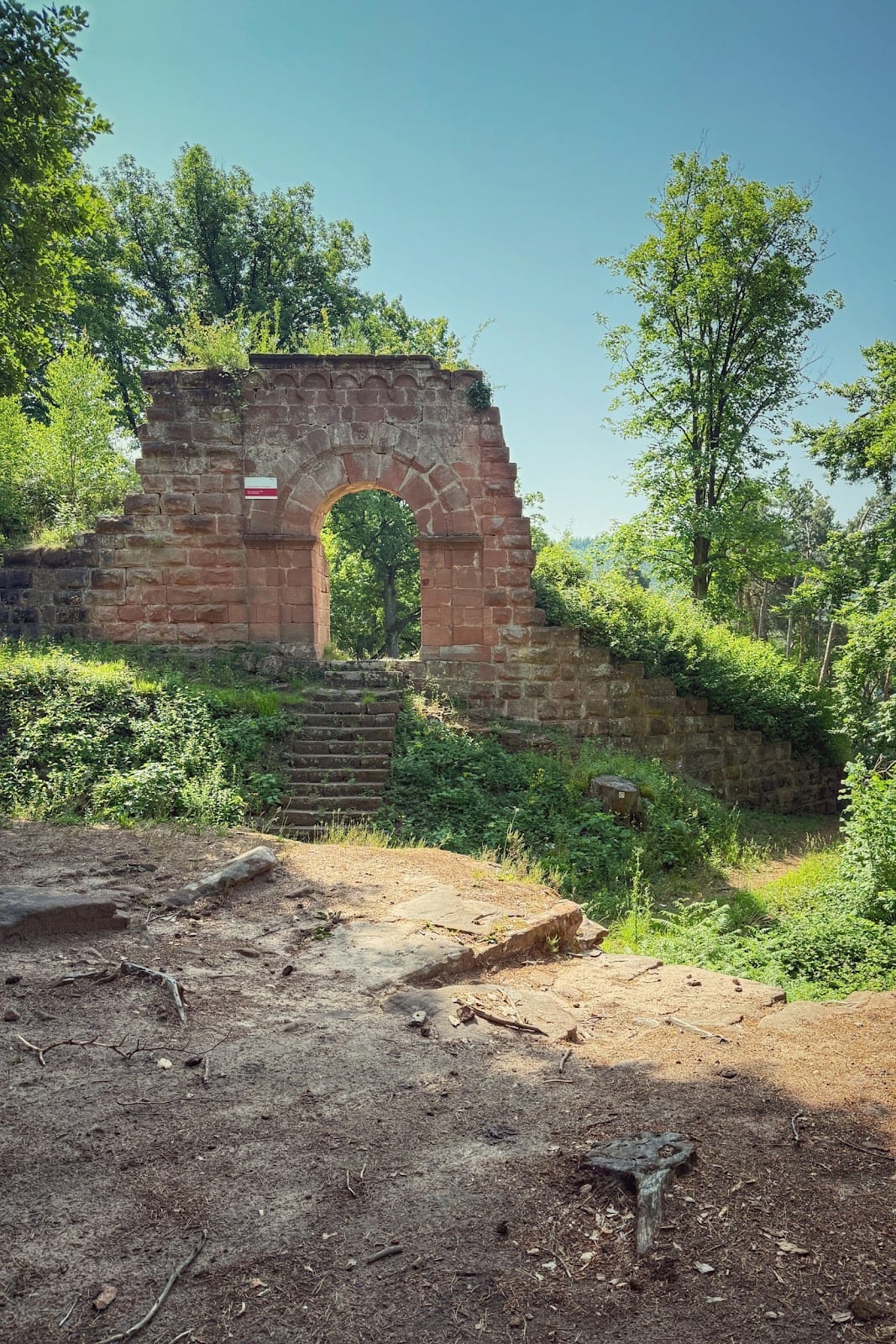
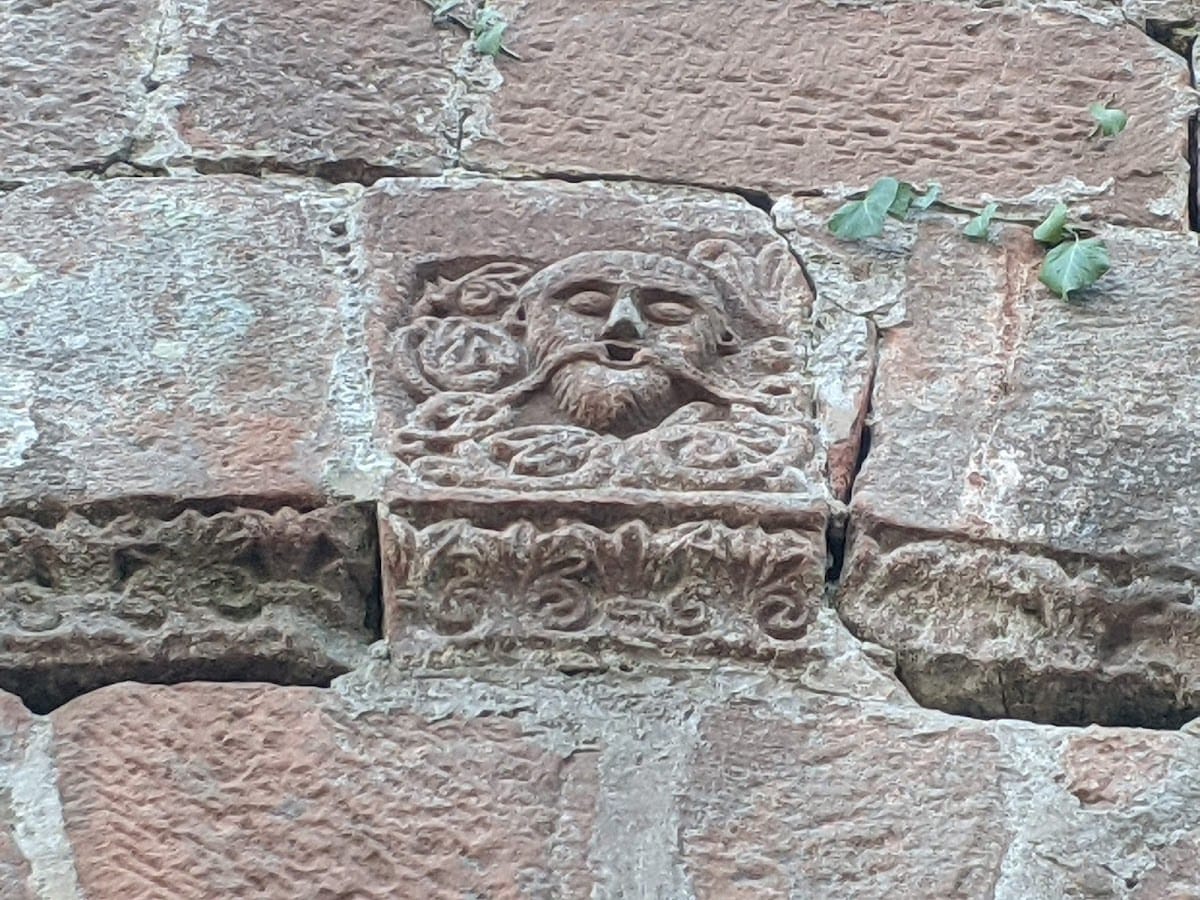
The reconstructed castle portal stands beside the keep and incorporates recovered architectural fragments. Its decoration includes eagle reliefs, comparable to those on the gates of the Erkenbert ruins in Frankenthal and at Worms Cathedral. The arch has a central keystone, the wedge-shaped block at the crown, carved with a leaf mask that combines a face with foliage ornament.
The surviving wall heights and the available building remains indicate a castle with a limited and unfinished architectural fabric. A residential hall, or palas, would have served as the main residential and representative building of a medieval castle, while the evidence at Burg Schlosseck instead points to provisional occupation and incomplete construction.
Nearby sites