Stauf Castle: A Medieval Hill Castle in Germany

Site at a Glance
- Rating
- 4.3
- Popularity
- Low
- Country
- Germany
- Primary era
- Medieval
- Eras represented
- Medieval
- Civilizations
- Holy Roman Empire
- Site type
- Military
- Remains
- Castle
On this page7 sections
History
Stauf Castle is a ruined hill castle in Germany, located south of Stauf near Eisenberg in the Palatinate. It probably originated before AD 1000 and was recorded around AD 1012 as castellum Stoufenburc. It is described as the oldest documented castle of its type in the Palatinate, although its early origins remain uncertain.
Salian origins and early uncertainty
The first historically secure reference to Stauf Castle is linked to a stay by Salian Duke Conrad I of Carinthia. The Salians were a medieval ruling dynasty whose leading members included German kings and emperors during the eleventh and early twelfth centuries. Conrad’s son, Duke Conrad II, also held comital authority in the Wormsgau, Speyergau, and Nahegau. After rebelling against his cousin, King Conrad II, he had several of his castles deliberately damaged or dismantled. This may account for the lack of further records of Stauf Castle for approximately two centuries. Conrad II died without issue.
The castle’s original foundation has not been settled. Its old name, “Staufenburg,” encouraged later associations with the Hohenstaufen, or Staufer, dynasty, a German royal and imperial family that rose after the Salian period. In 1913, the historian Hermann Schreibmüller argued instead that the castle began under the Salians and that its name came from later owners.
Medieval lordship
Godfrey of Staufen was probably a later owner and died in the late twelfth century. Around 1190, ownership passed to Count Eberhard III of Eberstein, apparently through his marriage to Kunigunde, who was probably the heiress of the lordship of Stauf. After an inheritance division, Eberhard IV of Eberstein became lord of Stauf and founded nearby Rosenthal Abbey.
Eberhard’s daughter Agnes III married Henry II of Saarbrücken-Zweibrücken in 1238. Through this marriage, the lordship of Stauf and Rosenthal Abbey passed to that family. Their daughter Kunigunde became Rosenthal’s first abbess and affiliated the convent with the Cistercian Order, a Western Christian monastic order that followed a disciplined interpretation of Benedictine practice. In 1282, Trier was recorded as the feudal lord of Stauf Castle in relation to Henry II. The Electorate of Trier was an ecclesiastical principality of the Holy Roman Empire ruled by an archbishop who also held the rank of imperial elector.
By the fourteenth century, the lordship of Stauf encompassed Breunigweiler, Eisenberg, Göllheim, Kerzenheim, Kerzweiler, Pfrimm, Ramsen, Rosenthal, Sippersfeld, and Stauf. It also included the Rhine villages of Bobenheim, Hochheim, Horchheim, Leiselheim, Mörsch, Pfiffligheim, Roxheim, Weinsheim, and Wiesoppenheim.
Nassau ownership and destruction
Count Henry II of Sponheim-Bolanden purchased the castle between 1378 and 1388. After his death in 1393, the lordship passed through inheritance to his granddaughter’s husband, Count Philip I of Nassau-Saarbrücken. Stauf Castle and the lordship of Kirchheim then remained with the House of Nassau, a European noble dynasty, until the end of the eighteenth century.
In 1525, during the German Peasants’ War, Stauf Castle was destroyed. This conflict was a widespread revolt in the Holy Roman Empire in 1524 and 1525 involving rural communities and other groups. After the Thirty Years’ War ended in 1648, the ruined castle was used as a stone quarry for rebuilding the village of Stauf. The Thirty Years’ War was a major European conflict fought from 1618 to 1648.
Preservation and local tradition
The Historische Verein Rosenthal owned the ruin from 1871 until it was transferred to the town of Eisenberg in June 2000. Since 2009, the site has been maintained by the local Association for the Promotion of Stauf Castle. These successive responsibilities reflect the continuing effort to preserve the ruined remains and their historical identity.
A local legend tells of three wealthy sisters who lived at the castle. One had red hair, one black hair, and the third was blonde and became blind in her youth. The two sighted sisters were said to have cheated the blind sister of her inheritance, hidden the treasure with help from a castle servant, and then blinded and drowned him. They were later believed to have been dragged into the same swamp by a supernatural force. According to the tradition, the blonde sister recovered the treasure with her husband’s help, used part of it to establish the church that later became the Ramsen monastery, and supported the poor. The other sisters were then said to wander the valley as restless spirits.
Remains
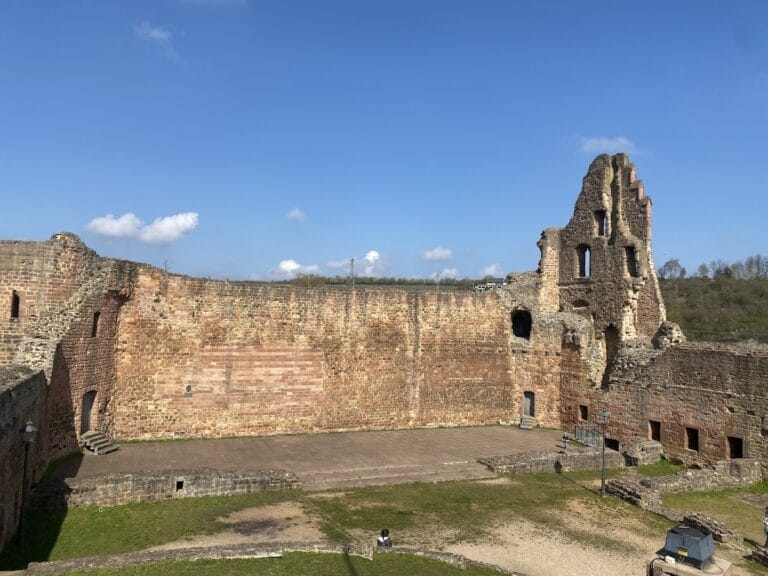
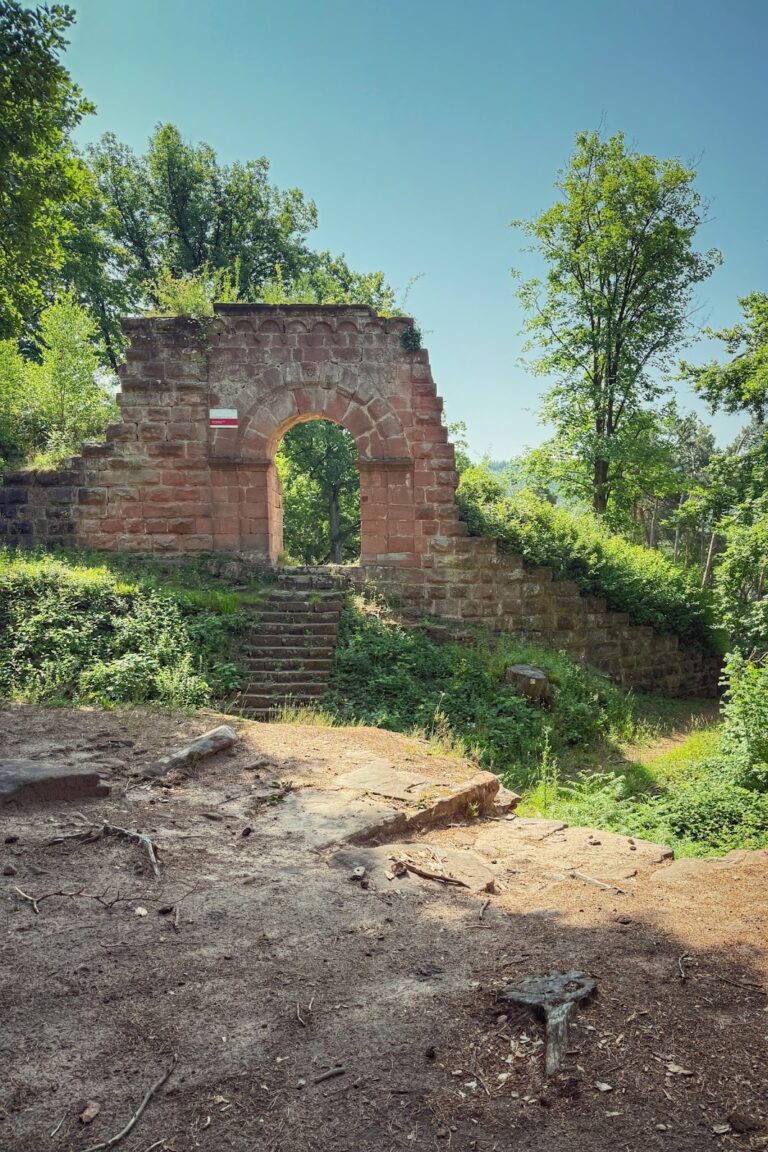
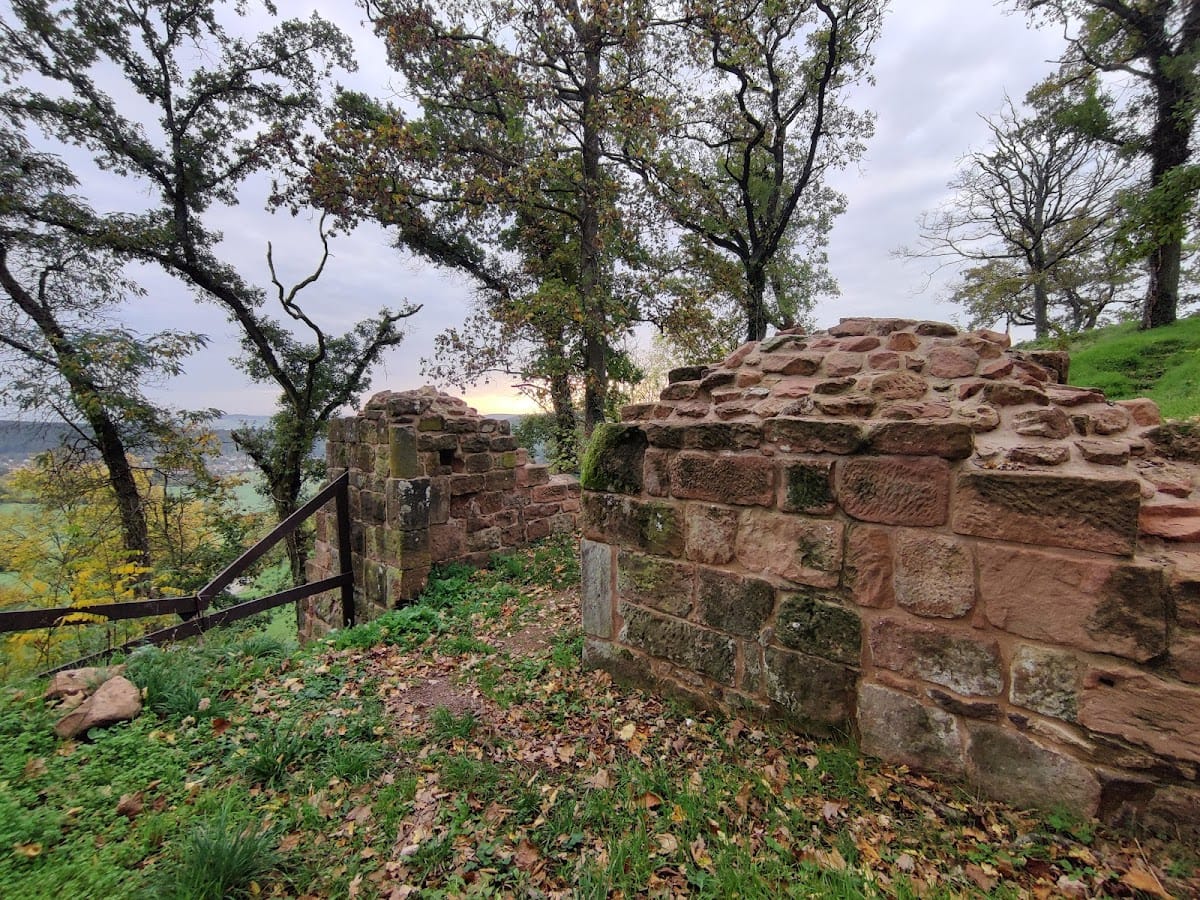
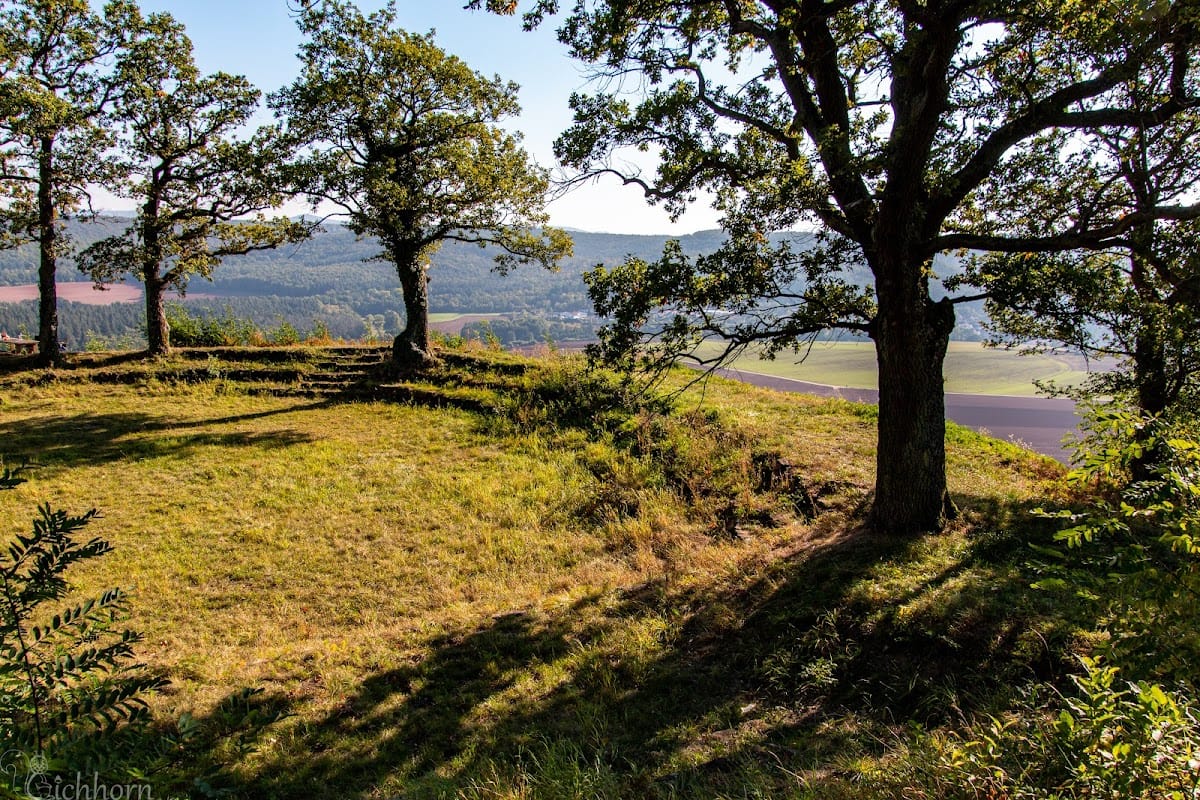
Stauf Castle occupies a projecting ridge on the 327.1-metre-high Schlossberg, a spur of the 366-metre Kühberg south of Stauf. The ridge rises northward above the Eisbach valley, giving the site its documented hilltop and spur-castle setting. The ruined complex was organized along the ridge in three enclosed areas: an outer or southern bailey, a middle bailey, and an inner or northern bailey.
Bailey layout
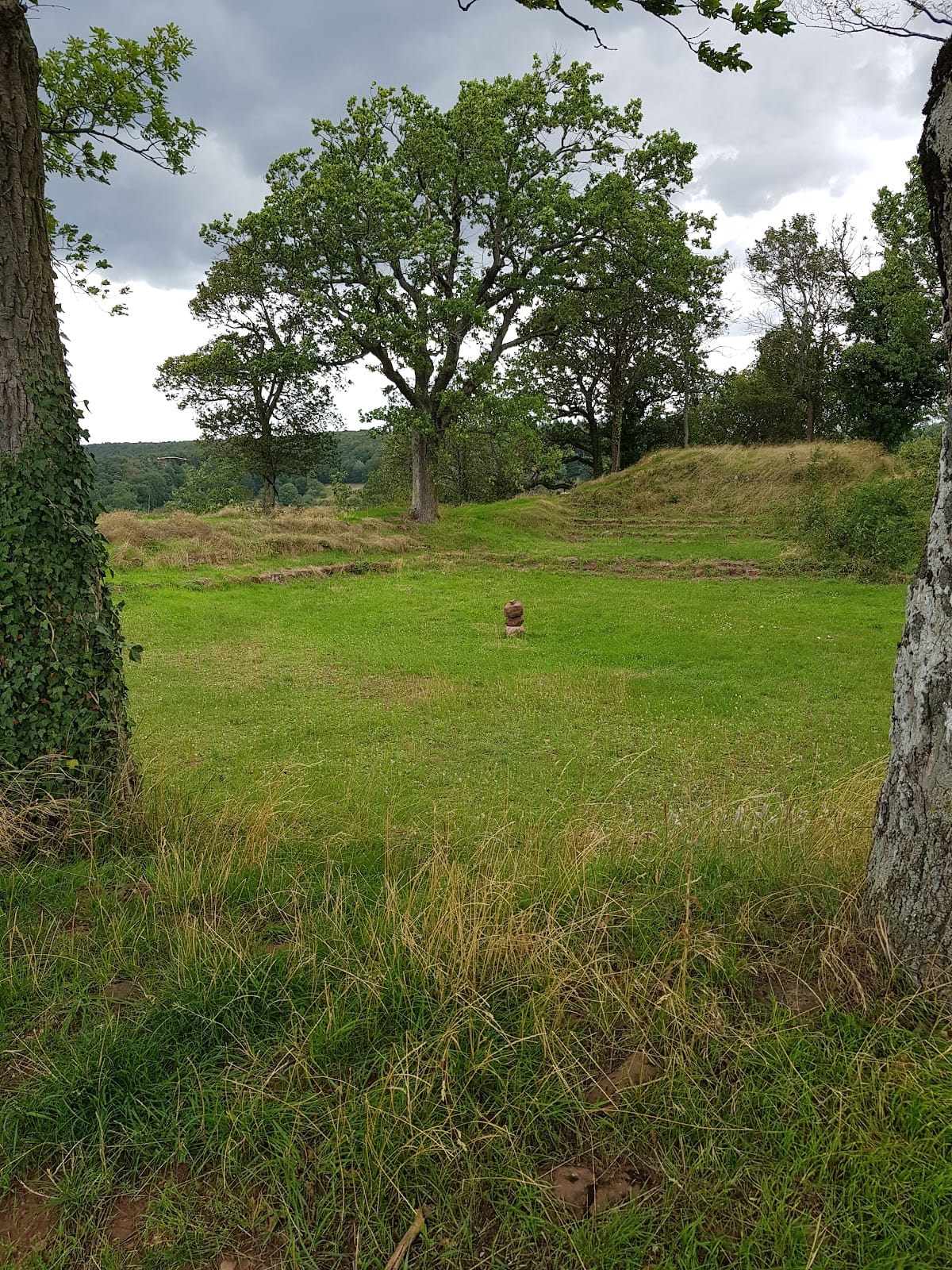
The outer bailey formed the southern part of the castle, followed by the middle bailey and then the inner bailey at the northern end. A bailey was an enclosed area within a medieval castle, separated from other parts of the complex by walls or internal divisions. The three-part arrangement defines the surviving site’s recorded plan, although the complex is now in a ruined condition. Stone from the remains was later quarried for rebuilding Stauf after 1648, linking the castle’s present form to the postwar reconstruction of the village.
Nearby sites