Castello di Briona: A Historic Fortress in Italy


Site at a Glance
- Rating
- 4.1
- Popularity
- Very Low
- Country
- Italy
- Primary era
- Medieval
- External website
- Open
- Eras represented
- Medieval, Early Modern
- Civilizations
- Duchy of Milan
- Site type
- Military
- Remains
- Castle
On this page9 sections
History
Castello di Briona is a historic fortress in Italy, above the settlement of Briona. The first evidence of a fortified building at the site dates to 1140, when it became the possession of Count Guido III of Biandrate. A garrison may already have occupied the site during the Lombard period, when the Lombards, a Germanic people, ruled much of northern and central Italy. The castle’s position controlled the route from the northwest toward Novara.
Visconti and Sforza rule
In 1356, the castle passed to the Visconti, the ruling dynasty of Milan. It was sacked in 1363 by the White Company, a fourteenth-century mercenary force active in Italy, under its commander Albert Sterz during the company’s conflict with Galeazzo II Visconti.
In 1449, Francesco Sforza, Duke of Milan, granted Briona and its castrum, meaning a fortified settlement or stronghold, as a fief to Giovanni Tornielli. Giovanni established his residence there with his son Melchiorre and enlarged the complex by constructing the fortress.
The Tornielli and later owners
Ownership passed to Manfredo Tornielli, Melchiorre’s son, in 1488. After Manfredo allied with the French against Lodovico Sforza, the late fifteenth-century ruler of Milan, the duke tried him and confiscated his possessions. The Tornielli recovered the fortress after a successful French military expedition against Lombardy in 1499 and Lodovico’s fall.
Count Manfredo II Tornielli disappeared in 1583 without a male successor. In 1653, the fortress passed to the related Dal Pozzo d’Annone marquises, who retained it until selling it in 1864 to the Piedmontese general Paolo Solaroli. King Victor Emmanuel II, the first king of unified Italy from 1861, granted Solaroli the title “Marquis of Briona” in 1867.
The complex has been adapted repeatedly over the centuries and remains inhabited. It is privately owned, in good condition, and listed as an Italian cultural property.
Remains
Hilltop complex
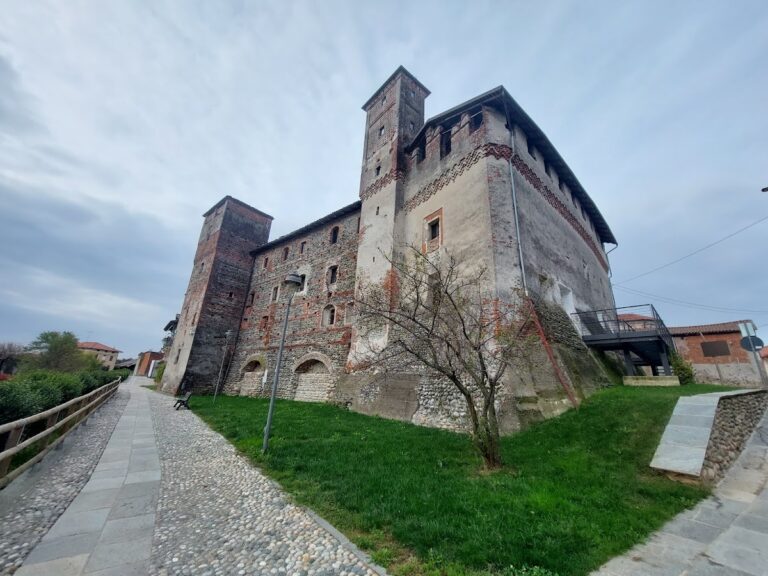
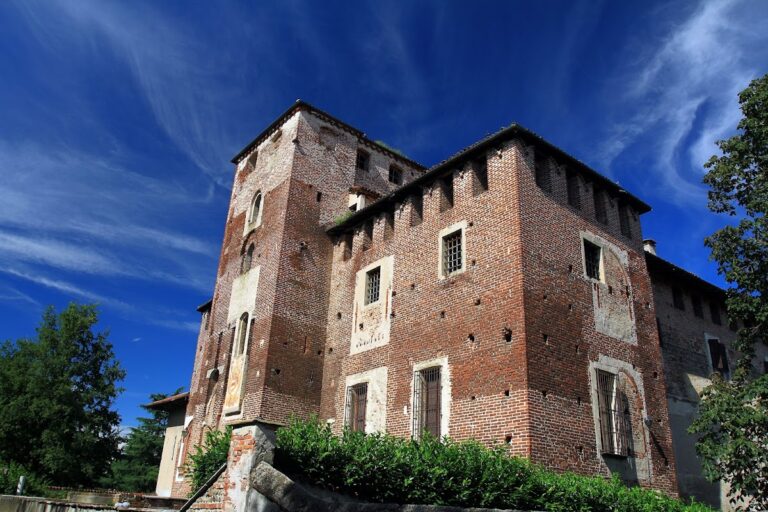
The castle stands on the slope of a hill behind Briona, overlooking the surrounding plain and the settlement below. Its buildings form a nearly perfect quadrilateral. Most of the structures date from the fourteenth and fifteenth centuries, although the construction range is also described as extending into the sixteenth century. The appearance seen today was probably established at the end of the fifteenth century by Marquis Manfredo I Tornielli. A park surrounds the complex.
Interior spaces
Raised courtyard
A raised courtyard occupies the level of the first floor. Cross vaults, which are ceilings formed by intersecting barrel vaults, support this level and rest on a central pillar.
Chapter hall and crypt
The ground floor contains a chapter hall and a crypt, forming part of the castle’s internal arrangement.
Upper tower
A tall tower rises above the complex and contains a dovecote, a structure used for keeping pigeons.
Nearby sites