Castle of Ocre: A Medieval Fortified Settlement in Italy



Site at a Glance
- Rating
- 4
- Popularity
- Low
- Country
- Italy
- Primary era
- Medieval
- Eras represented
- Medieval
- Civilizations
- Kingdom of Sicily, Norman
- Site type
- Military
- Remains
- Fortified Town
On this page10 sections
History
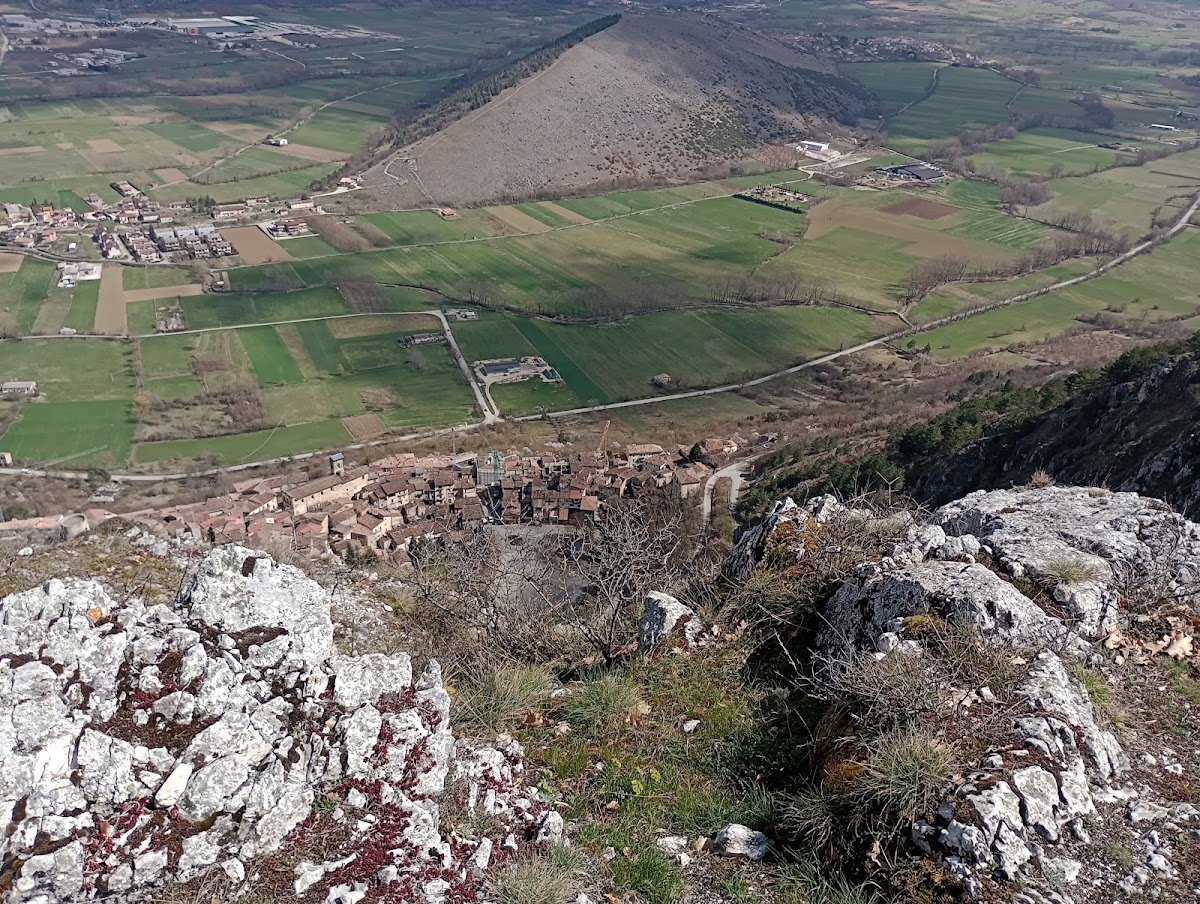
Castle of Ocre is a medieval fortified settlement in Italy, located in the municipality of Ocre in Abruzzo. Built on Monte Circolo at 933 metres above sea level, it occupies the edge of the sinkhole above Fossa. Construction began in the twelfth century, creating a fortified community whose history was closely connected with the feudal and military affairs of the L’Aquila area.
Twelfth-Century Foundations
The first documentary reference appears in the Catalogus baronum, a medieval administrative survey of feudal holdings and obligations in the Kingdom of Sicily. It names Todino di Collimento, a descendant of the Counts of the Marsi, as the settlement’s feudal lord. A papal bull issued by Alexander III in 1178 placed the castle among the possessions of the Diocese of Forcona, the historic ecclesiastical jurisdiction of the L’Aquila area.
Feudal Rule and Angevin Control
In 1254, the settlement was listed as Cassari Castro among the castles spared from a planned general destruction connected with the foundation of L’Aquila. Its exemption was linked to Gualtiero di Ocre, grand chancellor and last heir of the lords of Albe, whose family had held the fief since the Norman conquest of southern Italy.
In 1266, under Charles I of Anjou, the castle passed to the Kingdom of Sicily. That year, inhabitants of L’Aquila looted it after their city was rebuilt following its destruction by Manfred of Sicily, a Hohenstaufen ruler, with the support of surrounding barons. Charles I later confiscated castles in the L’Aquila area because of their support for Conradin of Hohenstaufen, the last Hohenstaufen claimant to the Kingdom of Sicily. In 1269, Ocre was entrusted to Morel de Saours, also known as Morello or Mauriello de Saurgio.
The castle was assigned to Giovanni di Bissone in 1283, but the inhabitants of L’Aquila looted it again in 1293. These attacks formed part of a longer period in which the settlement’s fortunes were tied to the political and military position of L’Aquila.
War and Abandonment
The most serious attack took place in 1423, when the condottiere Braccio da Montone, a professional military commander leading a contracted company of soldiers, assaulted the castle during the War of L’Aquila. This fifteenth-century conflict centered on L’Aquila and its surrounding territory.
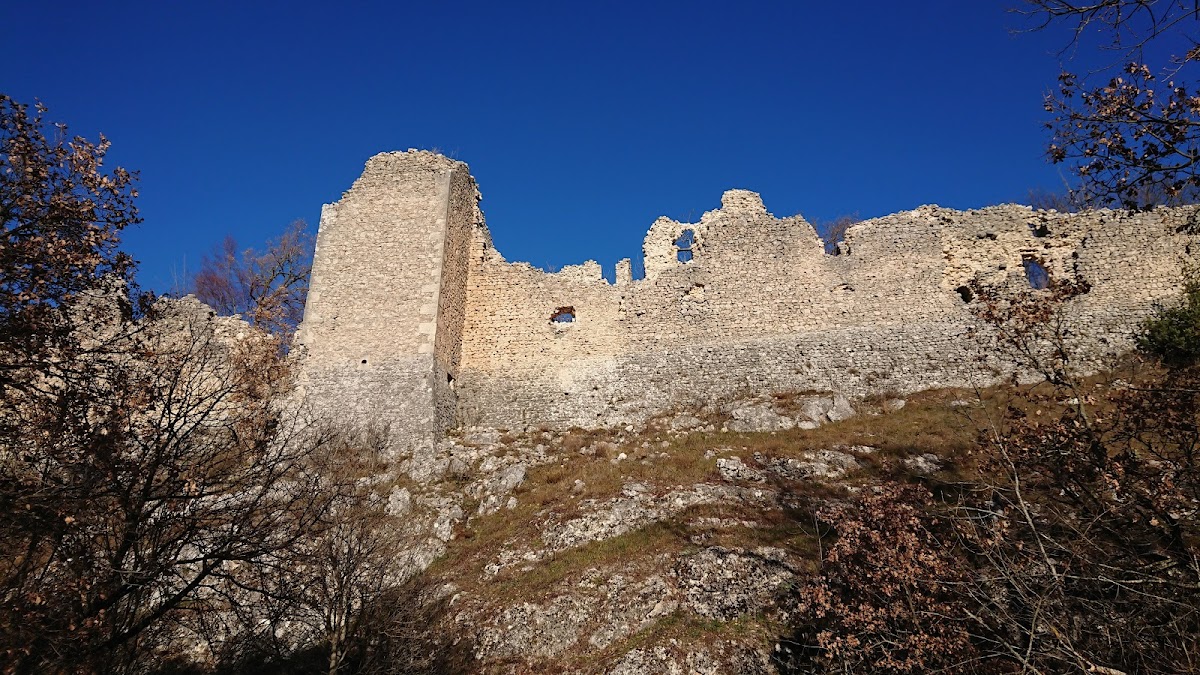
After the settlement lost its defensive role in relation to L’Aquila, it entered a period of progressive decline. By the beginning of the sixteenth century, Ocre was described as a villa rather than a castrum. In medieval Italian usage, these terms distinguished a settlement or village from a fortified settlement or castle. The population gradually abandoned the fortified site, whose strategic function had ended in the fifteenth century. Castle of Ocre is now a ruin.
Remains
Fortified Settlement and Defenses
The surviving site is a fortified settlement rather than only an isolated castle. Its triangular enclosure covers former dwellings, tower houses, and streets. The plan is an isosceles triangle with a perimeter of approximately 470 metres. The short side, which forms the base, lies to the northwest, while the apex points southeast. The northeast flank is naturally protected by the precipice above the Fossa sinkhole.
Seven towers are incorporated into the surrounding defensive enclosure, or enceinte. Three stand along the northwest side, including two positioned close together near the northern apex. Another tower occupies the southern apex, while three intermediate towers follow the line of the wall-walk, a passage used for movement and defense along a defensive wall. Two of these intermediate towers lie on the northwest side and one on the northeast flank. The enceinte and related structures were built in rubble masonry.
Western Gate
The only entrance is near the corner tower on the western flank. It consists of a pointed-arch gate dating from the thirteenth century and was protected by a crossfire defensive system, allowing defenders to cover the approach from intersecting positions.
Religious Remains
Church of San Salvatore
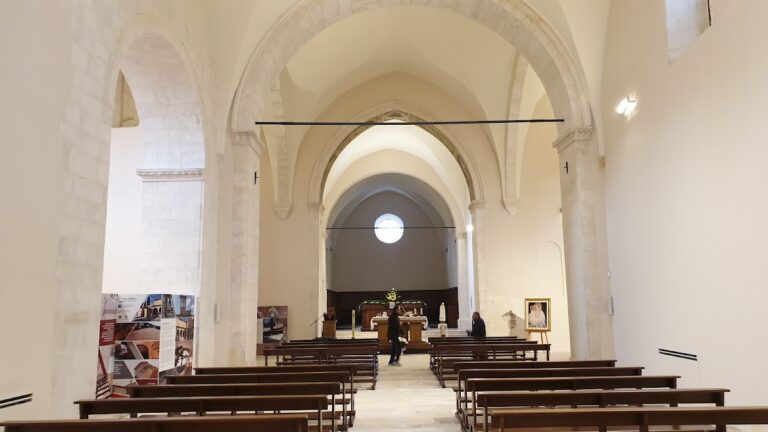
The Church of San Salvatore inter castrum Ocre stood at the southern tip of the fortified settlement. The church had three aisles and a terminal apse, the rounded or polygonal end of the building. It is now completely ruined, although it was still recorded in 1581.
Madonna de Ambro Fresco
A fresco from the middle of the twelfth century came from the church. Known as the “Madonna de Ambro,” it shows the Madonna enthroned and holding the centrally placed Christ Child between two saintly figures. Its strongly Byzantine-influenced features connect the surviving artwork with the religious culture of the church’s early period. The fresco is now held in the Museo Nazionale d’Abruzzo in L’Aquila.