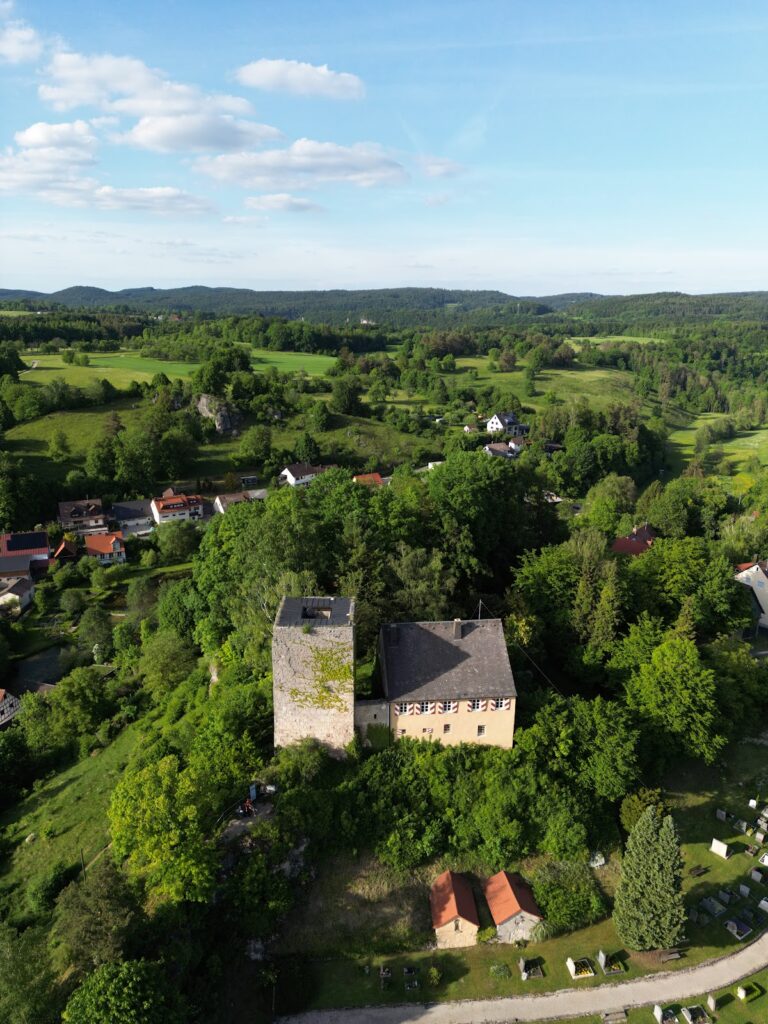
Feuerstein Castle: A Wartime Research Complex and Catholic Youth Center in Germany


Site at a Glance
- Rating
- 3.6
- Popularity
- Low
- Country
- Germany
- Primary era
- Modern
- External website
- Open
- Eras represented
- Modern
- Civilizations
- German
- Site type
- Civic
On this page11 sections
History
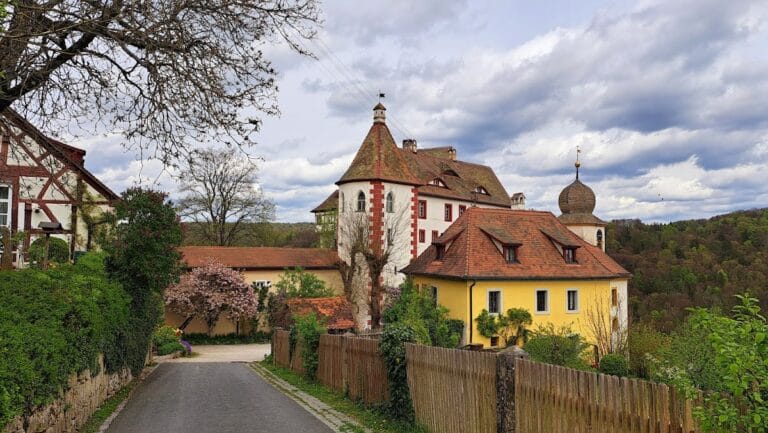
Feuerstein Castle is a modern castle-style complex in Germany near Ebermannstadt, built in 1941 by engineer and inventor Oskar Vierling as a laboratory for high-frequency technology and electroacoustics. Its castle form was designed to blend with the landscape, while the hilltop location provided a central site for research. During the Second World War, the complex became part of Germany’s armaments program and carried out secret work on weapons and communications technology.
Wartime research complex
Until 1945, about 250 employees worked at Feuerstein on projects including speech encryption, acoustic guidance systems for torpedoes, acoustic mine detonators, methods for preventing the detection of U-boats, and radio and electrical engineering. The site was disguised as a medical facility, despite its actual role in Nazi armaments research. A red cross made from roof tiles reinforced this deception.
The buildings were constructed from light tuff stone that was darkened with soot as part of the camouflage measures. At the end of the war, American soldiers seized the complex. It was later abandoned, and the destruction of its construction plans and documents obscured details of its wartime activities for many years. In 2011, cryptographer and historian Norbert Ryska obtained a document from TICOM, an American special unit that gathered intelligence on German communications and related technical research. The document provided further information about Vierling’s work at Feuerstein.
Conversion to a Catholic center
In 1946, the Archdiocese of Bamberg rented the castle under the direction of Jupp Schneider, a Catholic cleric, and acquired it in 1949. Since then, the castle and its estate have served as a Roman Catholic youth and conference center. The Diocese of Bamberg now operates the site as a youth facility.
The estate expanded with dormitories, a dining hall, leisure facilities, conference rooms, camping sites, agricultural operations, a riding stable, and a glider airfield. The Church of the Transfiguration of the Lord was consecrated in 1961. Its upper church anticipated the liturgical reform associated with the Second Vatican Council, the major Roman Catholic council held from 1962 to 1965 that brought changes to Catholic worship and church practice.
Related Feuerstein sites
The Feuerstein Observatory was founded in 1999, about 500 metres south of the Feuerstein airfield, and took its name from the castle. An astronomical observatory is a facility for observing and studying celestial objects and phenomena. About 1.5 kilometres north of the castle, the Kleine Feuerstein was built in connection with the radio-relay system. It is now known as the Lindersberg Scout House. Feuerstein Castle is designated as an architectural heritage monument in Bavaria.
Remains
Castle complex and technical remains
Feuerstein survives as a modern ensemble designed in the form of a castle rather than as a medieval fortress. Its light tuff-stone construction was darkened with soot during the war, and roof tiles formed the red-cross disguise. The present wine cellar is a surviving part of the original construction period. It began as a walk-in safe, protected by a steel door 10 centimetres thick.
The castle tower was built by Vierling to test the first radio-relay link. The observatory continues to use the tower as a radio-relay station connecting Feuerstein with Ebermannstadt in the valley, allowing the structure to retain its original technical purpose. Other parts of the estate include dormitories, a dining hall, a bowling alley, table-tennis and volleyball facilities, a hard court, a sports field, conference rooms, camping sites, agricultural areas, a riding stable, and a glider airfield.
Church of the Transfiguration of the Lord
Crypt
The church is arranged in three spaces: a crypt, a lower church, and an upper church. Stairs lead from the lower church to the dimly lit crypt, where the eternal light marks the presence of the Eucharist. A tabernacle, the receptacle for the consecrated Eucharistic host, stands between twelve candlesticks representing the twelve apostles.
Lower church
The lower church is dedicated to Mary as the Mother of Wisdom. Its altar stands before a mural showing the Litany of the Blessed Virgin Mary, a series of formal invocations honoring Mary in Christian prayer. Alfred Heller of Bamberg created both the mural and the dark-toned glass windows.
The windows on one side show a predatory animal’s head, fire, broken ears of grain, and the Grim Reaper. The opposite side presents human figures, a rainbow, the sun, and angels’ wings. A passage beyond the lower church has windows representing the Christian spiritual attitudes of prayer, meditation, and contemplation.
Upper church
The upper church was built under the direction of architect Heinzmann and cathedral master builder Schädel. Its altar is positioned within the church so that the priest faces the congregation during Mass. A large glass wall shows the Burning Bush on the right and Elijah’s sacrifice on the left. Glass artist Georg Meistermann created the wall, while a youth group made the Stations of the Cross in 2005. The Stations of the Cross are devotional representations of episodes from Christ’s Passion.
Lindersberg Scout House
The building formerly called Kleine Feuerstein lies about 1.5 kilometres north of the castle. Built in connection with the radio-relay system, it is now the Lindersberg Scout House.