Santa Maria ad Cryptas: A Medieval Catholic Church in Fossa, Italy


Site at a Glance
- Rating
- 4.7
- Popularity
- Low
- Country
- Italy
- Primary era
- Medieval
- External website
- Open
- Eras represented
- Medieval, Early Modern
- Civilizations
- Kingdom of Naples, Kingdom of Sicily
- Site type
- Religious
- Remains
- Church
On this page11 sections
History
Early church and medieval rebuilding
Santa Maria ad Cryptas is a Catholic church in Fossa, Italy, probably first built in the ninth or tenth century as a Roman-Byzantine-style temple with a crypt. Its name, also found in the form Santa Maria delle Grotte, refers to this subterranean sacred space. About four centuries later, Benedictine craftsmen constructed a Gothic-Cistercian building over the earlier temple. Cistercian architecture developed from a reform of Western monasticism and generally favors clear structural arrangements and restrained decoration.
The church depended on the Monastery of Santo Spirito at Ocre and is under the Archdiocese of L’Aquila. Its position on a slope required major structural work. A buried counterfort wall was built along the entire side facing the valley, while two supporting pillars strengthened the ends of the lateral wall. The exterior masonry also incorporates stones reused from buildings of Aveia, a Roman city in the central Apennine region of present-day Abruzzo.
The thirteenth-century frescoes
The church received its large fresco cycle in the final years of the thirteenth century, approximately between 1264 and 1283. The paintings are attributed to Gentile da Rocca and belong to the major thirteenth-century pictorial tradition of Abruzzo, which was associated with artists from Montecassino. The workshop seems to have begun under an artist working with Byzantine-derived schemes, before other painters added scenes from the Old and New Testaments.
The paintings also reflect French artistic influence that entered the region after Charles of Anjou conquered Swabian Abruzzo. Charles was the Angevin ruler whose conquest of the Kingdom of Sicily brought French political and artistic influence into Abruzzo during the later thirteenth century. The frescoes use sharply outlined garments and faces, pronounced folds, and strongly marked eyes. These features convey spirituality and emotion rather than the ornamental or doctrinal character associated with the Romanesque Benedictine manner described for the church.
Several patrons appear within the decoration. At the bottom of the apse are the names of Guglielmo Morelli of Sant’Eusanio, his wife, an abbot named Guido, and three young women. Morelli’s existence is recorded in 1259. Beneath the Passion scenes, Guglielmo Amore is shown with a cross-bearing shield beside members of his family. An inscription identifies him as a member of a chivalric order.
Later history and restoration
The church was declared a national monument in 1902. It originally housed the 1283 tempera-on-wood Madonna del Latte by Gentile da Rocca, one of the oldest works in Abruzzo. The painting is now preserved in the National Museum of Abruzzo in L’Aquila. The Madonna di Fossa also came from Santa Maria ad Cryptas and is now held in the same museum.
The 2009 L’Aquila earthquake severely damaged the church. After a prolonged restoration, Santa Maria ad Cryptas reopened for worship on 28 April 2019.
Remains
Building and crypt
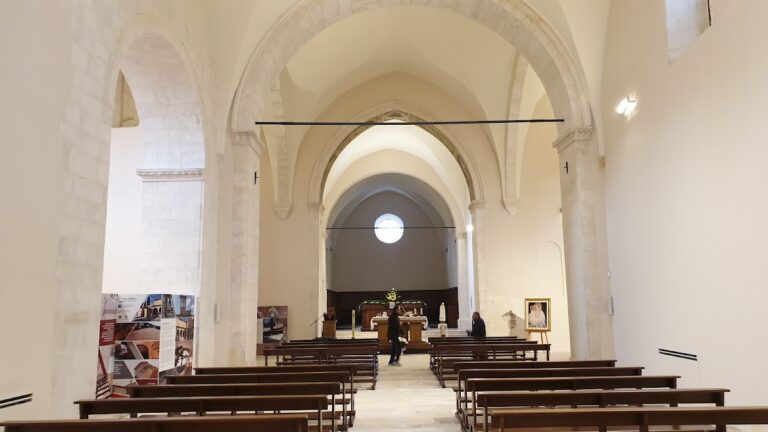
The church stands about one kilometre from the centre of Fossa and a few kilometres from the Monastery of Santo Spirito at Ocre. Its simple Gothic-Cistercian structure has a single nave divided into three bays, with the raised square presbytery, the area around the main altar, separated from the nave by an arch. The surviving fabric combines the later medieval construction with reused stone from Aveia and the substantial supports required by the sloping ground.
Facade and exterior
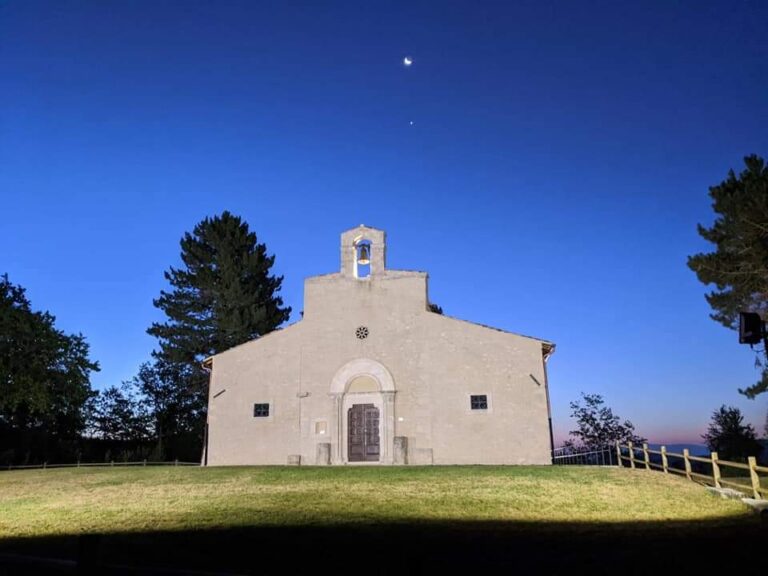
The west facade has a plain gabled outline. A projection on the left is associated with the reinforcement of the valley-side wall. The pointed Gothic portal is topped by a large rectangular window that appears stylistically out of alignment with the rest of the facade and was probably added later. Small columns beside the portal have capitals carved with rosettes, flowers, and palms. They support sculpted lions, although the lion on the right has been lost, while a third lion stands above the portal arch. Only traces survive of the fresco that once occupied the lunette above the entrance.
The rear facade ends in a triangular pediment and contains two openings, a long narrow window with splayed sides below and a small square opening above. Each side wall has two further long, narrow, double-splayed windows. The nave is now covered by wooden roof trusses. Traces of arches and the pillars intended to carry them indicate that a pointed barrel vault in masonry may originally have been planned, in a form comparable to the vault of the Oratory of San Pellegrino at Bominaco. Whether the vault was left unfinished or later collapsed remains uncertain.
Interior and crypt
The side walls are divided into three bays by pilasters. On the left, one pilaster is replaced by a half-column probably reused from Aveia. The square presbytery rises three steps above the nave, and the apsidal area is covered by a ribbed cross-vault. Its four ribs rest on four small columns. A staircase in front of the presbytery descends to the crypt, preserving the connection between the upper church and the earlier subterranean space.
The crypt contains an altar made from a stone altar slab resting on part of a column, together with a fragmentary fresco of the Crucifixion. The space may derive from an earlier hypogeum, meaning a subterranean chamber used for religious, funerary, or ritual purposes, dedicated to the goddess Vesta. The surviving evidence therefore links the crypt to both the church’s early history and the earlier use of the site.
Painted decoration
Nave and chapel
The principal fresco cycle extends from the triumphal arch to the presbytery, along the side walls, and across the counter-facade, the interior wall opposite the entrance. Its scenes place subjects from the Old and New Testaments within a connected painted program. The Genesis sequence begins on the triumphal arch and continues along the right wall. It includes the separation of the sun and moon, with God shown as a young, beardless man; the division of Good from Evil; the Creation of the Animals; the Creation of Adam and Eve; the warning concerning the Tree of Life; Original Sin; and the Expulsion from Eden. A cherub guards the gate of Eden, an element identified as a distinctive Abruzzese addition.
Other scenes include the Dormition of the Virgin, episodes from the lives of Jesus and Mary, the Annunciation, the Creation of the World through the separation of light and darkness, and the Crucifixion. A ciborium detail shows Saint John the Baptist and Saint Paul the Apostle. A second cycle presents figures in niches holding scrolls, including prophets and saints. In the upper register of the third bay, Saint George kills the dragon while Saint Martin removes his cloak. The middle register represents the final six months of the year through scenes of labor, and the lower register shows Abraham, Isaac, and Jacob holding small figures representing the elect of Paradise.
The central chapel on the north wall contains the 1486 Annunciation by Sebastiano di Nicola da Casentino, a major representative of the Abruzzese Renaissance.
Presbytery and counter-facade
The Passion of Christ occupies the presbytery and the walls of the apse. The scenes include five book-holding figures in the left lunette, the Last Supper, and the Kiss of Judas, in which Judas is separated from the Apostles. The cycle continues with the adult Christ Pantocrator, a representation of Christ as universal ruler, together with Saint John the Baptist, Saint Paul, Saint Peter, and Saint John the Evangelist. The Flagellation, Pontius Pilate’s decision, the tortured Christ, the Crucifixion with the Madonna and Saint John the Apostle, and the Deposition complete the sequence.
The counter-facade bears a Last Judgment cycle arranged in five registers and regarded as one of the oldest such cycles in Abruzzo. At the top, Christ in Majesty appears with angels blowing trumpets. The next register contains ten figures and later additions made in the sixteenth century. Below them, angels carrying scrolls separate the elect from the damned according to the divine sentence. The Resurrection of the Dead shows figures emerging from rows of tombs. In the lowest register, Saint Michael weighs souls beside the Virgin, while Hell appears with its punishments. Monks are included among the figures as representatives of Divine Justice.