Château de Mortagne-sur-Sèvre: A Medieval Fortress in France


Site at a Glance
- Rating
- 4.6
- Popularity
- Low
- Country
- France
- Primary era
- Medieval
- External website
- Open
- Eras represented
- Medieval, Early Modern, Modern
- Civilizations
- English
- Site type
- Military
- Remains
- Castle
On this page10 sections
History
Mortagne-sur-Sèvre Castle is a medieval fortified castle in France, built by the lords of Mortagne on the frontier of the County of Poitou. Its precise construction date is uncertain, although the stone fortress belongs to the Middle Ages. Mortagne had been a barony since the eleventh century under the suzerainty, or overlordship, of the Viscounts of Thouars.
Medieval lordship
Among the early lords of Mortagne were Antier I of Mortagne, recorded around 1040, and his grandson Guillaume I of Mortagne, known as Chotard, recorded around 1083. Their line ended with Guillaume’s granddaughter, Sybille Chotard of Mortagne. Her marriage to Pierre III of Chemillé, lord of Chemillé, transferred Mortagne’s dynastic connection to the Chemillé family.
From the medieval period until the French Revolution, the castle and lordship passed successively through the houses of Thouars, Chemillé, La Haye, Scépeaux, Gondy, and Neuville de Villeroy.
War and later defenses
During the Hundred Years’ War, a prolonged conflict between the English and French crowns fought mainly in France from the fourteenth to the fifteenth century, English forces seized and strengthened the fortress between 1346 and 1373. Olivier de Clisson, a major Breton commander serving the French cause, failed to recapture Mortagne in 1372. He and Bertrand du Guesclin, a prominent French constable and military leader, later secured the fortress through an exchange involving the captured English captain Jean d’Évreux. The English surrendered Mortagne to the French on 23 August 1373 in return for his release.
Henri of Navarre, the Huguenot prince who later became King Henri IV of France, stayed at the castle in September 1588. At the end of the sixteenth century, the defenses were reinforced by a large artillery tower known as the English Tower. A fortified town was later established around the castle, strengthening the defenses at the end of the promontory. It consisted of three enclosures, whose approximate outline can still be discerned in Napoleonic cadastral plans.
Transformation into a manor
At the beginning of the twentieth century, a manor was built within the medieval castle enclosure, between the high ramparts and the spur tower. The property is now used as a manor, and the remains of that building stand within the former fortress. Victor Durand is listed as the initial owner of the property.
Remains
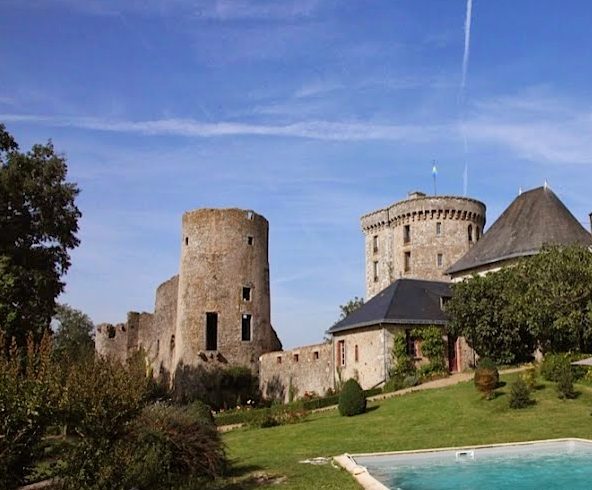
The castle occupied the end of a granite spur or plateau above the left bank of the Sèvre Nantaise. Its original enclosure followed the rocky promontory toward the southwest, overlooking the river valley, and was flanked by towers. The surviving medieval features, the later manor, and traces of the fortified town together reflect the site’s successive defensive and residential phases.
Fortress structures
Spur Tower
The principal surviving medieval feature is a large cylindrical tower with projecting beaks, defensive projections that strengthened the tower and created forward positions for weapons. Known as the spur tower or English Tower, it belongs to the later defensive history of the fortress and is associated with an unusual construction described as unique in France. The early-twentieth-century manor stands between this tower and the high medieval ramparts.
Treasure Tower
The Treasure Tower contains doors showing that it was connected to other internal buildings within the castle. These openings preserve evidence of the relationships between the tower and the buildings that once occupied the medieval enclosure.
Early-twentieth-century manor
The manor was inserted into the former castle enclosure at the beginning of the twentieth century. Its position between the high ramparts and the spur tower places the later residence within the surviving framework of the medieval fortress.
Fortified town and gates
The later fortified town comprised three enclosures and included several fortified gates. The Nantes, La Rochelle, Saint-Louis, and Poitiers gates were mentioned in connection with the Vendée Wars after the battle of 1794. Other entrances were the Bourneau Gate, the Bourbouttault or Bourbetault Gate, and the Bourneuf Gate. The Bourneau Gate stood at the level of the present Rue des Étangs, opposite the Bourneau suburb, while the Bourbettault and Bourneuf gates stood on the present Rue Nationale. The names of the former Nantes and Saint-Louis gates survive in Rue Nantaise and Rue Saint-Louis.