Bellefontaine Abbey: A French Catholic Monastery and Trappist Foundation


Site at a Glance
- Rating
- 4.5
- Popularity
- Low
- Country
- France
- Primary era
- Medieval
- External website
- Open
- Eras represented
- Medieval
- Civilizations
- Unclassified
- Site type
- Religious
- Remains
- Monastery
On this page10 sections
History
Bellefontaine Abbey is a Catholic monastery in France, located at Bégrolles-en-Mauges, and dedicated to Mary, the mother of Jesus. Hermitages are believed to have existed at Bellefontaine around 1010, while the abbey itself was founded around 1120. A charter from that period records an agreement between Pétronille de Chemillé, the first abbess of Fontevraud Abbey, and Pierre, Bellefontaine’s first abbot.
Medieval foundation and papal memory
Bellefontaine passed through successive Benedictine and Cistercian affiliations. In 1305, Bertrand de Got, then archbishop of Bordeaux, visited the abbey and learned there that he had been elected pope. He took the name Clement V, serving as pope from 1305 to 1314, and later gave the abbey a statue of the Virgin to commemorate the event.
Commende and reform attempts
From the end of the fifteenth century, the abbey was placed under the commende, a system in which an abbey’s revenues and administration could be assigned to a commendatory holder who did not necessarily belong to the resident religious community. This arrangement contributed to a pronounced spiritual and material decline.
In 1637, the commendatory abbot Michel Sublet tried to replace Cistercian observance with the rule of the Benedictines of the Congregation of Saint-Maur, a reform movement known for disciplined communal life and scholarly work. The attempt failed. Five years later, the Maurists were replaced by the Feuillants, a stricter Cistercian reform congregation that remained at Bellefontaine for more than a century and a half.
Revolutionary destruction and monastic revival
By 1790, only four Feuillant monks remained. During the French Revolution, the community was expelled, the library was burned, and the furnishings were sold. The monastery was converted into a prison, and Bellefontaine became an important site in the fighting of the War in the Vendée, a major counter-revolutionary conflict in western France during the Revolution.
In 1816, the Trappist Urbain Guillet bought the remains of the monastery for Augustin de Lestrange and established a new community with several Trappist monks. Trappists belong to the later Cistercian Order of the Strict Observance. The community numbered about fifteen monks by 1817 and later expanded.
An international monastic network
Bellefontaine founded or supported several daughter communities. Its influence extended to Fontgombault Abbey, active under its direction from 1849 to 1904 and Benedictine again from 1948; Oka Abbey in Quebec, founded in 1880 and later moved to Saint-Jean-de-Matha in 2009; and Notre-Dame des Prairies in Manitoba, founded in 1892 and later moved to Holland, Manitoba, in 1978. Bellefontaine also supported Our Lady of the Valley in Rhode Island from 1900 to 1950, founded Notre-Dame du Kokoubou in Benin in 1972, and maintained a connection with Notre-Dame des Gardes in Maine-et-Loire. These foundations extended its monastic network across five continents during the twentieth century.
Since 1966, the community has published spiritual texts, particularly writings on Eastern spirituality and the relationship between Eastern and Western monastic traditions. In the early twenty-first century, about fourteen monks lived at Bellefontaine. They cultivated apples and kiwis and maintained a guesthouse for retreatants seeking silence, prayer, and participation in the liturgical offices.
Change of community
The Trappist community announced its departure from Bellefontaine on 13 November 2025 because of the advanced age of its members. Twelve Benedictine monks from Barroux Abbey took possession of the monastery during 2026. Their installation Mass was celebrated on 11 July 2026 by Dom Louis-Marie, abbot of Barroux, in the presence of Emmanuel Delmas, bishop of Angers, and Renauld de Dinechin, bishop of Luçon.
Remains
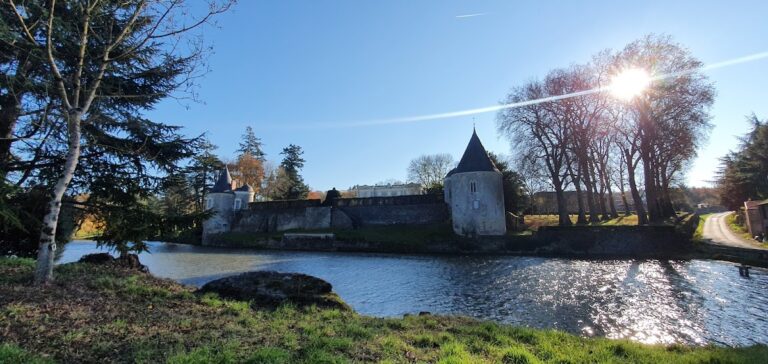
The surviving abbey complex stands at Bellefontaine in the commune of Bégrolles-en-Mauges, in Maine-et-Loire. Its physical remains include the abbey church and the monastery buildings acquired for renewed monastic use in 1816 after the revolutionary conversion of the site into a prison.
Church and monastic remains
Statue of the Virgin
The abbey church contains the statue of the Virgin presented by Clement V after his visit in 1305. In 2013, the statue stood against the pillar on the right side of the choir, where its presence preserved a material connection with the papal episode in Bellefontaine’s history.
Monastery buildings
The monastery’s surviving remains were acquired by Urbain Guillet in 1816 and returned to monastic use by the Trappist community. The complex therefore retains the physical setting in which the renewed community developed after the revolutionary expulsion, prison conversion, and sale of the abbey’s furnishings.