Château d’Ardelay: A Medieval Fortified Castle in Les Herbiers, France


Site at a Glance
- Rating
- 4.2
- Popularity
- Low
- Country
- France
- Primary era
- Medieval
- External website
- Open
- Eras represented
- Medieval, Early Modern
- Civilizations
- Duchy of Aquitaine, French
- Site type
- Military
- Remains
- Castle
On this page12 sections
History
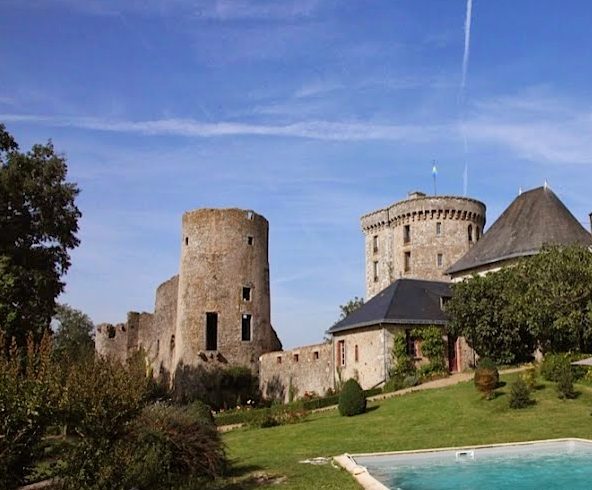
Château d’Ardelay is a medieval fortified castle in Les Herbiers, France, built on the site of an earlier feudal stronghold and later developed through Renaissance and eighteenth-century phases. Its surviving keep, moats, and drawbridge form the last fragment of a more extensive fortified complex that once included residential, service, religious, and burial areas.
The medieval stronghold
A wooden castle was established here around the tenth century on a raised castle mound, an earthwork platform for a fortified residence. A wooden palisade and ditch protected the mound. The timber structure was later replaced by a stone castle with a second enclosure containing the castle, service buildings, a church, and a cemetery.
The earliest known lords of Ardelay came from the Pareds family, followed by the Chantemerle family. Through the marriage of Jeanne de Naillac, daughter of Guillaume de Naillac, to Jean de Brosse, lord of Boussac and Sainte-Sévère, the lands passed into the Brosse lineage and later to the Vivonne family.
The Vivonne lords
André de Vivonne, lord of Ardelay and other estates in Poitou, held important royal offices. He served as councillor, chamberlain, and seneschal of Poitou under Louis XI, Charles VIII, Louis XII, and Francis I. Charles VIII appointed him lieutenant general of the royal army in Brittany, while Francis I made him chamberlain to the Dauphin and one of the Dauphin’s governors. André took part in the capture of Naples and died at Anville on 31 July 1532, aged 80.
François de Vivonne received the favor of Henry II and fought Guy Chabot, son of the lord of Jarnac, in a public combat on 10 July 1547. François died during the encounter. His daughter Diane de Vivonne became lady of Ardelay and married Nicolas de Gremonville.
Charles de Vivonne II, baron of La Châtaigneraie and lord of Ardelay, served Charles IX during the civil wars. He defended Angoulême during its siege and remained loyal to Henry III, who made him a knight of the Order of the Holy Spirit, a prestigious French chivalric order established by the king.
From the seventeenth century to the Revolution
Andrée de Vivonne inherited the family estates and married François VI de La Rochefoucauld in 1627. Through this marriage, François became lord of Ardelay. He remained connected with the lordship until the châtellenie, a territorial lordship administered from a fortified seat, was acquired by the Couhé family around 1635. He took part in the Fronde, a series of rebellions and political conflicts during the minority of Louis XIV, and joined opposition intrigues against Cardinal Richelieu, the chief minister of Louis XIII. He was also the author of Maxims, first published in 1665.
Ardelay was sold in 1687 to Henri François des Herbiers de L’Estenduère, a naval officer who became commander-in-chief of the naval forces at Rochefort. The estate stayed with his family until 1767, when it passed after the death of Antoine Augustin des Herbiers to his son-in-law Jacques d’Escoubleau, Count of Sourdis.
Decline and rehabilitation
After the death of Zénobie Reine d’Escoubleau, a Trappist nun, in 1848, the estate passed to her grandnephews, the Jousbert barons du Landreau. The last Jousbert heiress, Antoinette, and her husband, Jean Michel Laurent Émile, Count of Bermond d’Auriac, neglected the château and eventually sold it with the adjoining farm. The subsequent owner also failed to maintain the property.
German troops partially destroyed the château during the Second World War. When the commune of Les Herbiers acquired it on 16 April 1984, the buildings stood in ruins and were overgrown with brambles. A major rehabilitation program directed by an architect of the French Buildings Service took place from 1985 to 1988, after which the château became an exhibition venue. It has been protected as a monument historique since 26 December 1927 and is owned by the commune of Les Herbiers.
Remains
The fortified core
Fifteenth-century keep
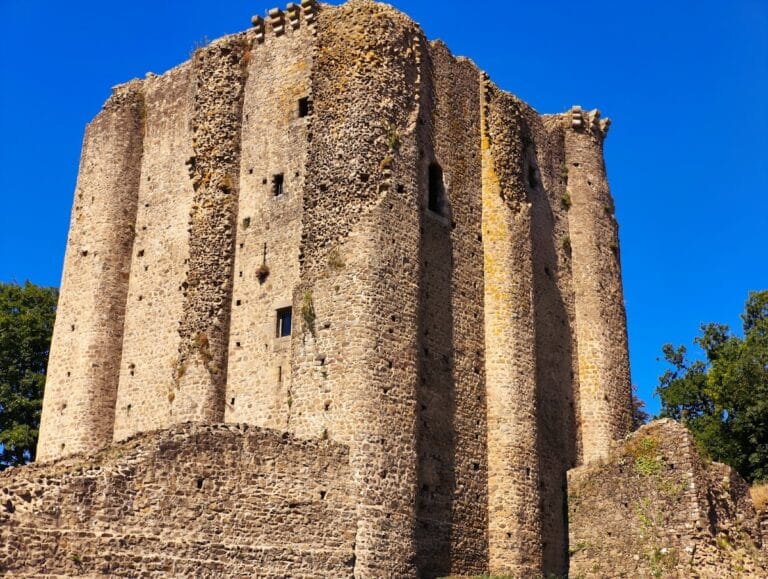
The château occupies the edge of the former Grand Chemin du Bocage and stands on the original castle mound. Its principal surviving structure is a massive square keep dating from the fifteenth century. The keep combined the lord’s living quarters with defensive functions and includes a firing chamber. Its austere character reflects the military purpose of the late medieval fortified complex.
Moats and drawbridge
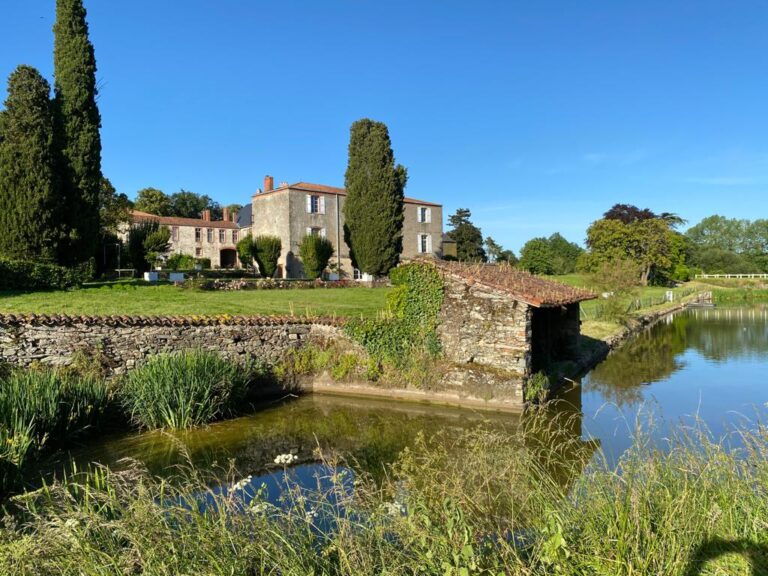
Moats remain around the château, together with a drawbridge restored in a traditional manner. These features continue to express the defensive arrangement of the castle mound and its enclosing works. Together with the keep, they form the principal surviving elements of the fortified core.
Residential and service buildings
Renaissance residential building
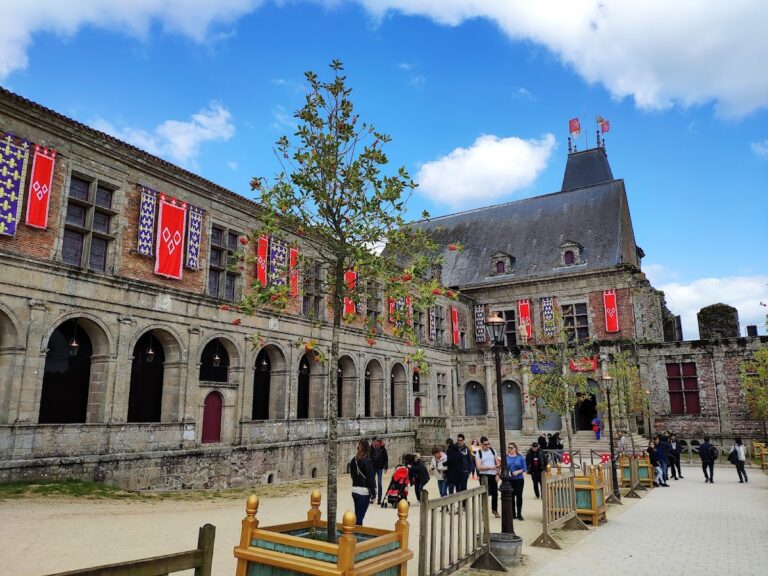
A small inner courtyard is enclosed in part by a Renaissance residential building. This structure represents a later phase of construction within the fortified setting, when domestic accommodation was added to the older defensive core. Large fireplaces decorate every room, contributing to the surviving character of the residence.
Eighteenth-century service buildings
Eighteenth-century service buildings complete the courtyard group. They belong to a later building phase than the keep and residential structure and form part of the surviving fragment of the former enclosure. The wider stone complex had also incorporated service areas, a church, and a cemetery.