Burg Hochhaus: A Medieval Hilltop Castle Ruin in Germany
Site at a Glance
- Rating
- 4.7
- Popularity
- Low
- Country
- Germany
- Primary era
- Medieval
- Eras represented
- Medieval, Early Modern
- Civilizations
- Holy Roman Empire
- Site type
- Military
- Remains
- Castle
On this page9 sections
History
Burg Hochhaus is a castle ruin in Germany, near Ederheim, established around 1200 as a high-medieval hilltop stronghold. It probably began as the ancestral seat of a collateral branch of the noble Hürnheim family. The family later adopted the castle’s name, which derives from the Latin phrase de alta domo, meaning “to or from the high house.” The castle stands on Hochhauser Berg above the Kartäusertal, on the edge of the Ries impact crater in Swabia.
The Hochhaus Lords
Rudolf I of Hochhaus appears as a witness to a document in 1236. In 1347, Konrad II sold the castle to the Counts of Oettingen-Oettingen for 3,000 pounds. The last lord of Hochhaus died without heirs in 1353, probably contributing to the sale and the end of the family’s direct lordship over the castle.
Administrative Castle and Palace
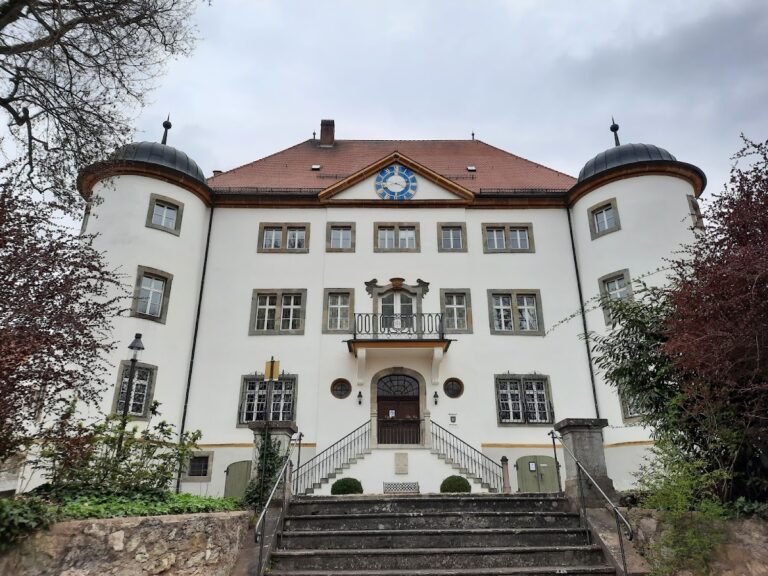
The Counts of Oettingen used Hochhaus as an administrative seat. During the fifteenth and sixteenth centuries, they modernized the complex and reinforced it with military defenses. In 1719, the older castle was converted into a palace. Much of the fortification system and the old residential hall were retained, but the palace burned in 1749 and was never rebuilt.
From 1787 to 1792, the journalist and Enlightenment writer Wilhelm Ludwig Wekhrlin was imprisoned at Hochhaus. While confined there, he wrote articles for his political journals Das graue Ungeheur, Hyperboreische Briefe, and Paragrafen. The old residential hall continued as the administrative office of the Oettingen-Wallerstein line until 1807.
Abandonment and Preservation
After 1807, the residential hall was abandoned and allowed to decay. Its deterioration was deliberately hastened for Romantic reasons, so that the ruin, together with neighboring Burg Niederhaus, would become a picturesque feature of the Kartäusertal landscape. The site apparently remained inhabited for some time afterward. In 1839, the council of Nördlingen granted Helene le Bret, a female court councillor from Hochhaus, permission to move into the city.
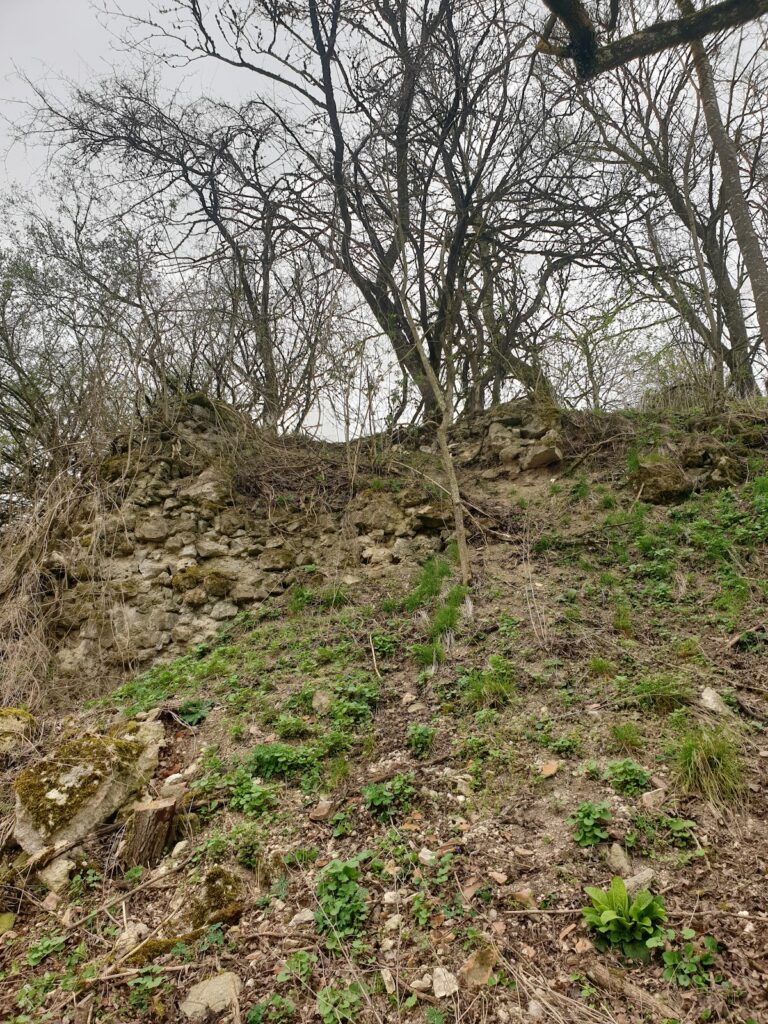
In the 1960s, the outer retaining slope of the neck ditch was secured, although parts of it have since collapsed again. Burg Hochhaus is protected as an architectural heritage monument in Bavaria.
Remains
Hilltop Earthworks
The castle occupies a hilltop at approximately 555.2 metres above sea level within an extensive system of earthworks from different periods. About 300 metres before the main castle’s neck ditch, a ditch-and-bank defense approximately 200 metres long cuts across the plateau from the hinterland. A second ditch lies between this outer defense and the castle, extending partly down the slope. A fore-castle may have stood behind the middle ditch, but its structural remains and visible traces in the terrain have not survived.
Neck Ditch and Main Enclosure
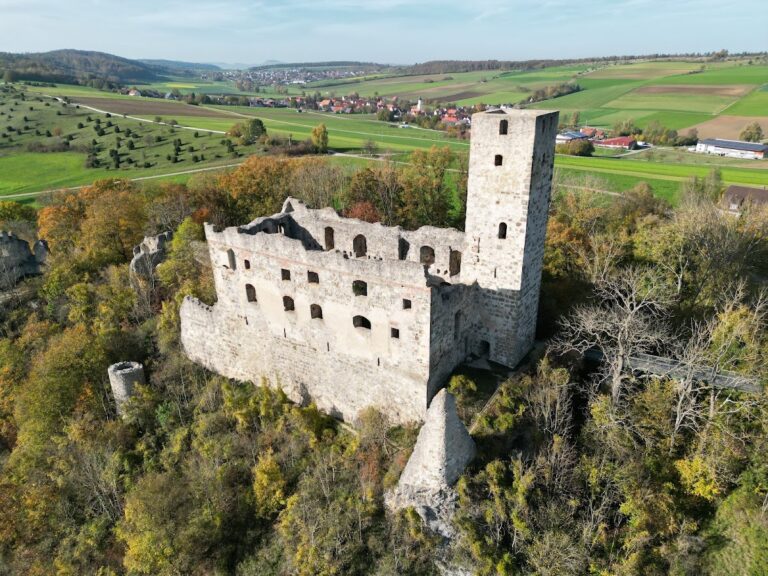
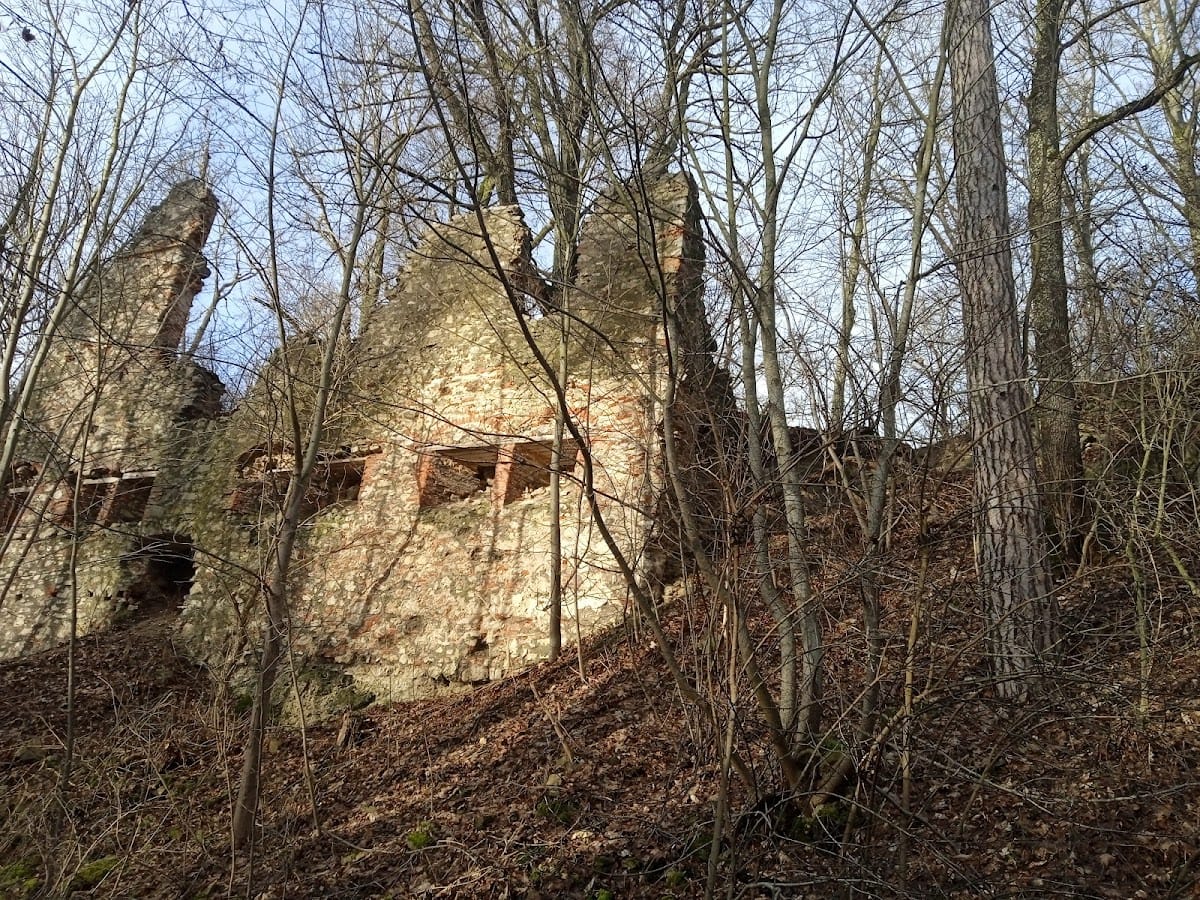
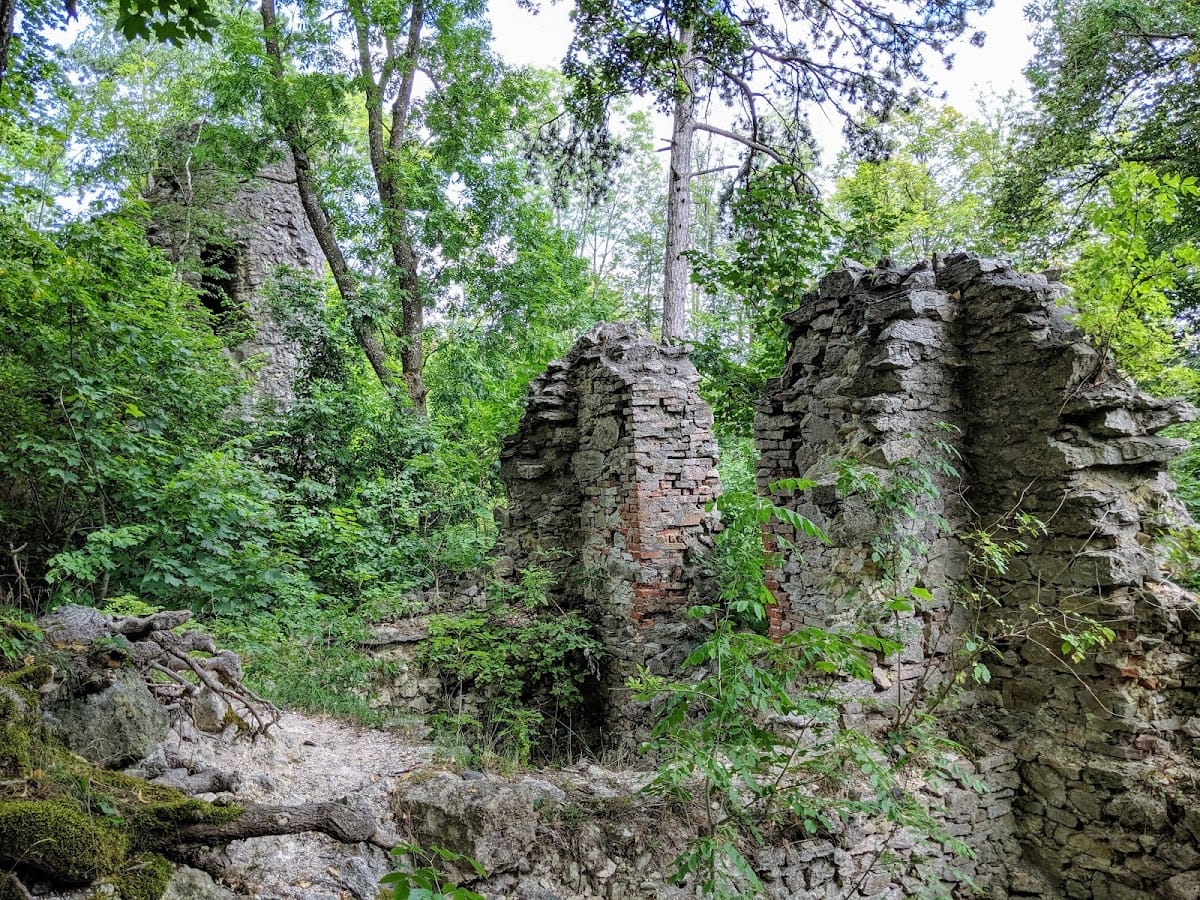
The outer wall, or counterscarp, of the neck ditch is partly built of masonry. Behind it, the remaining structures rise above the older curtain wall. The main castle has an irregular quadrilateral plan measuring about 60 by 70 metres. The courtyard and substantial parts of the enclosure are ruined, while the surviving walls and towers are highly threatened by collapse.
Residential and Defensive Structures
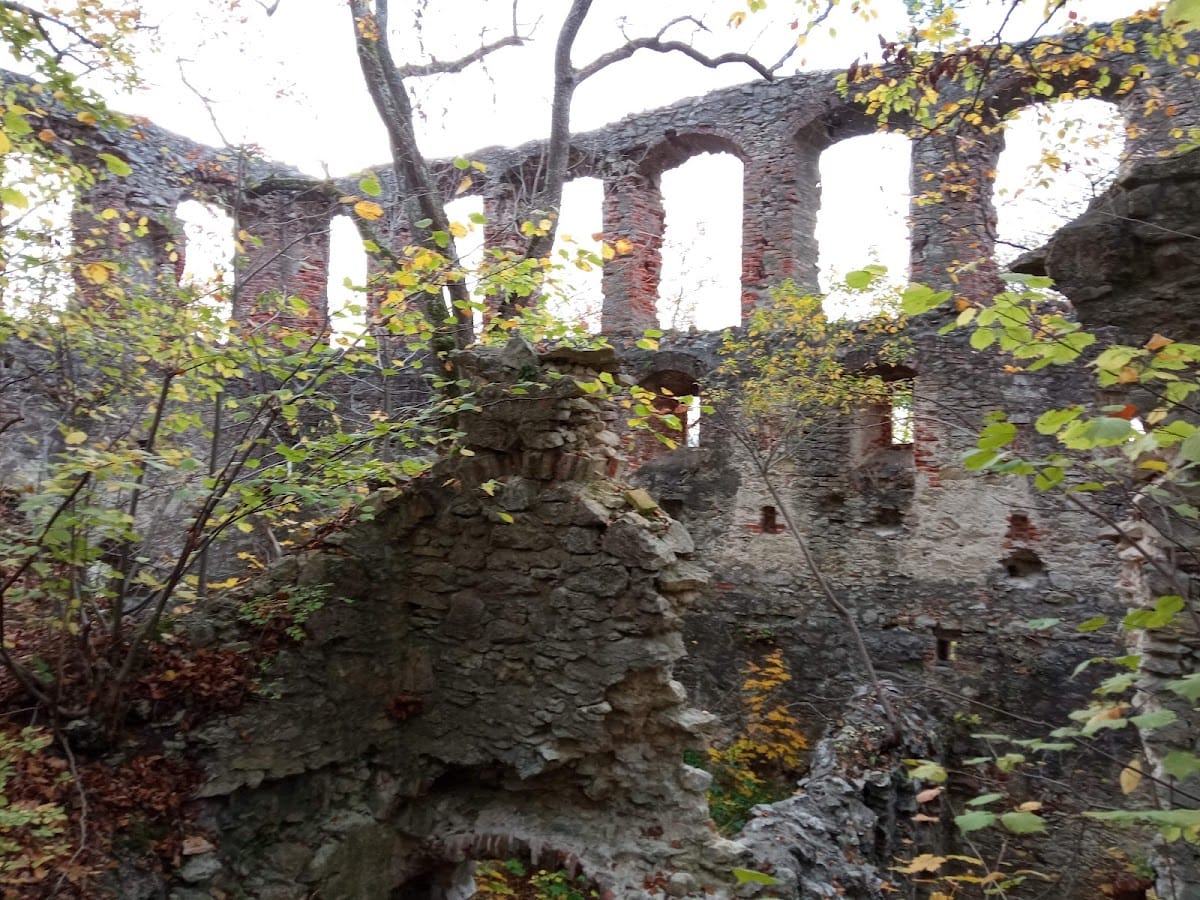
West of the remaining palace structures stands the old residential hall, known as a Palas, the principal residential and representative building of a medieval castle. It survives to three storeys and retains large window openings, but its fabric is at risk of collapse. South of the hall is the gate zwinger, an enclosed defensive approach between or in front of gates. It preserves part of a flanking tower, which allowed defenders to fire along the adjacent wall, while the main gate itself has disappeared.
The best-preserved part of the former palace is its slender southwestern corner tower. A low, elongated gun tower stands in front of it. Other surviving features include a semicircular tower belonging to the gate zwinger, southern casemates, which are protected enclosed spaces used for defense or storage, a southeastern tower, and a wall extending north from that tower.
Evidence for the Former Palace
Two oil paintings made around 1750 to 1760 preserve views of the palace before its destruction. They are held at Harburg Castle, with one showing the complex from the northwest and the other from the southwest. The paintings depict a main building with a half-timbered upper storey and a small stone or plastered turret. The lower side wings ended in small curved gables, while the slender corner tower rose to the ridge height of the main building. Because of the danger of collapse, only substantial structural parts of the ruin can be viewed from outside.