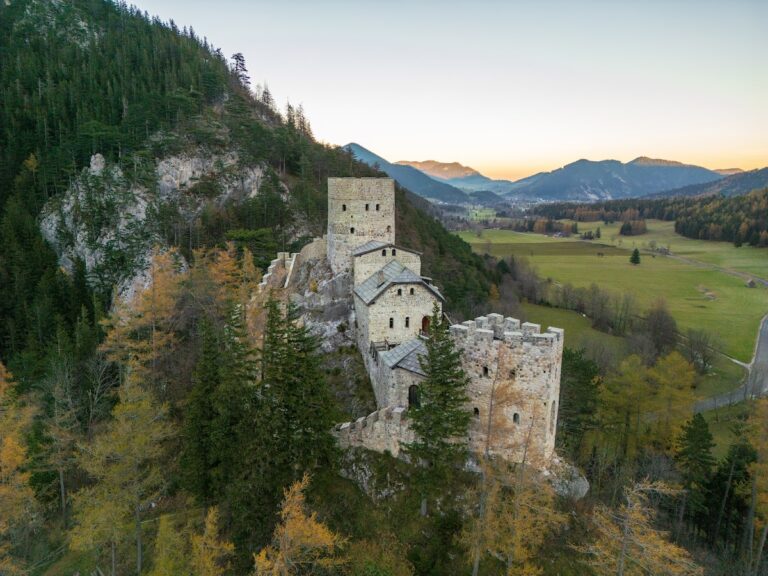
Stixenstein Castle: A Medieval Hilltop Fortress in Austria


Site at a Glance
- Rating
- 4.5
- Popularity
- Very Low
- Country
- Austria
- Primary era
- Medieval
- Eras represented
- Medieval, Early Modern, Modern
- Civilizations
- Duchy of Austria, Habsburg, Holy Roman Empire
- Site type
- Military
- Remains
- Castle
On this page7 sections
History
Stixenstein Castle is a medieval hilltop castle in Austria, above the village of Stixenstein in the municipality of Ternitz. Its earliest structures probably date from the second half of the twelfth century, when elevated fortresses served defensive and territorial purposes.
Origins and Medieval Rule
Earlier interpretations identified Stixenstein as the ancestral seat of the Stuchse family, later known as Stuchs von Trautmannsdorf. More recent research proposes that the family acquired an existing castle called Stein and renamed it Stüchsenstein only at the beginning of the fourteenth century. A major fire damaged the castle in 1347, after which the Stuchse family renewed it.
From about 1350, the castle was administered by the territorial ruler. The Stuchse line became extinct in 1426. The property had been sold to Duke Leopold III of Austria before 1381, and it was later granted to the administrator Hans von Liechtenstein. His tenure was brief, and the castle returned to the imperial house in 1478. The Habsburgs were the dynasty that ruled Austria and, at various periods, held the imperial title within the Holy Roman Empire.
Habsburg Control and Sixteenth-Century Transformation
Emperor Frederick III strengthened Stixenstein’s defenses. Hungarian forces under King Matthias Corvinus captured it in about 1487 or 1488 during the expansion of Hungarian power into Austrian territories, but Habsburg control was restored in 1490.
On 28 November 1520, Emperor Maximilian I transferred the castle to Marx Treitzsaurwein. After Treitzsaurwein’s death in 1527, it passed to his widow, Barbara Keckh. In 1531, she transferred it to her son-in-law Wolfgang Strein zu Schwarzenau. The Hoyos family acquired the property in 1547 and renovated the residence in 1549. After a period of neglect, the medieval fortress was transformed into a spacious Renaissance aristocratic residence. Renaissance architecture developed in Europe from the fifteenth century and favored classical forms and more spacious residential designs than a purely medieval fortress.
Fires, Rebuilding, and Modern Ownership
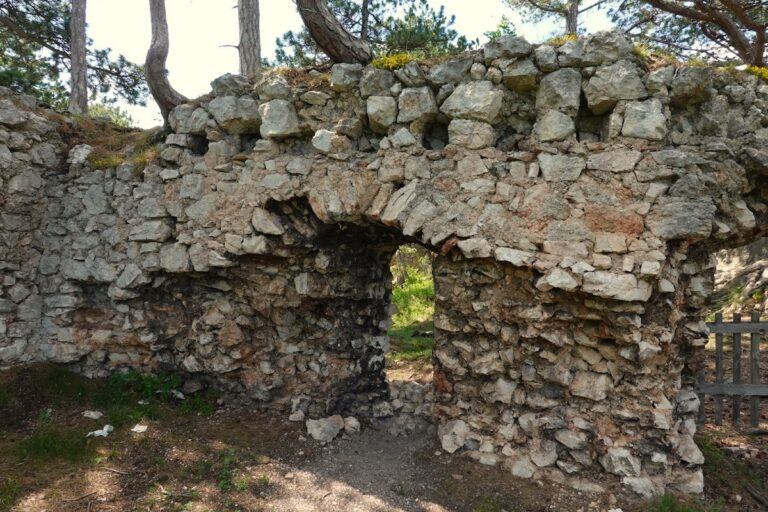
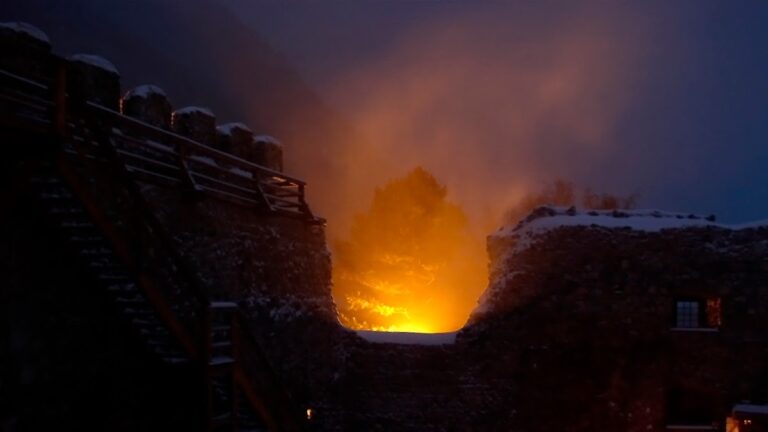
Severe fires in 1735 and in the early nineteenth century caused extensive damage. In some areas, little more than the outer walls remained. The complex had been only partly rebuilt by 1832. During the first half of the nineteenth century, Count Johann Ernst Hoyos-Sprinzenstein adapted the outer courtyard, especially, for residential use.
The Hoyos family retained Stixenstein until 1937, when the City of Vienna acquired it together with a nearby spring and surrounding forests needed for the city’s water supply. During the Second World War, the castle became one of sixteen Lower Austrian depots for art objects from the collections of the City of Vienna. Storage began in August 1943 after an air raid on Wiener Neustadt, and Vienna’s forestry department guarded the depot.
After heavy fighting, the Red Army occupied the castle on 2 April 1945. The stored artworks began to be returned after the war, but extensive losses caused by looting by Soviet soldiers and local inhabitants were discovered. The surviving buildings underwent a major cycle of conservation during the second half of the twentieth century. In 1996, Vienna and Ternitz decided to pursue further rehabilitation and public access, and the Friends of Stixenstein Castle association was established for this purpose.
The City of Vienna has owned the castle since 1937, and the complex is now used as an event venue. Two new bells were dedicated for the castle in November 2023. Stixenstein Castle and its park are protected under Austrian monument-protection law.
Remains
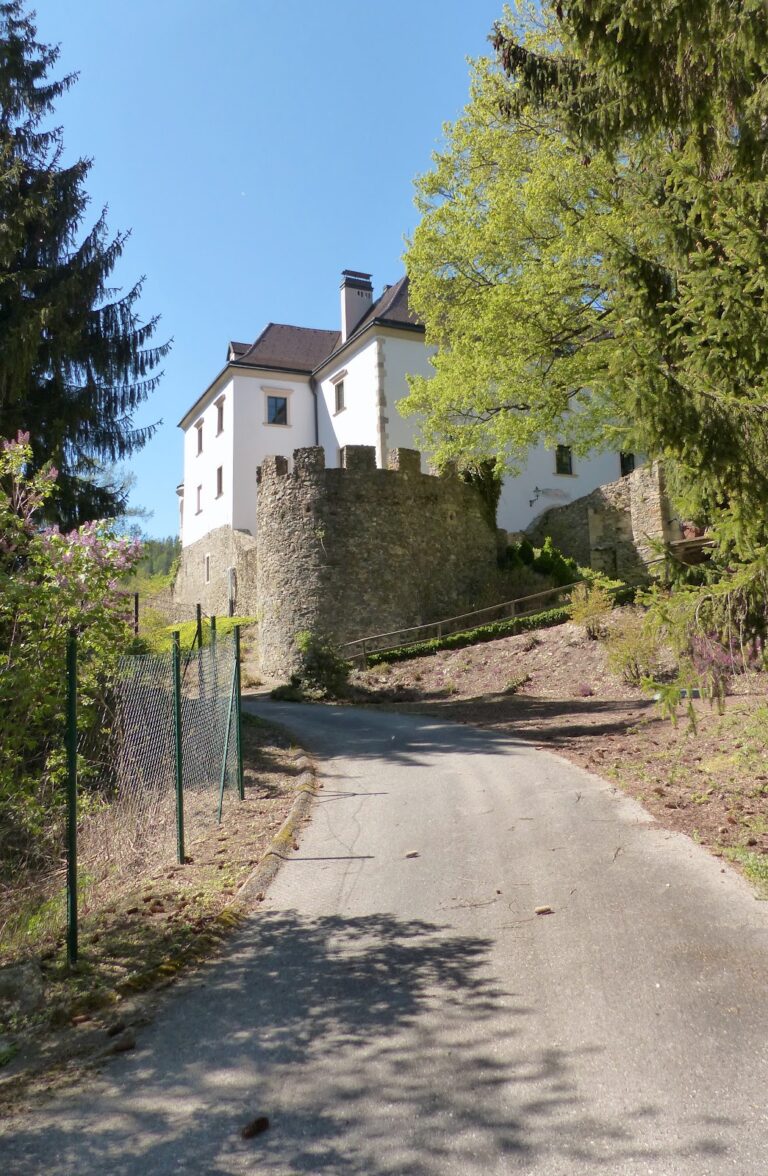
Stixenstein Castle is a partly ruined but still used hilltop complex above the Sierning Valley, overlooking Stixenstein north of Sieding. A former valley barrier lies on the road between Sieding and Puchberg am Schneeberg. The buildings stand within an extensive park that stretches downhill. The entrance portal and pointed-arch windows have Neo-Gothic forms, while the buildings carry steep gabled roofs. A bell tower with a hexagonal base rises beside the keep, the principal fortified tower of a medieval castle.
Fortified Core
The keep and the buildings beside it form the central architectural group. The massive keep has four stories and a square plan measuring approximately 13 metres on each side. Its northeast side has only small openings, while the ground-floor entrance has an unusual arrangement described as rare in a medieval keep. The upper covering forms a platform with four solid masonry blocks at the corners. The keep may have been built by the Stuchs von Trautmannsdorf family during the first half of the fourteenth century and was modified in the sixteenth century.
Chapel and Residential Areas
A chapel adjoins the keep and residential section on the west. Originally Gothic, it connects with the residential area through an arched doorway. The outer courtyard became the principal residential area during the nineteenth-century rebuilding because it was more suitable for domestic use, preserving the complex’s adaptation from a medieval fortress to a residence.