Burg Werdenstein: Ancestral Castle of the Werdenstein Lords in Germany


Site at a Glance
- Rating
- 4.6
- Popularity
- Very Low
- Country
- Germany
- Primary era
- Medieval
- External website
- Open
- Eras represented
- Medieval
- Civilizations
- Habsburg, Holy Roman Empire
- Site type
- Military
- Remains
- Castle
On this page9 sections
History
Burg Werdenstein is a medieval hilltop castle in Germany, above Immenstadt im Allgäu, built by the Lords of Werdenstein as the ancestral seat of their family and the center of the Werdenstein lordship. The first recorded bearer of the name was Hildebrand von Werdenstein, who appeared as a witness in a document of Kempten Abbey in 1239.
Service to Kempten Abbey
The family was probably originally free nobility and entered the service of Kempten Abbey, a major ecclesiastical territorial institution in the Allgäu. From 1350, the Werdensteins held the hereditary office of chamberlain, an important court and administrative position, and received several fiefs, including four houses in Kempten.
At the beginning of the fifteenth century, the family submitted to the House of Austria, the Habsburg ruling dynasty whose archdukes controlled extensive territories in Central Europe. This change apparently sought greater independence from the prince-abbey and a stronger position against the Counts of Montfort. Their double castle of Rothenfels-Hugofels stood a few kilometres to the southeast.
Feud, Austrian allegiance, and the Peasants’ War
Count Hugo of Montfort besieged Werdenstein in 1457 during a feud. In 1464, the hilltop castle was listed among Austria’s Swabian fiefs. This meant that the Werdensteins had placed their lordship under the Habsburg archdukes and received it back as a fief, a lordship granted in return for allegiance and service. In 1491, Hildbrand von Werdenstein was serving Maximilian I, the Habsburg ruler who later became Holy Roman Emperor.
Insurgents looted the castle during the German Peasants’ War in 1525, a widespread uprising against aspects of lordly and ecclesiastical authority. Georg von Werdenstein fled behind the protective walls of the nearby Imperial City of Kempten and recorded the wartime events in the Werdenstein Chronicle.
Relocation and decline
In 1659, the family moved to its newly acquired lordship of Dellmensingen near Ulm. Werdenstein thereafter housed only an administrator, although the family occasionally used the ancestral castle as a summer residence until 1782.
Financial difficulties led the last Baron von Werdenstein, Anton Christoph von Werdenstein, to sell the castle in 1785 to the Counts of Königsegg-Rothenfels. The sale was intended to preserve the Dellmensingen lordship for his daughters. The old Allgäu noble family died out in the male line in 1796, after both of Anton Christoph’s sons had died in childhood.
The Counts of Königsegg had no use for the former aristocratic residence and soon removed its roofs, beginning the castle’s definitive decline. The Habsburgs acquired the lordship from the Königsegg family in 1804, and it passed to the Bavarian state in 1805. In 1821, the state sold the ruin to the estate owner Gruber, who quarried the remaining masonry for building stone. The Rapp family acquired the grounds in 1898 and farmed the property in front of the castle.
Conservation and historical memory
Conservation of the remains began in 1988. The former economic and building yard was converted into the beer garden of the associated Burg-Café, while the surviving castle fabric was stabilized. Burg Werdenstein is now protected as an architectural heritage monument in Bavaria.
A memorial plaque installed above the gateway in 1929 summarizes the castle’s history, including the first recorded mention in 1239, the family’s hereditary chamberlainship of Kempten Abbey, the looting of 1525, and the transfer to the Counts of Königsegg-Rothenfels. Some dates on the plaque differ from the historical chronology. Related inscriptions were placed on the building yard west of the castle and on the Burgmühle, also known as the Fleschermühle, to the north.
Remains
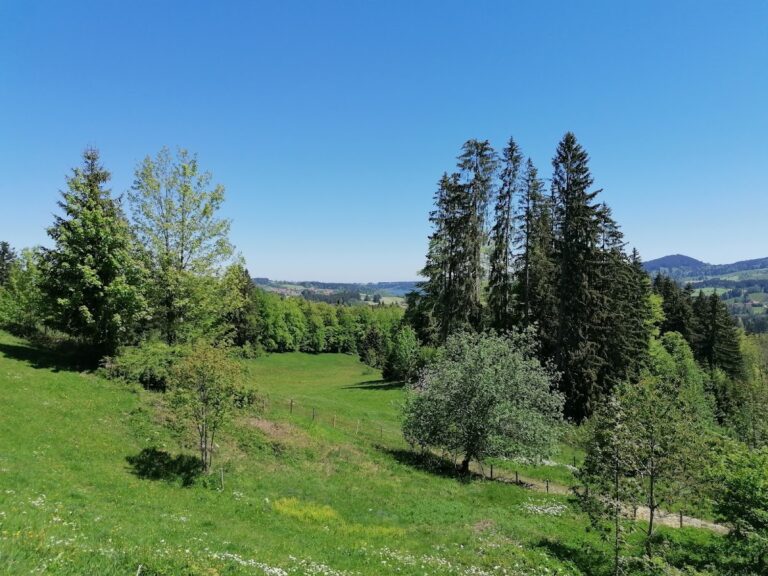
Burg Werdenstein stands on a sandstone hill at about 740 metres above sea level above the Iller Valley in Eckarts, within Immenstadt im Allgäu in the Oberallgäu district of Swabia. The former high-medieval to post-medieval complex was a hilltop castle built in sandstone. Most of it was removed in the early nineteenth century, leaving the gate structure and slight wall and foundation remains. The partially preserved gate tower and southern foundations were conserved and slightly raised with additional masonry during the final decades of the twentieth century.
Gate tower and entrance area
The surviving gate tower was formerly reached from the building yard by a bridge. The route along the castle hill belongs to a later phase. The tower is approximately six metres high and consists of sandstone and rounded-stone rubble. Conservation renewed its roof and added several courses of masonry. Larger, more regular stones form the quoins at the corners.
Four western loopholes pierce the tower’s two storeys. These gun ports were designed for hook guns, early firearms mounted or supported by a hook. On the outer, field-facing side they appear as horizontal slits, while inside the tower they run vertically. Several small, square openings set at an angle also pass through the masonry on the narrow sides.
Castle hill and surviving foundations
The highest point of the hill, on the north side, carried the bergfried, the principal defensive tower of a medieval German castle. Its southern wall was still standing around 1825. A 1985 survey identified only slight foundation traces in that area, within a fenced area.
The palas, the castle’s main residential and representative building, formerly stood on the southern side. The southern foundation remains belong to this part of the complex. Beneath the bergfried was a medieval castle chapel, and a small chapel was inaugurated at that location during the conservation work. The surviving tower, southern foundations, and reconstructed chapel form the principal visible remains of the former castle.
Former economic and building yard
The area in front of the castle formerly served as the economic and building yard. It now largely functions as the beer garden of the Burg-Café. The related Burgmühle, or Fleschermühle, stands to the north and carries one of the inscriptions associated with the site’s historical memory.