Burg Linau: A Medieval Motte Castle in Germany
Site at a Glance
- Rating
- 4.3
- Popularity
- Very Low
- Country
- Germany
- Primary era
- Medieval
- Eras represented
- Medieval
- Civilizations
- Holy Roman Empire
- Site type
- Military
- Remains
- Castle
On this page10 sections
History
Burg Linau is a medieval fortified castle in Germany, built by the Scharpenberg family toward the end of the thirteenth century. Linau was first mentioned in 1230, and the castle’s position allowed its occupants to watch the old Hamburg–Lübeck road and the travelers and merchants who used it. The Scharpenbergs were described as robber knights, nobles who used fortified bases for coercive raids against travelers and neighboring territories.
Conflict with the Scharpenbergs
In 1291, Wendish princes and towns, together with the dukes of Lauenburg, moved against Burg Linau in an effort to destroy the fortress and suppress the Scharpenbergs. Wendish referred to Slavic-speaking populations and political communities in the southern Baltic region during the medieval period. The Peace of Deitzow required the family to demolish the castle themselves, but they later rebuilt it and continued their activities.
A long-standing interpretation placed an earlier castle about 2 kilometres away at the Linau Oberteich. Excavations in 2018 instead identified a layer of fire at the present site, showing that the earlier castle there had been demolished. The Lübeck chronicler Detmar recorded that Burg Linau had been restored by 1308. In 1312, Count Gerhard II of Holstein-Plön attacked it with siege engines, but the castle resisted without suffering damage.
Regional campaigns and final destruction
In 1326, Count Johann the Mild of Holstein-Plön built Trittau Castle near the Holstein border and stationed a garrison there to counter the forces of Linau. Johann defeated them in a battle at Borstorf, capturing many prisoners and substantial booty, yet the Scharpenbergs continued their raids. An attack by Hamburg and Lübeck in 1338 also failed.
In 1344, the dukes of Saxony-Lauenburg, Erich I and his son Erich II, bought Burg Linau from the Scharpenberg brothers Heino and Lüdeke. The purchase removed the immediate threat posed by the castle, but the Scharpenbergs moved to Dartsingen, now in Amt Neuhaus on the Elbe, and continued their activities from there. They recaptured Linau in 1347.
A broader alliance formed against the castle in 1349. Its members were Counts Gerhard and Johann of Holstein-Plön, Adolf of Holstein-Pinneberg, Duke Erich of Lauenburg, and the cities of Lübeck and Hamburg. After a three-week siege, the well-provisioned Scharpenbergs surrendered on 23 September. Hamburg and Lübeck then sent 1,500 men to demolish the walls and tower, reducing the fortress to the ground. The Scharpenbergs nevertheless retained possession of the Linau lands after their defeat.
Clearance, excavation, and restoration in 2018 exposed the foundations of the tower and revealed a later brick kiln within them. These discoveries helped establish the location and sequence of the castle’s earlier and later phases.
Remains
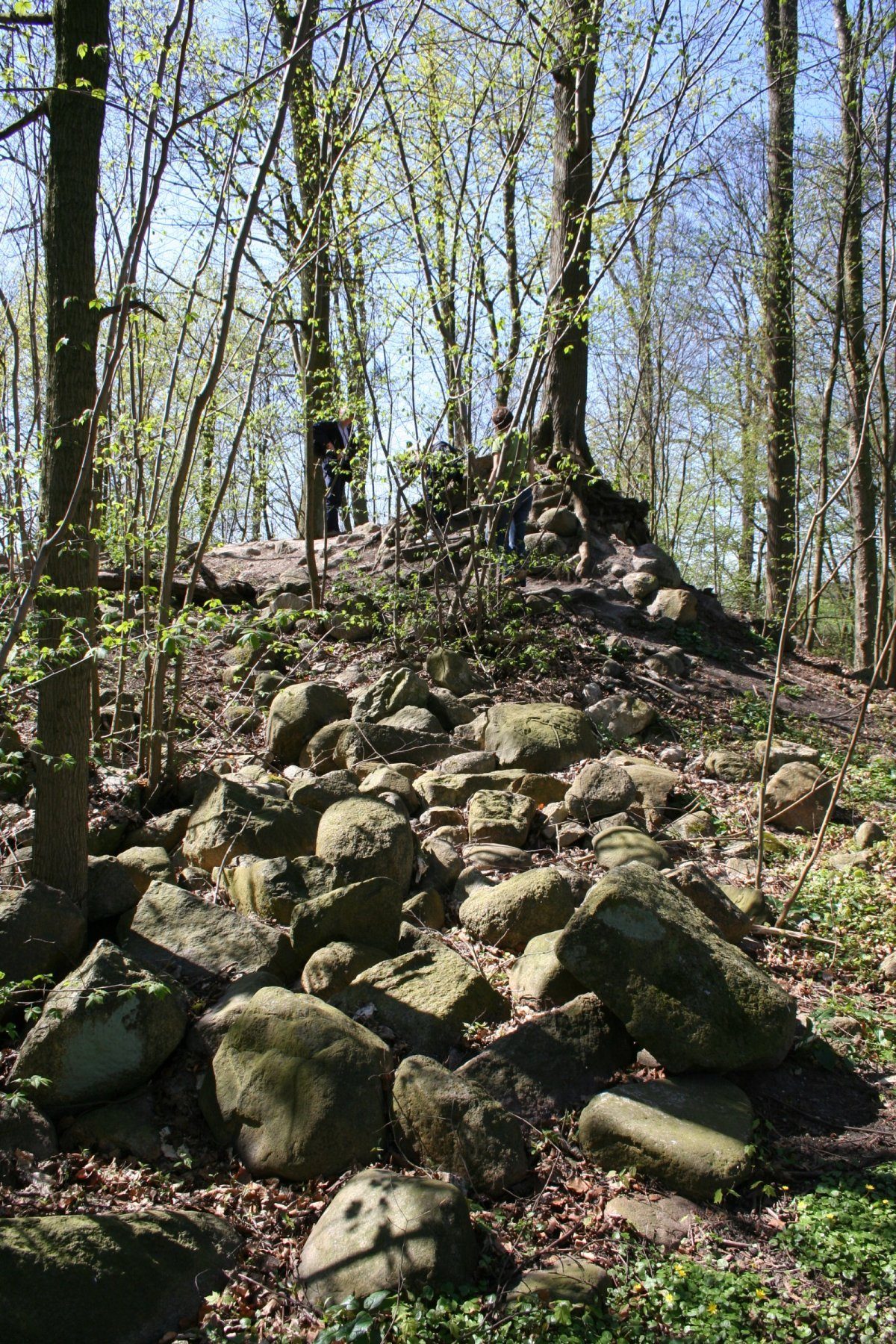
Burg Linau was a lowland motte castle, meaning a medieval fortified mound that carried a tower or small castle. Its remains extend across three modest hilltops arranged in a row within the present municipality of Linau. The castle site covered approximately 500 by 100 metres, excluding service buildings that stood farther away. Today it is a Burgstall, an archaeological castle site where the fortress itself has largely disappeared, with a tower mound and surviving wall remains.
Mound and water defenses
Castle mound
The principal castle stood on a rise approximately 3.5 metres high. This mound forms the central physical element of the surviving site and belongs to the lowland defensive layout. A portion of the moat remains visible around it, giving evidence of the water defenses that protected the castle.
Moat and the Bille
The moat was connected to the Bille, whose source lies nearby. This link tied the defensive ditch to the local water system and formed part of the castle’s setting in the lowland landscape.
Tower and masonry remains
Keep foundations
The surviving foundations belong to the keep, the castle’s principal fortified tower. Their walls are more than 2 metres thick and were constructed from unworked glacial erratic stones bonded with Segeberg lime. Excavation and clearance exposed these foundations in 2018, clarifying the position of the tower on the castle mound.
Wall remains and brick kiln
Sections of masonry survive alongside the tower foundations. The 2018 work also revealed a later brick kiln within the foundations, showing that the area was reused after the medieval fortress had been destroyed. The remaining masonry makes Burg Linau a modest surviving ruin among the former stone castles of Schleswig-Holstein. It is described, alongside the former territorial castle of Glambek on Fehmarn, as probably the only medieval stone castle in the region still preserved with masonry remains, while many noble motte castles from the eleventh to fifteenth centuries were built mainly of wood on earthen mounds.