Church in Breitenfelde: An Early Gothic Evangelical Lutheran Church in Germany

Site at a Glance
- Rating
- 4.3
- Popularity
- Very Low
- Country
- Germany
- Primary era
- Medieval
- External website
- Open
- Eras represented
- Medieval, Early Modern, Modern
- Civilizations
- Holy Roman Empire
- Site type
- Religious
- Remains
- Church
On this page12 sections
History
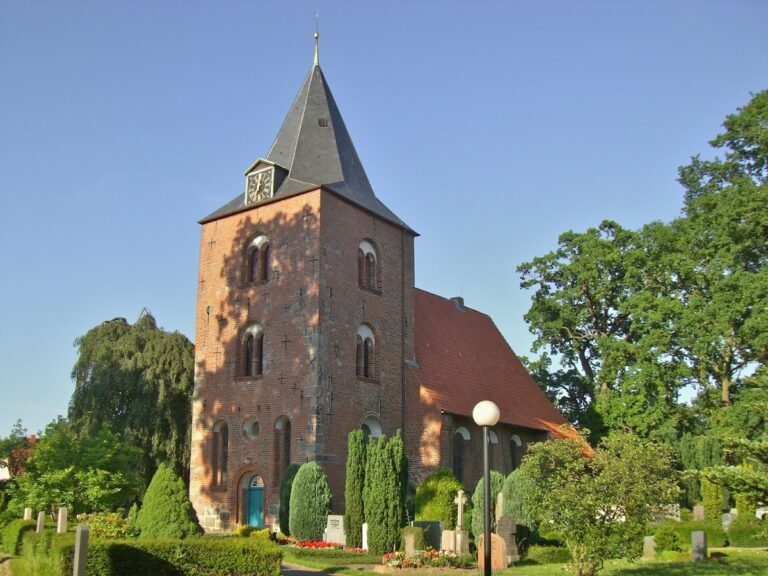
The Church in Breitenfelde is an Evangelical Lutheran church in Germany, with a medieval core dating from the beginning of the thirteenth century and built in the Early Gothic period. Breitenfelde was first mentioned in 1194 and was listed as a parish in the Ratzeburg tithe register in 1230, indicating that a church probably stood here by that time. The building is also associated with what is probably the oldest surviving medieval stained-glass window in Germany north of the Elbe.
Medieval parish and changing patronage
The church’s right of patronage, meaning the authority to appoint or supervise clergy and exercise related privileges, changed between the city of Lübeck and the Duchy of Lauenburg. Lübeck continued to assert claims to the Mölln appurtenances, including Breitenfelde, until it finally relinquished them in 1747. These changes concerned ecclesiastical and legal authority rather than the movement of the church itself.
Knowledge of the church’s history before 1685 is limited because the parsonage burned on 16 May of that year. Archival material kept there was destroyed in the fire, removing much of the earlier written record.
Nineteenth-century rebuilding
A major alteration and renovation campaign took place from 1866 to 1868 in the Neo-Gothic style. The work renewed the side windows, east gable, and entire roof structure, added a western extension and a 36-metre-high tower, and constructed the present sacristy on the south side of the choir. The former southern entrance was bricked up, and the main entrance was moved into the new western extension. Until this period, the west front had a stepped gable, while a separate wooden bell tower stood south of the church.
The interior was refitted in the same campaign. Two side galleries were installed, along with a very tall wooden retable, an altar structure placed behind the altar. The nave received a consistent Neo-Gothic interior, while older elements survived particularly in the arches of the choir vault.
The church received a new organ from Hans Hantelmann in 1717. During the nineteenth-century alterations, it was replaced by the present instrument built by Marcussen & Son. In 1913, four bells were still hanging in the church. Two had been recast in 1851 from older bells by Friedrich Wilhelm Hirt, the Lübeck council bell founder. The church now has three bells, including one dating from 1511.
Twentieth-century restoration
The interior was redesigned again in 1967 and 1968. The galleries were removed, and the tall former altar was replaced with a low, simply built masonry altar block. Floors, vaults, masonry joints, and window frames were restored as part of the work. The changes made the choir windows more visible and created a lighter, more spacious interior. The nave’s slate roof was completely re-covered in 2019.
Remains
The surviving medieval structure is an Early Gothic hall church, a type in which the aisles are nearly as high as the central space and form a unified interior. It consists of a rectangular box choir and a three-bay, three-aisled nave. Fieldstone and brick form the building fabric, with fieldstone dominating the wall surfaces and brick used for the portals and windows. Traces of an earlier sacristy remain on the north side of the choir.
Medieval choir and nave
Choir
The choir retains its original Early Gothic windows. Three windows form a stepped group in the east wall, while paired windows open in the side walls. Their materials show only limited repair. The choir gable contains a tracery rose, an ornamental framework dividing a Gothic window, and the eaves friezes are formed with zigzag patterns in glazed brick.
The central east window contains thirteenth-century stained glass and is an important work from the historic Lower Saxon-Westphalian sphere of influence. Its affinities include window series at Neukloster, in southern Lower Saxony, and on Gotland. The two flanking windows were reglazed by Carl Julius Milde during the 1867 alterations. He used geometric forms in adapted colors and made a matching replacement for the damaged lowest image in the central window.
The glass uses blue, red, green, yellow, and white, with very little tonal variation. More complex mixed colors appear in the section added by Milde. The imagery forms a Christ cycle, a sequence of scenes from the life of Christ, arranged from bottom to top as the Annunciation to Mary, the Nativity, the Crucifixion, the Resurrection, Christ as gardener, and the Ascension. Two heraldic shields in the Resurrection scene resemble the arms of the local noble families Schack and Ritzerow.
Nave
The nave’s four principal interior piers are made of brick. The two diagonally opposed pairs share the same design, and the older part of the church resembles the older section of St Mary’s Church in Büchen. All side windows were replaced in the modern period. Their construction shows large bricks bonding the openings into the fieldstone walls, with smaller bricks used in the reveals. Their width may have suited the High Gothic period from the outset, although the replacement of the reveals makes it impossible to establish whether they originally contained stone tracery.
The vault paintings preserve remnants of Early Gothic motifs together with some Late Gothic additions. The choir’s vault arches retain numerous older elements despite the later Neo-Gothic refitting of the nave.
Historic furnishings and fittings
Baptismal font
The baptismal font is carved from Gotland limestone, and its upper section dates from the fourteenth century. From the beginning of the nineteenth century until 1931, it stood outside the church’s liturgical setting and was used as a livestock watering trough. Its damaged foot was supplemented and repaired in 1968.
Bells
The church’s three bells include the bell cast in 1511. Decoration on the second bell incorporates three pilgrimage badges, small devotional signs associated with visits to pilgrimage centers. They represent the Holy Three Kings and Saint Ursula from Cologne, the Madonna from Büchen, and a Crucifixion group from Königslutter with a bust of Lothar III beneath it. Inscriptions connected with the 1511 bells state that one was cast in honor of the Holy Body and the Holy Trinity, named “Jesus,” intended to be rung on Fridays to signify the Passion, and cast by Peter Wulf. Another was made in honor of Saint Michael the Archangel.
Organ
The present organ has 17 stops distributed between two manuals and a pedal. Its Neo-Gothic case uses tracery forms in polygonal towers and a pointed-arch central field. The finials, or crowning ornaments, are topped with cross-flowers and crockets, small projecting Gothic leaf forms.