Castello Malvasia: A Renaissance Residential and Agricultural Castle in Italy


Site at a Glance
- Rating
- 4.6
- Popularity
- Low
- Country
- Italy
- Primary era
- Early Modern
- Eras represented
- Medieval, Early Modern
- Civilizations
- Holy Roman Empire
- Site type
- Domestic
- Remains
- Castle
On this page15 sections
History
Castello Malvasia is a sixteenth-century lowland castle in Panzano, Italy, built by the Malvasia family on the remains of a medieval settlement and reshaped in the Renaissance as a noble residence and agricultural estate. The family moved from Modena to Panzano in 1496 and became proprietors of the surrounding area.
The Malvasia transformation
The major reorganization of the castle began in 1599, after Monsignor Innocenzo Malvasia inherited the estate with his brothers Ercole and Giulio and acquired Giulio’s share in 1593. Innocenzo reshaped the landscape around the fortified complex by straightening the Canal Torbido, which then ran east of the walls. The mill was first moved inside the castle, beside the second courtyard, and was later transferred to the southern side of the complex.
Innocenzo was subsequently summoned to Rome for ecclesiastical duties. After 1600 he appeared at Panzano only occasionally and entrusted the remodelling to his sister Isabella. The residential wing was completed first, followed by a tower, probably the southern tower, which was finished in 1612. The essential structure was complete by 1609, although work continued until Innocenzo’s death in 1612.
Ercole Malvasia continued the project, concentrating on interior decoration and the chapel. He commissioned a portrait of Innocenzo for the chapel, linking the family’s religious identity with the building’s transformation. Ercole died in 1619, and his son, Marquess Cornelio Malvasia, completed the first major phase of the conversion.
Cornelio Malvasia and the observatory
Cornelio Malvasia was an artillery general in the service of the Este dynasty, the ruling house of the Duchy of Modena and Reggio. After the death of Alfonso IV d’Este, Cornelio settled permanently at Panzano. Around 1650 he established an astronomical observatory, a facility equipped for systematic observation of celestial objects, in the castle’s central tower.
The observatory attracted astronomers including Giovanni Domenico Cassini and Geminiano Montanari, who had previously been fellow students of Cornelio. Duke Francesco I d’Este, who shared an interest in astronomy, frequently visited Panzano to take part in the observatory’s activities and examine its instruments. In 1652 he witnessed the observation of a comet that appeared shortly before Christmas and was studied by Cornelio Malvasia and Corsini with specially constructed equipment.
Cornelio also commissioned a religious complex between the vegetable garden and the garden. It included a convent, church, sacristy, and cells for Capuchin friars, members of a reform branch of the Franciscan order known for strict communal religious life. Cornelio sometimes withdrew there for prayer and meditation.
An agricultural estate and eighteenth-century changes
The conversion changed the medieval fortified structure into a residential agricultural estate. The castle retained towers, battlements, and loopholes, but it increasingly functioned as a noble rural residence and productive farm complex. The Canal Torbido supplied water to a mill, oil mill, sawmill, fishpond, and paper mill. It also provided a transport route for agricultural products traveling to Bomporto and then to Venice.
Beginning in 1735, the seventeenth-century tower commissioned by Innocenzo was demolished. The facade was then remodelled, although the work was still unfinished in 1745. An eighteenth-century engraving preserved in Bologna’s Biblioteca Comunale dell’Archiginnasio shows the renewed southern entrance, the central observatory tower, and the northern tower before its later demolition.
Cesare Malvasia, of the Bolognese branch of the family, raised one wing of the main courtyard to create additional apartments. These included a large salon facing the garden and three finely decorated rooms. His son Giuseppe added a northern building that linked Cornelio’s small convent with the main courtyard and provided space for a stable, hayloft, and storage. The fishpond created in the sixteenth century was filled in in 1775.
During the second half of the eighteenth century, Senator Giuseppe Malvasia made limited use of the Panzano complex, which led to several leases. Among them were two summer leases to students of the Collegio San Carlo in Modena.
Inheritance, decline, and restoration
The death of Marc’Antonio Malvasia in 1867 ended the family’s presence at Panzano. Through Eleonora Malvasia’s marriage to Marquess Alessandro Frosini, a hereditary nobleman, the estate passed to the Frosini family. After slightly more than a decade it was sold to the Larco family of Genoa and later passed through Francesca Larco’s marriage to Marquess Giuseppe Negrotto.
Giuseppe Negrotto managed the agricultural estate and palace until 1909, commissioning the redecoration of the rooms in which he usually lived. In the summer of 1899, the central tower containing Cornelio Malvasia’s observatory suddenly collapsed under the weight of grain sacks stored inside it. The Negrotto family escaped because they had just passed beneath the tower on their way to morning Mass.
The property later passed from the Negrotto family to Cavalier Giovanni Lombardini and, in 1917, to Giovanni Orlandini. Orlandini’s long ownership was marked by serious neglect, and the palace also suffered substantial damage during the Second World War. The current ownership restored the internal courtyards to their characteristic appearance and carried out maintenance made necessary by the prolonged neglect. Castello Malvasia is recognized as Italian national heritage, and the restored historic building now houses the Collezione Righini, an extensive collection of antique automobiles.
Remains
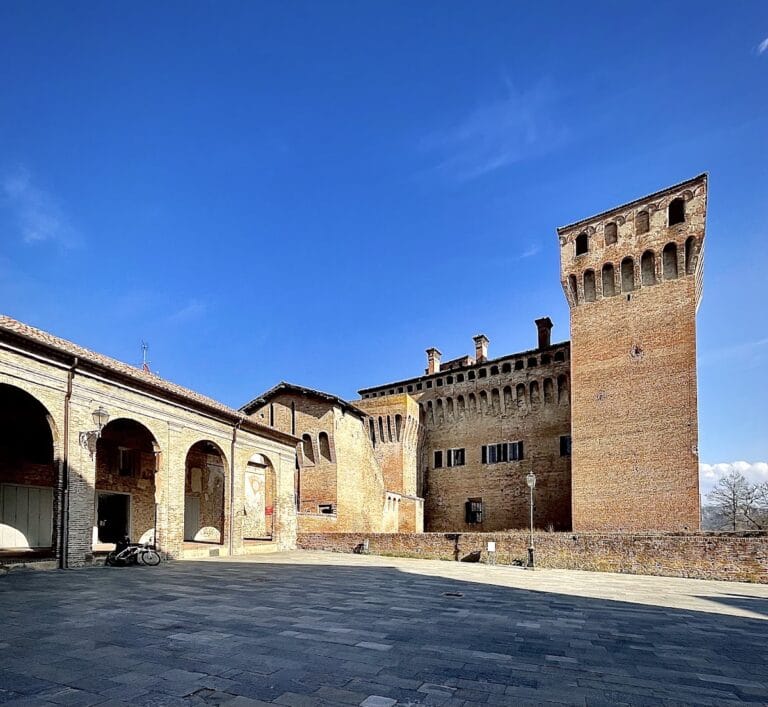
Castello Malvasia is a brick-built lowland complex in which medieval defensive fabric was adapted into a Renaissance residential and agricultural centre. Its surviving organization includes a main courtyard and internal courtyards, a residential wing beside the Canal Torbido, religious buildings, service areas, gardens, and the remains of a water-powered productive estate.
Defensive and residential structures
Walls, towers, and entrances
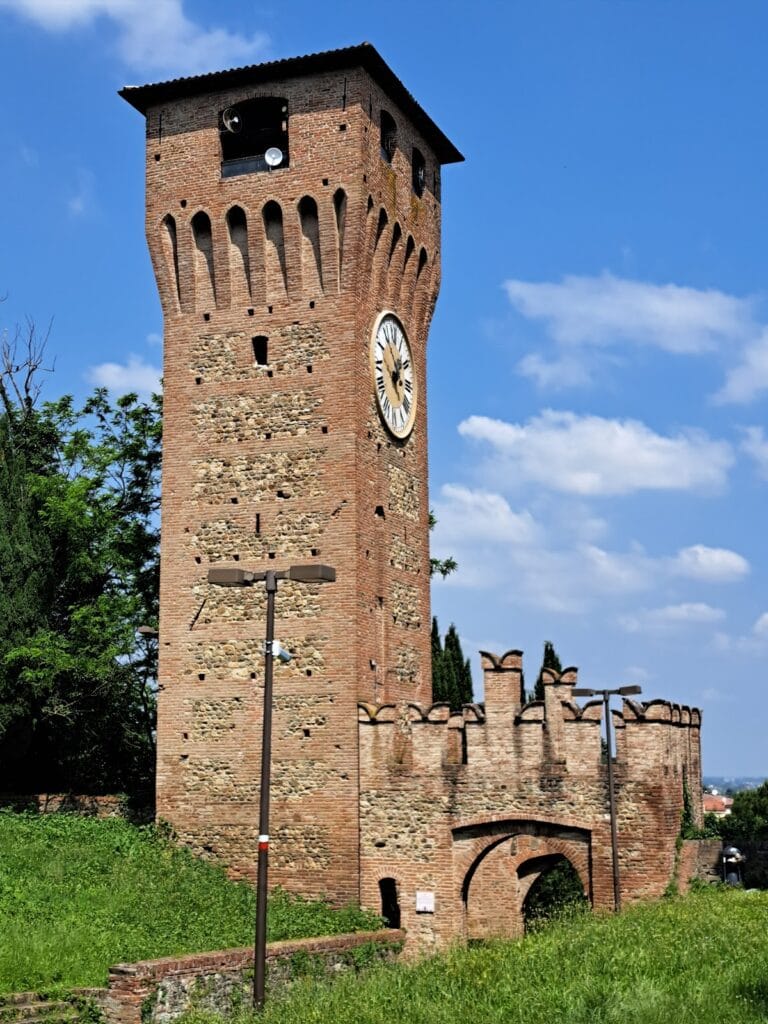
The castle retained defensive features from its medieval fabric, including towers, battlements, and loopholes. The southern entrance was remodelled in the eighteenth century. The central tower that housed Cornelio Malvasia’s observatory collapsed in 1899, while the tower commissioned by Innocenzo was demolished from 1735 onward. A northern tower shown in an eighteenth-century engraving was later demolished as well.
Courtyards and apartments
The main courtyard forms part of a group of internal courts around which the residential and agricultural functions were arranged. Cesare Malvasia raised one wing of the main courtyard to make additional apartments, including a large salon facing the garden and three finely decorated rooms. The salon beside the kitchen retains ceiling images with maritime subjects, including a lantern symbolizing Genoa, Giuseppe Negrotto’s city of origin.
Religious and agricultural areas
Chapel and Capuchin complex
The estate includes a chapel associated with the Malvasia family’s remodelling of the castle. Its interior contained the portrait of Innocenzo Malvasia commissioned by his brother Ercole. Between the vegetable garden and garden, Cornelio Malvasia established a complex with a convent, church, sacristy, and cells for Capuchin friars.
Service buildings and waterworks
The northern building added by Giuseppe connected the small convent to the main courtyard. Its uses included a stable, hayloft, and storage spaces. The Canal Torbido ran east of the walls after its course was straightened, and water from it served the mill, oil mill, sawmill, fishpond, and paper mill. The mill occupied more than one position, first beside the second courtyard and later on the southern side of the complex. The sixteenth-century fishpond was filled in in 1775.
Observatory and later collection
The central tower
The central tower once contained Cornelio Malvasia’s astronomical observatory. Its instruments supported observations by Cornelio and visiting astronomers, including Giovanni Domenico Cassini and Geminiano Montanari. The tower collapsed in 1899 after grain sacks stored inside placed excessive weight on the structure.
Collezione Righini
The restored historic building now contains the Collezione Righini, an extensive collection of antique automobiles described as among the world’s most important. The collection occupies a complex whose earlier residential, religious, defensive, and agricultural functions remain part of its architectural history.