Palazzo Comunale, Modena: The Historic City Hall
Site at a Glance
- Popularity
- Medium
- Country
- Italy
- Primary era
- Early Modern
- Eras represented
- Medieval, Early Modern, Modern
- Civilizations
- Holy Roman Empire, Italian
- Site type
- Civic
- Remains
- Town Hall
On this page18 sections
History
The Palazzo Comunale, Modena, is a civic complex in Italy that grew from buildings erected for city administration from 1046 onward. Baroque restructuring in the seventeenth and eighteenth centuries shaped its present form, and the building remains the seat of Modena’s municipal government. It forms part of the Cathedral, Civic Tower and Piazza Grande ensemble, recognized as a UNESCO World Heritage property in 1997.
Medieval origins and civic traditions
The complex developed as a place for both governing the city and representing its civic life. In the Middle Ages, the Preda Ringadora served as a platform for public speakers. It was also used for death sentences and for displaying bodies while they awaited identification.
A wooden bucket kept in the palace commemorates Modena’s victory over Bologna at the Battle of Zappolino in 1325. Tradition says Modenese residents took it from a well in Bologna and carried it home as a trophy. The story later inspired Alessandro Tassoni’s mock-heroic poem La secchia rapita, published in 1622.
The Bonissima statue was placed in Piazza Grande in 1268 and later moved above the palace portico at the corner of Via Castellaro. Local tradition links the figure to Bona, a noblewoman remembered for helping the poor. A more likely interpretation connects her with accurate measurement in trade. Modenese commercial measures associated with the statue are recorded from 1547 on the cathedral apse.
Renaissance and Baroque development
The civic tower was built in the sixteenth century to replace the thirteenth-century Arengario, a civic structure used for public assemblies and municipal government. The tower collapsed in an earthquake in 1671. The palace itself underwent major Baroque changes during the seventeenth and eighteenth centuries.
The building’s decoration conveyed ideas about civic identity and responsible government. Renaissance paintings in the Sala del Fuoco (Room of Fire) drew on ancient history to celebrate Modena’s past and civic virtues. The decoration of the Sala del Vecchio Consiglio (Old Council Room) likewise expressed attachment to the city and the value of good government. The Room of Fire also had a practical public role: residents could take embers from its fireplace to light household fires, and street traders received embers to help them through winter.
Eighteenth-century decoration in the Tapestry Hall celebrated municipal autonomy and authority. The palace’s civic meaning also extended beyond its rooms, linking its history to the public life of Piazza Grande.
Remains
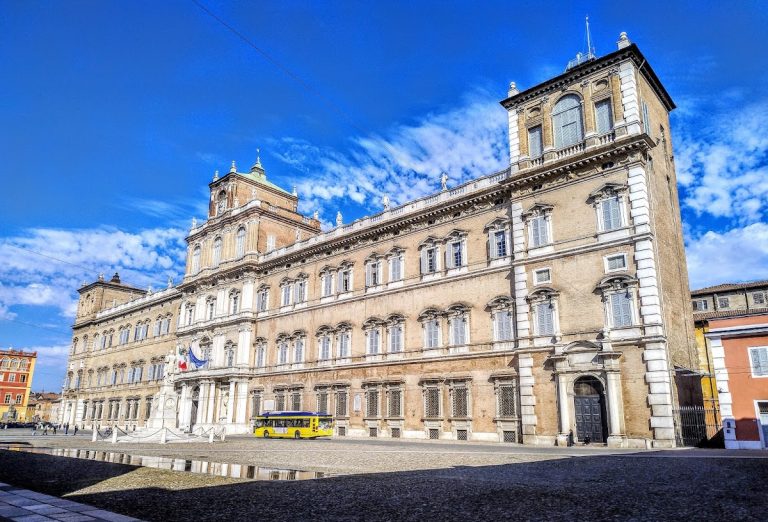
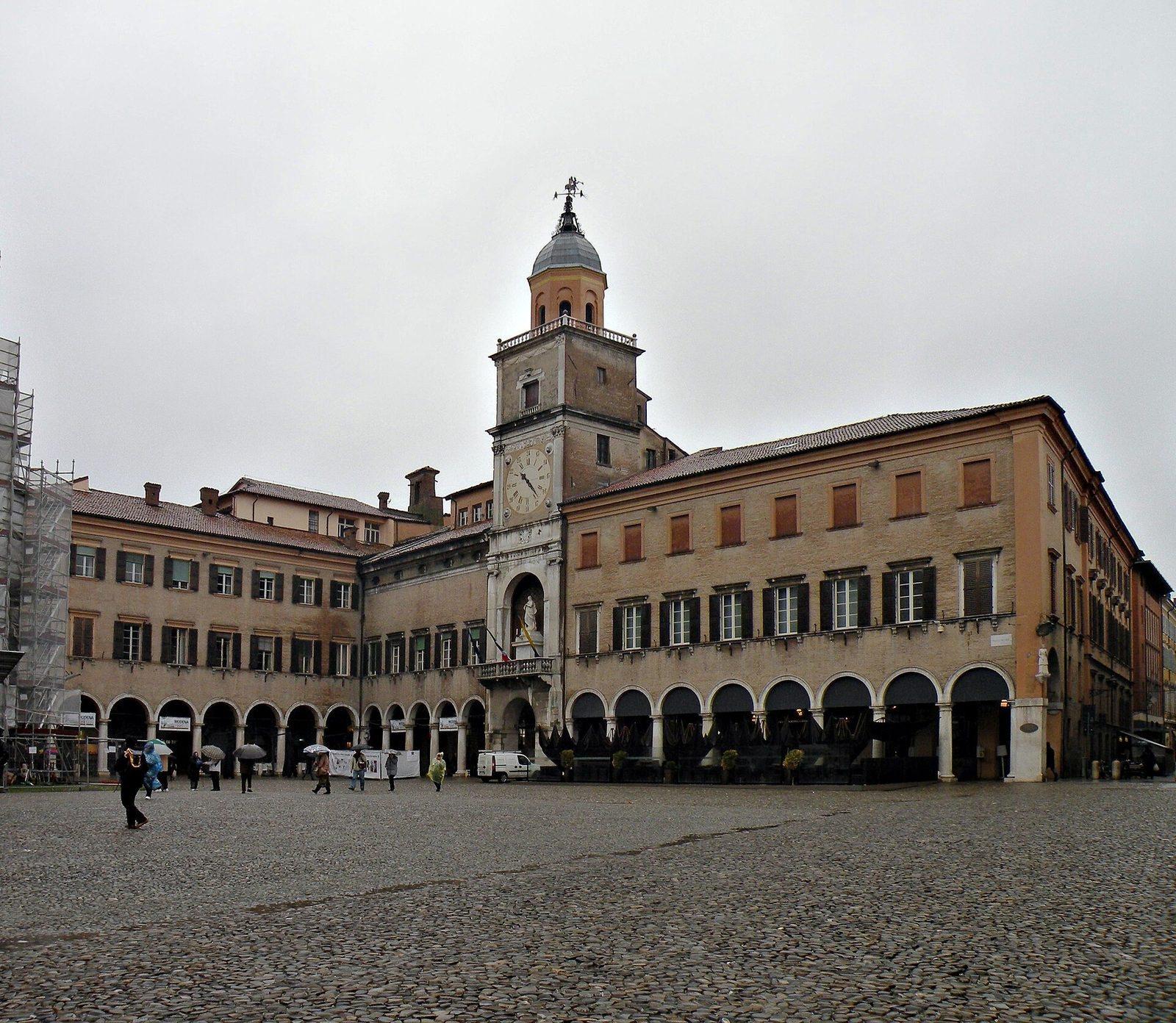
The palace’s porticoes define the eastern and northern sides of Piazza Grande, while its interior combines earlier fabric with later civic rooms and decoration. The main entrance lies beneath the portico; the first arch on the eastern side opens onto a grand staircase, a Renaissance gallery open along its sides, and the town hall beyond.
Exterior and earlier fabric
Porticoes and entrance
A corridor decorated with paintings by Modenese artists of the second half of the nineteenth century leads through the building. In the Sala della Torre Mozza, beside the elevator, a section of wall from an earlier city tower remains visible.
Earlier façade
In the north wing, the Sala delle Bifore contains part of an earlier medieval façade uncovered during later work. The room’s name uses the Italian term for paired window openings. The exposed façade stood several metres behind the later front of the building.
Civic clock tower
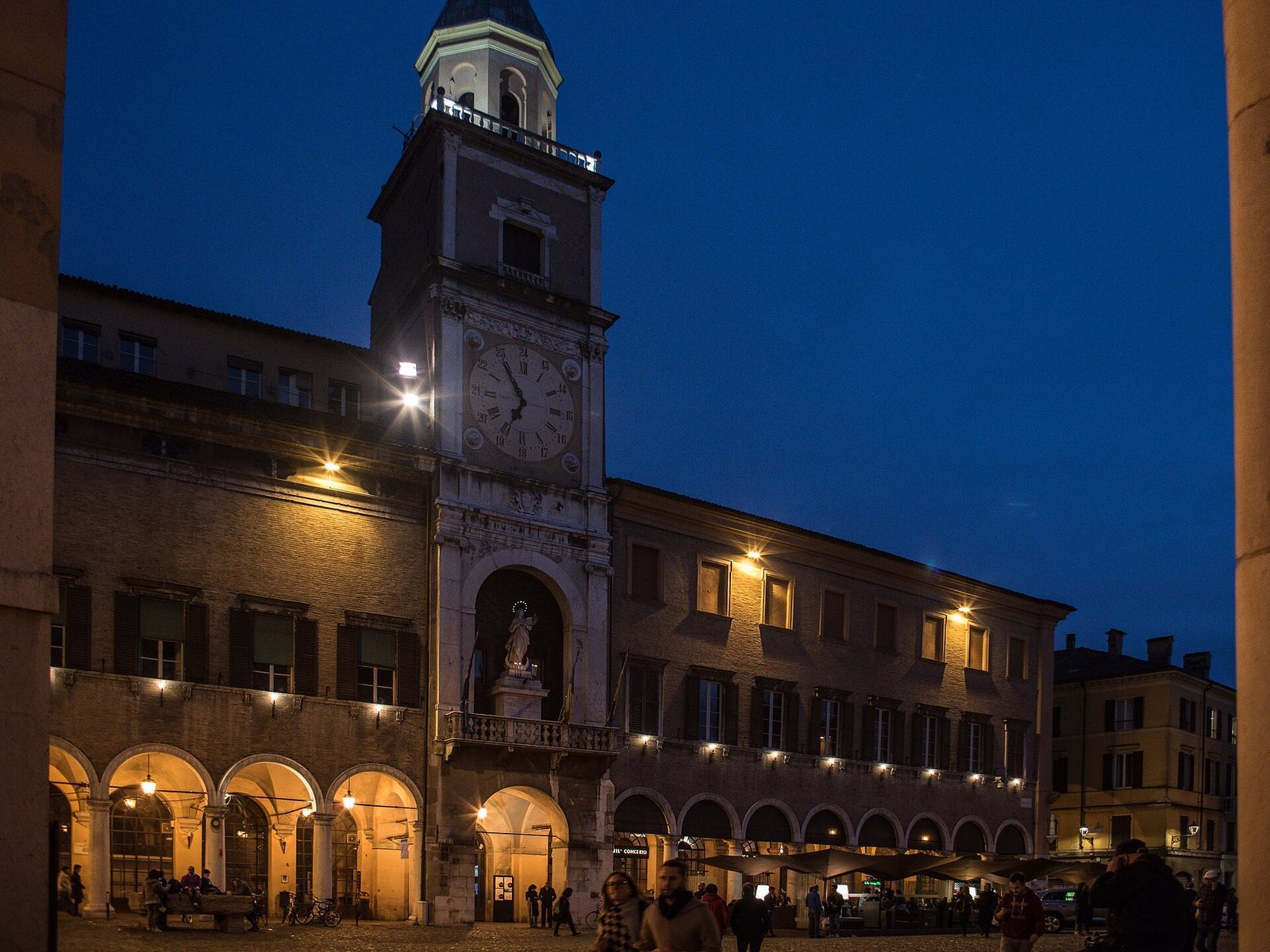
The clock was decorated with the arms of the House of Este, the ruling dynasty associated with Modena, by Francesco Bianchi Ferrari in 1480. Bartolomeo Bonascia added an octagonal domed top in 1508, and a balustrade was built around the square tower body in 1520. Ludovico Riva’s replacement clock was installed in 1730. In 1868, Louis Gavioli designed the two clock faces still on the building, one facing Piazza Grande and the other Piazzetta de Ova. They are less than 40 metres apart and share a mechanism.
Immaculate Conception balcony
The balcony’s marble balustrade dates to 1761, and a statue of the Virgin was placed there in 1805. A separate terracotta group showing the Virgin and Child with the young Saint John, made by Antonio Begarelli, is now held at the Museo Civico d’Arte di Modena.
Features of Piazza Grande
Preda Ringadora
A few metres from the portico stands the Preda Ringadora, a large rectangular block of marble. It probably came from an ancient Roman building.
Bonissima
The medieval female figure now stands above the portico at the corner of Via Castellaro. She may once have held a balance in her right hand, but the object is lost. Old Modenese commercial measures are engraved at the statue’s feet.
Interior rooms and decoration
Tapestry Hall
Eighteenth-century decorations cover three walls of the Tapestry Hall. Their scenes include the Treaty of Constance, the 1183 agreement between Emperor Frederick I and the Lombard League that recognized important self-government rights for northern Italian cities, and a mayor receiving homage from community leaders of the region.
Marriage Hall
The large Sala dei Matrimoni (Marriage Hall) is entered through a doorway from the former council room. Francesco Vaccari painted its vaulted ceiling in 1767, and works by Adeodato Malatesta (1806–1891) hang on its walls.
Camerino dei Confirmati
Between the Room of Fire and the Old Council Room, the Camerino dei Confirmati contains the wooden bucket known as the Secchia rapita.
Room of Fire
The Room of Fire retains its fireplace, coffered wooden ceiling and a painted frieze made by Nicolò dell’Abate in 1546. The paintings depict the siege of Modena in 44 BCE, with figures including Mark Antony, Brutus and Augustus, major participants in Rome’s transition from republic to empire. An Emilian landscape and views of Modena form the setting.
Old Council Room
Bartolomeo Schedoni and Nicolò dell’Abate decorated the ceiling in the early seventeenth century. Paintings by Francesco Vellani show miraculous episodes from the life of Geminian, Modena’s patron saint, traditionally identified as an early Christian bishop. The principal scene shows him kneeling before the Virgin of the Rosary. The room also contains dell’Abate’s Saint Francis and the Angel and Schedoni’s Saint John the Baptist with an Angel.