San Biagio, Modena: A Carmelite Church in Italy


Site at a Glance
- Rating
- 4.1
- Popularity
- Very Low
- Country
- Italy
- Primary era
- Early Modern
- External website
- Open
- Eras represented
- Medieval, Early Modern
- Civilizations
- Holy Roman Empire
- Site type
- Religious
- Remains
- Church
On this page14 sections
History
San Biagio, Modena, is a Roman Catholic church in Italy that originated in 1319 as a Carmelite foundation dedicated to the Virgin of Mount Carmel. The church stood in the Porta Saliceto area along the Via Emilia, within the parish of San Giovanni Evangelist, which depended on the Benedictine Abbey of San Pietro. Its later history brought repeated rebuilding and artistic enrichment, making the complex a record of religious and architectural change in Modena’s historic center.
The Carmelite foundation
The Carmelites, a Catholic religious order whose urban communities combined religious life with churches serving local populations, established their friary and church on land whose occupation was disputed by the Benedictines. The bishop settled the disagreement after the Carmelites compensated the landowners for several years. The church soon attracted popular devotion and private gifts, while prominent citizens selected it for burial. The physician Jacopino Cagnoli, for instance, requested in his will that he be buried beside the church.
Before 1495, successive campaigns enlarged the complex, improved its furnishings, arranged a crypt beneath the presbytery, relaid the floor, and completed work on the convent. In the opening decades of the sixteenth century, the church received a new bell tower, an altered presbytery, and enriched side chapels. The adjacent cloister was later enlarged according to designs by Pietro Barabani of Carpi and remodeled during the following century.
Consecration and seventeenth-century rebuilding
The church was solemnly consecrated on 31 August 1572 by Sisto Visdomini, bishop of Modena. Work continued after the ceremony. Repairs were made to the choir vault, whose condition threatened collapse, and the crypt beneath the presbytery was closed. A pipe organ was installed, the sacristy was rebuilt, and Girolamo Curti, known as Il Dentone, together with members of his school, decorated the ceilings with frescoes.
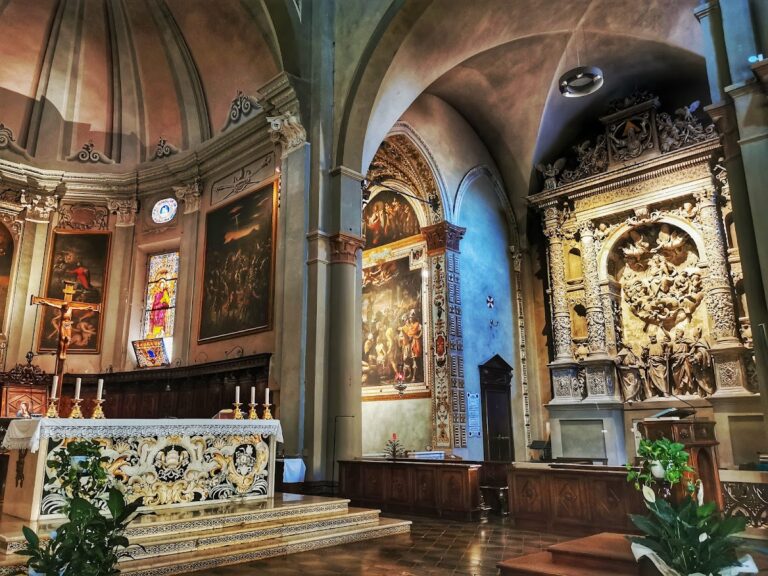
The principal rebuilding took place between 1649 and 1658 under Cristoforo Malagola, known as Galaverna. The apse was reconstructed, a dome was placed over the central space, the facade was modified, and the interior was given new decoration. During this campaign, Mattia Preti painted the apse basin with scenes including an angelic concert, Paradise with the Assumption of the Madonna, and the Evangelists. The finely carved wooden high altar followed in 1660, with the other altars made soon afterward.
Parish union, suppression, and modern restoration
The facade was restored about a century later as Modena’s Via Emilia was straightened. In 1768, the nearby parish church of San Biagio was demolished at the site now occupied by Palazzo Montecuccoli degli Erri. Its parish was joined to the Carmelite parish, which inherited the dedication and became known as San Biagio del Carmine, or San Biagio nel Carmine. San Biagio means Saint Blaise, a Christian bishop and martyr honored in Catholic tradition.
Toward the end of the eighteenth century, Duke Ercole III d’Este suppressed the Carmelite monastery and transferred the friars to Reggio Emilia, although the church remained in use. A major restoration followed around the middle of the nineteenth century, with further twentieth-century work affecting the altars and the right side of the building. The 2012 Emilia earthquake seriously damaged the church and led to its closure for structural consolidation. The work continued until 2023, when worship resumed. The church now belongs to the Archdiocese of Modena–Nonantola and to the Modena historic-center vicariate, a subdivision grouping local parishes. Its parish is united with that of the Tempio.
Remains
San Biagio stands on the Via Emilia in Modena’s historic center and is traditionally oriented toward the east. Its tall, narrow facade and exposed-brick right side face the urban space, while the remaining sides adjoin the former convent cloister and other buildings. The surviving complex combines a Neoclassical exterior with a single-nave interior, a richly decorated presbytery, and furnishings and artworks accumulated from the fourteenth century onward.
Exterior and church layout
The facade has a tall, narrow Neoclassical gabled composition. A porch with a triangular pediment frames the entrance portal, while a large window above it lights the nave. The composition ends in a broad Neoclassical pediment. Along the right side, large buttresses alternate with rectangular windows framed by curved elements. Blocked openings preserve traces of earlier arcades, while the exposed brick remains visible across the side wall.
Interior architecture
The interior consists of a single nave covered by a cross vault. Six altars on each side stand within large arches. The slightly raised presbytery is enclosed by columns and semipilasters, which support the richly frescoed dome. The high altar is a finely carved wooden work made in 1660. The other altars are made of wood or scagliola, a polished composite material designed to imitate colored stone or marble, except for the marble altar in the fifth bay on the left.
Cloister and sacristy
Cloister chapel
The church retains a fourteenth-century cloister adjoining the former convent. A chapel within it contains a fresco of the Madonna and Child by Tommaso da Modena.
Sacristy decoration
The sacristy contains walnut cupboards and ceiling paintings attributed to Girolamo Curti. Its central frescoes depict Elias and the Fiery Chariot. Painted architectural illusionism, known as quadratura, was supplied by Agostino Mitelli, while the figures were painted by Angelo Colonna.
Paintings and devotional furnishings
Nave altars and arches
Near the entrance, the first arch contains Luigi Manzini’s painting of Saints Lucia, Agatha, and Apollonia. The third arch holds a 1530 painting of Saint Albert fighting a female demon, attributed either to Dosso Dossi or Giovanni Gherardo delle Catene. The fifth arch contains Paolo Beroaldi’s canvas of Modena’s patron saints, with Saint Geminiano at the center and Saints Omobono and Contardo beside him. Another painting by Beroaldi shows Saints Michael and Anthony Abbot beneath God the Father.
The church also contains a painting of Saint Joseph with the Child Jesus and Saint Teresa attributed to Giambettino Cignaroli. A related canvas shows Saint Teresa kneeling before Saint Joseph and the Child Jesus; it is attributed either to Cignaroli or Cignani and came from the suppressed church of Santa Teresa delle Carmelite Scalze. A fourteenth-century painting depicts the Madonna and Child within a mandorla, an almond-shaped aureole, together with Saint Martin. Another Madonna and Child is attributed to Mattia Preti, although the altarpiece in the second chapel, dedicated to the Madonna of Mount Carmel, has also been assigned by some to Preti and by others to an earlier period.
Choir and side chapels
The choir contains Mattia Preti’s frescoes of an angelic concert, while the apse basin and choir decoration include the scenes created during the seventeenth-century artistic campaign. Other works include Giovanni Battista Codebò’s 1596 canvas of the Trinity and the Annunciation, Francesco Vellani’s painting of Saint John of the Cross near the confessional, and a sixteenth-century painting attributed to Raffaele Rinaldi that depicts Jesus and the Samaritan Woman on the right tribune.
The last chapel beside the entrance contains a baptismal font and Domenico Carnevali’s canvas of the Baptism of Christ. Agostino Mitelli and Angelo Colonna frescoed its walls. At the fourth altar stands a seventeenth-century Crucifix by Gregorio Rossi.
Pulpit, organ, and funerary monument
The pulpit and its marble reliefs date from the fourteenth and fifteenth centuries. To the right of the entrance is the funerary monument of Countess Anna Maria Seghizzi, who died in 1821. Giuseppe Pisani designed and sculpted the monument.
The organ to the left of the altar was built by Antonio Colonna in 1625 and refurbished by Antonio Traeri in 1772. In 1936, a modern organ was installed within the earlier frame, preserving the relationship between the later instrument and its historic setting.