San Pietro Church: A Benedictine Parish and Minor Basilica in Modena


Site at a Glance
- Rating
- 4.6
- Popularity
- Low
- Country
- Italy
- Primary era
- Early Modern
- Eras represented
- Medieval, Early Modern
- Civilizations
- Holy Roman Empire
- Site type
- Religious
- Remains
- Church
On this page16 sections
History
Early Christian traditions
San Pietro Church is a Roman Catholic parish and Benedictine monastic church in Modena, Italy, dedicated to the Apostle Peter. It belongs to the Archdiocese of Modena-Nonantola and holds the title of minor basilica, a special Catholic designation for a church of religious, historical, or pastoral importance that is not the seat of a bishop.
Local tradition places the church on the site of a Roman temple dedicated to Jupiter Capitolinus, supposedly dating to 270 BC. The same tradition says that Dionysius Areopagites of Athens and Bishop Eutropius began Christian preaching there in AD 93. According to this account, they formed Modena’s first Christian community and dedicated the former temple to Saint Peter. Another tradition relates that Saint Geminianus, Modena’s patron saint, prayed at the church during the fourth century after reaching it by an underground route.
The episcopal foundation and Benedictine monastery
The monastery originated as an episcopal foundation in 983. In 996, Bishop John established a Benedictine monastery beside the church. Benedictines follow the Rule of Saint Benedict, a monastic tradition governing communal religious life. In 1434, the monastery joined the Congregation of Santa Giustina, a Benedictine association later known as the Cassinese Congregation.
In 1188, the church and monastery became enclosed within the walls built around Modena. After a period of monastic decline, the unstable church required extensive rebuilding. Work took place between 1476 and 1518 and has been attributed to Pietro Barabani of Carpi. The principal parts were complete by 1506, and the church was consecrated in 1518.
Suppression, restoration, and continuing religious use
During the French invasion of 1796, in the Napoleonic period, the monastery was suppressed and part of its complex was converted into a cavalry barracks. The church remained open for worship and continued to be served by Benedictines. The monastery reopened during the restoration of the Duke of Modena, but it was closed again in 1866. Benedictines nevertheless continued to serve as the church’s parish priests.
After Giovanni Borcesi was elected prior, a major restoration campaign began in 1876. A prior is the superior of a monastery or religious house. The monastic community was re-established in 1911. The church and monastery continue to function as a parish and Benedictine complex, while the minor-basilica title reflects the church’s recognized religious importance.
The principal artistic and liturgical furnishings belong mainly to the fifteenth and sixteenth centuries. They include works by artists from Modena and elsewhere in Italy, among them Francesco Bianchi Ferrari, Ercole dell’Abate, Giacomo Cavedone, J. van Ghelde, Giovanni Battista Ingoni, Ludovico Lana, Pellegrino Munari, Girolamo Romanino, Carlo Ricci, Ercole Setti, Giovanni Taraschi, and Francesco da Verona.
Remains
Plan and exterior
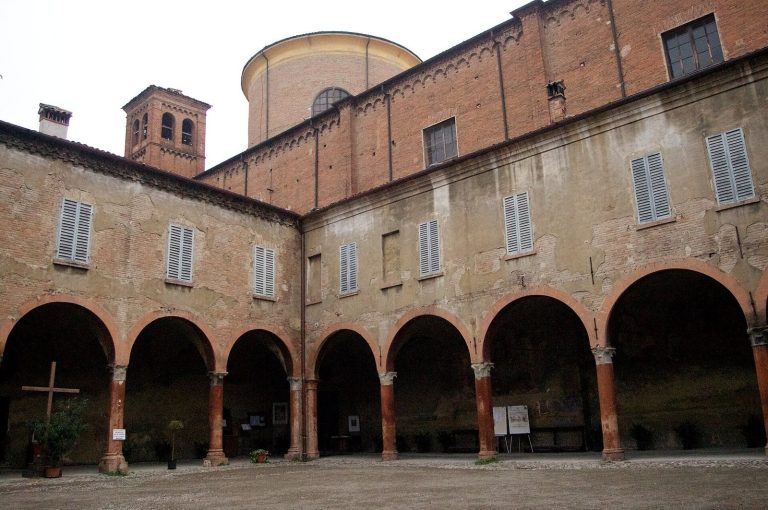
The complex occupies the southeastern part of Modena’s historic center on Via San Pietro and consists of the church with its attached Benedictine monastery. The church has a rectangular plan and five aisles. Four rows of supports divide the interior, using trilobed piers with terracotta capitals.
Terracotta facade
The facade is built in terracotta brickwork and has three lower sections with marble entrance portals. Its lateral wings correspond to the side aisles, while the upper order is divided into three parts aligned with the three principal aisles. A large central rose window is surmounted by a cusp. A horizontal terracotta frieze carries mythological and secular imagery, including hippocamps, creatures with the forepart of a horse and the hindquarters of a fish, and winged satyrs. The frieze was made by the Modenese brothers Andrea, Camillo, and Paolo Bisogni.
Cross and bell tower
Saint Peter’s Cross, a column standing in front of the church, dates from before the eleventh century. The bell tower dates from 1629.
Interior sculpture and painting
Aisle supports and transept altar
Six terracotta statues by Antonio Begarelli decorate the aisle supports. They represent Saint Francis, Saint Bonaventure, the Madonna and Child, Saint Justina, Saint Peter, and Saint Benedict. Begarelli, an Italian Renaissance sculptor known especially for terracotta work in the Modena region, also created the monumental altar dedicated to Saints Peter and Paul in the right transept, the crosswise arm of the church. Commonly called the Altar of the Statues, it has a tombstone in front commemorating Begarelli and the transfer of his remains there in 1875.
High altar and chapel paintings
Above the high altar, at the end of the central aisle, is a large pediment painted in 1866 by Ferdinando Manzini and Carlo Goldoni. It depicts the Delivery of the Keys to Saint Peter. The sixth chapel on the right contains an altarpiece by Giovanni Gherardo Dalle Catene showing the Madonna, Saint Luke, and Saint John the Evangelist. Other altarpieces are by Francesco Bianchi Ferrari, Ercole dell’Abate, Giacomo Cavedone, J. van Ghelde, Giovanni Battista Ingoni, Ludovico Lana, Pellegrino Munari, Girolamo Romanino, Carlo Ricci, Ercole Setti, Giovanni Taraschi, Francesco da Verona, and other artists.
Choir and sacristy
The wooden choir was carved by Gian Francesco Testi. The sacristy contains frescoes attributed to Girolamo da Vignola and engraved choir stalls dated 1548, made by Gianfrancesco da Cremona.
Treasury Room
The Treasury Room beside the monumental sacristy preserves numerous saintly relics. Among them are the head of Saint Caesarius of Terracina, the foot of Saint Mary Magdalene, and a bone fragment of Saint Benedict of Nursia.
The historic organ
Instrument and reconstruction
Gian Battista Facchetti built the pipe organ in 1524 and 1525. Facchetti was an Italian organ builder active during the Renaissance. The upper case decorations date from 1524 and are attributed to Giovanni Antonio Scaccieri of Parma. Their date appears on a painted cartouche at the lower right. Structural fragility had already damaged the painted decoration and distorted the instrument before the 2012 earthquake caused further harm. Only the facade pipes remained from Facchetti’s original instrument, while the sound-producing mechanism had been reconstructed in 1964 on the model of the earlier one, following a project by Luigi Ferdinando Tagliavini and Paolo Marenzi.
Painted galleries and shutters
In 1546, Giovanni Taraschi added painted decoration to the organ shutters, depicting two miracles of Saints Peter and Paul. He also decorated the gallery linking the organ with the monastery and the singers’ gallery, or cantoria. These works show Stories of David beneath the arches and the Transport of the Holy Ark along the balcony. Their pictorial culture is close to the Mantuan model associated with Giulio Romano and to Raphael’s designs for the Sistine Chapel tapestries, which were known through prints and engravings.
Following the earthquake damage, the organ was restored under the supervision of the relevant archaeological, fine-arts, and landscape authority. The intervention forms part of the continuing preservation of the church’s historic furnishings and artistic fabric.