Bronllys Castle: A Medieval Motte-and-Bailey Fortress in Wales


Site at a Glance
- Rating
- 4.4
- Popularity
- Low
- Country
- United Kingdom
- Primary era
- Medieval
- External website
- Open
- Eras represented
- Medieval
- Civilizations
- Norman
- Site type
- Military
- Remains
- Castle
On this page7 sections
History
Bronllys Castle is a ruined motte-and-bailey fortress in the United Kingdom, at Bronllys in Powys, Wales. Founded by the Norman lord Richard Fitz Pons in or soon after 1100, it formed part of the Norman conquest of Brycheiniog, the Welsh kingdom later known as Brecknock. The first fortress was built of wood and stood within a raised earthwork and defended enclosure, the characteristic arrangement of a motte-and-bailey castle.
Foundation and stone rebuilding
Richard Fitz Pons owned the nearby Herefordshire barony of Clifford and supported Bernard of Neufmarché, a Norman lord associated with the conquest of Brycheiniog. In 1144, Roger Fitzmiles, Earl of Hereford, detached the land around Bronllys from the Lordship of Brecknock, a medieval territorial lordship in central Wales, and granted it to Richard’s son, Walter de Clifford.
Walter rebuilt Bronllys in stone in 1144 or shortly afterward. The work included a round tower on the motte and replaced the earlier timber defenses with rubble masonry. In 1165, the tower caught fire. During the incident, a stone fell from its battlements and killed Mahel de Hereford, Roger Fitzmiles’s last surviving brother. Gerald of Wales, a twelfth-century cleric and writer on Welsh history and ecclesiastical affairs, wrote that Mahel repented while dying of his earlier persecution of the Bishop of St Davids and believed the accident was punishment for it.
Inheritance and thirteenth-century conflict
Roger Fitzmiles and his brothers died without children, so Brecknock first passed to their sister’s husband, Philip de Braose, and later to Eleanor de Braose and her husband, Humphrey de Bohun. Bronllys itself remained connected to the Clifford inheritance. In September 1233, Walter de Clifford, the grandson of Walter who had rebuilt the castle, defended it with more than 200 men against his father-in-law, Llywelyn ab Iorwerth, commonly known as Llywelyn the Great, the leading Welsh prince of early thirteenth-century Gwynedd.
Walter died in 1263 without a son. His daughter Maud married John Giffard and inherited the lands, which were later divided between their two daughters. Bronllys passed to the younger Maud. When she died in 1311, Edward II granted the castle to Rhys ap Hywel, a local descendant of the former kings of Brycheiniog, as a reward for loyalty to the Crown.
Royal confiscation and later medieval ownership
Rhys later rebelled against the actions of Edward II’s favourite, and the king confiscated Bronllys. Rhys subsequently helped to depose Edward and joined the party that captured him, after which he regained the castle. Bronllys then passed to his son, Philip ap Rhys.
Although Philip’s brother Einion Sais was a prominent military supporter of Edward III, the king transferred Bronllys to Humphrey de Bohun, Lord of Brecknock. The decision followed the argument that the castle should be held by a powerful magnate rather than by Philip. It was later inherited by Humphrey de Bohun’s nephew, also named Humphrey de Bohun.
When the younger Humphrey died in 1373 leaving only daughters, his widow initially retained the land. His titles and authority entered abeyance, meaning that they were left without a settled holder, and became contested by the Duke of Gloucester, husband of the elder daughter Eleanor, and Henry Bolingbroke, husband of Mary de Bohun. After deposing Richard II in 1399, Henry ended the dispute in Mary’s favour and effectively acquired the lands through his marriage.
Decline and Crown ownership
After Richard II’s deposition and death, the Glyndŵr Rising began in Wales in 1400. Led by Owain Glyndŵr, a Welsh nobleman who headed a major revolt against English rule, the uprising prompted the fortification of Bronllys against his forces. The castle was never occupied again.
Anne of Gloucester, the daughter of Mary de Bohun’s elder sister Eleanor, petitioned Henry for the return of her grandfather’s lands. Her son and heir, Humphrey Stafford, inherited the earldom of Buckingham and was later made a duke for his loyalty to the heirs of Henry Bolingbroke, who had become Henry IV. Humphrey’s grandson, Edward Stafford, 3rd Duke of Buckingham, was executed for treason in 1521 after being suspected of plotting against Henry VIII. Bronllys was then forfeited to the Crown and has remained Crown property.
John Leland inspected the castle in 1521, the year it became Crown property, and found it already in great disrepair. Its condition had deteriorated substantially further by 1583. During the twentieth century, Cadw, the Welsh government body responsible for caring for and protecting historic monuments, assumed guardianship and maintenance. Ownership remains vested in the owners of the adjoining Bronllys Castle House. Since 2024, Cadw has used the Welsh name Castell Bronllys in English as part of an effort to standardize the castle’s names in both languages.
Remains
Motte and round tower
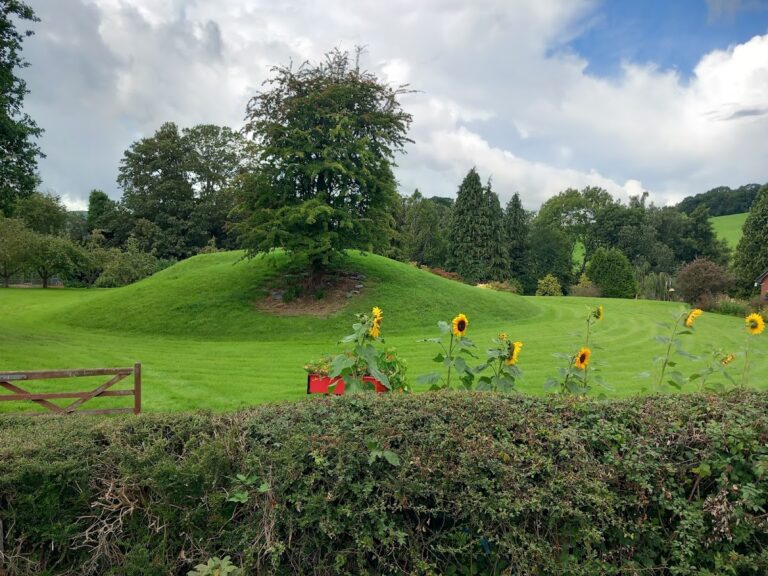
Bronllys survives as a lowland motte castle, meaning a motte castle situated in relatively low-lying terrain rather than on a high mountain or hilltop. The site lies in a valley at approximately 124 to 125 metres above sea level, south of Bronllys toward Talgarth. The motte stands beside the road leading toward Talgarth and supports the ruins of the round stone tower.
The earliest defenses were timber, but the castle was rebuilt in stone in 1144 or shortly afterward using rubble masonry. The round tower was probably constructed by Walter de Clifford on the motte. Its battlements were involved in the fatal accident of 1165, when a falling stone killed Mahel de Hereford. The surviving remains therefore consist chiefly of the earthwork motte and the ruined round tower, preserving the central physical elements of the medieval fortress.
Nearby sites