Brecon Castle: A Norman Fortress and Administrative Centre in Wales



Site at a Glance
- Rating
- 4.1
- Popularity
- Low
- Country
- United Kingdom
- Primary era
- Medieval
- External website
- Open
- Eras represented
- Medieval
- Civilizations
- Norman
- Site type
- Military
- Remains
- Castle
On this page13 sections
History
Brecon Castle is a Norman fortress in the United Kingdom, located in Brecon, Wales. Bernard de Neufmarché established it around 1093 after conquering the Welsh kingdom of Brycheiniog, making the castle a base for securing his authority and governing the surrounding territory.
Norman foundation and lordship
Bernard’s victory at the Battle of Brecon, fought around Easter 1093, led to his becoming Lord of Brecon. He founded the castle as a motte-and-bailey fortress, combining a raised mound with a defended enclosure, beside a ford at the meeting point of the River Usk and the River Honddu. The location offered protection, access to water power for mills, and control of an important administrative centre that later became associated with Brecknockshire.
After Bernard’s death, his daughter Sibyl inherited the lordship through her marriage to Miles de Gloucester. Their family connection brought the castle to William de Braose in 1166, when he acquired it through his marriage to one of their daughters. After William rebelled against King John, the English Crown seized Brecon Castle around 1207 or 1208.
Welsh attacks and the Bohun inheritance
Giles de Braose recovered the castle in 1215 with the help of Llywelyn ap Iorwerth, also known as Llywelyn the Great, a powerful thirteenth-century Welsh prince. This occurred during the First Barons’ War, a rebellion by English barons against King John between 1215 and 1217.
The castle remained exposed to repeated Welsh attacks. Llywelyn ap Iorwerth destroyed it in 1231, and further attacks or captures followed in 1233, 1264, 1265, 1273, and 1403. Llywelyn ap Gruffydd, his grandson and the last native Welsh prince to hold the title Prince of Wales before Edward I’s conquest, captured it in 1264. Prince Edward, the future King Edward I, took it in 1265. The attacks of 1273 and 1403 inflicted serious damage.
William de Braose was executed by Llywelyn ap Iorwerth in 1230, after which his lands were divided among his daughters. Brecon passed to Eleanor, who married Humphrey V de Bohun after 1241, bringing the castle into the Bohun family. During the 1260s, Humphrey V and his son joined the baronial conflict against Henry III. The Bohuns retained Brecon until 1372 or 1373, when the death of Humphrey de Bohun, 7th Earl of Hereford, without a male heir caused the castle to revert to the Crown.
Stafford control and decline
The Crown later granted Brecon to the Stafford family. Henry Stafford, 2nd Duke of Buckingham, withdrew to the castle in 1483 after losing royal favor and plotted there with John Morton, Bishop of Ely, against Richard III. The conspiracy failed. Henry Stafford was captured and executed, while Morton escaped to Henry Tudor, who defeated Richard III and became King Henry VII.
Edward Stafford, 3rd Duke of Buckingham, was born at Brecon Castle in 1477. Henry VIII executed him for treason in 1521, and his estates were forfeited to the Crown after his posthumous attainder in 1523. The castle then entered a prolonged decline.
Destruction, reuse, and protection
During the English Civil War, the conflict between Parliament and the supporters of Charles I from 1642 to 1651, the people of Brecon dismantled the castle’s fortifications to prevent the town from becoming involved in the fighting. Rowland Laugharne, a military commander serving Parliament, besieged the castle for the last time in 1645.
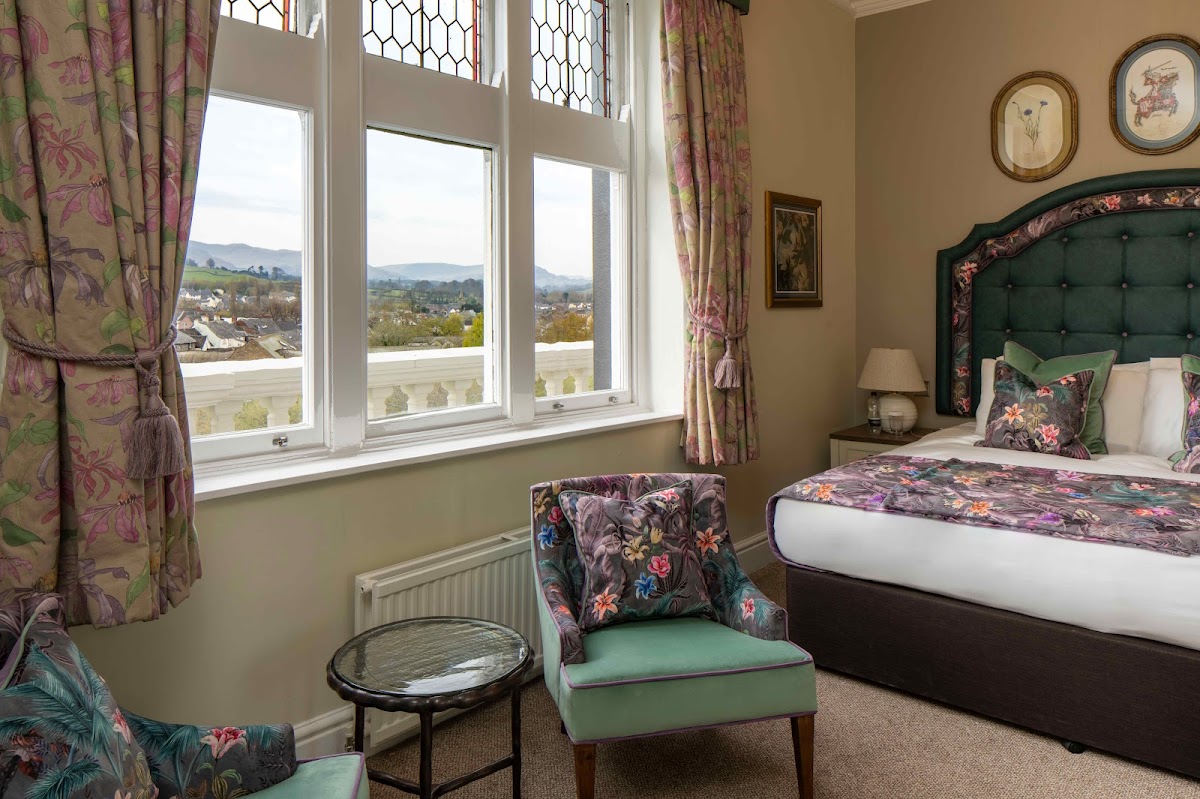
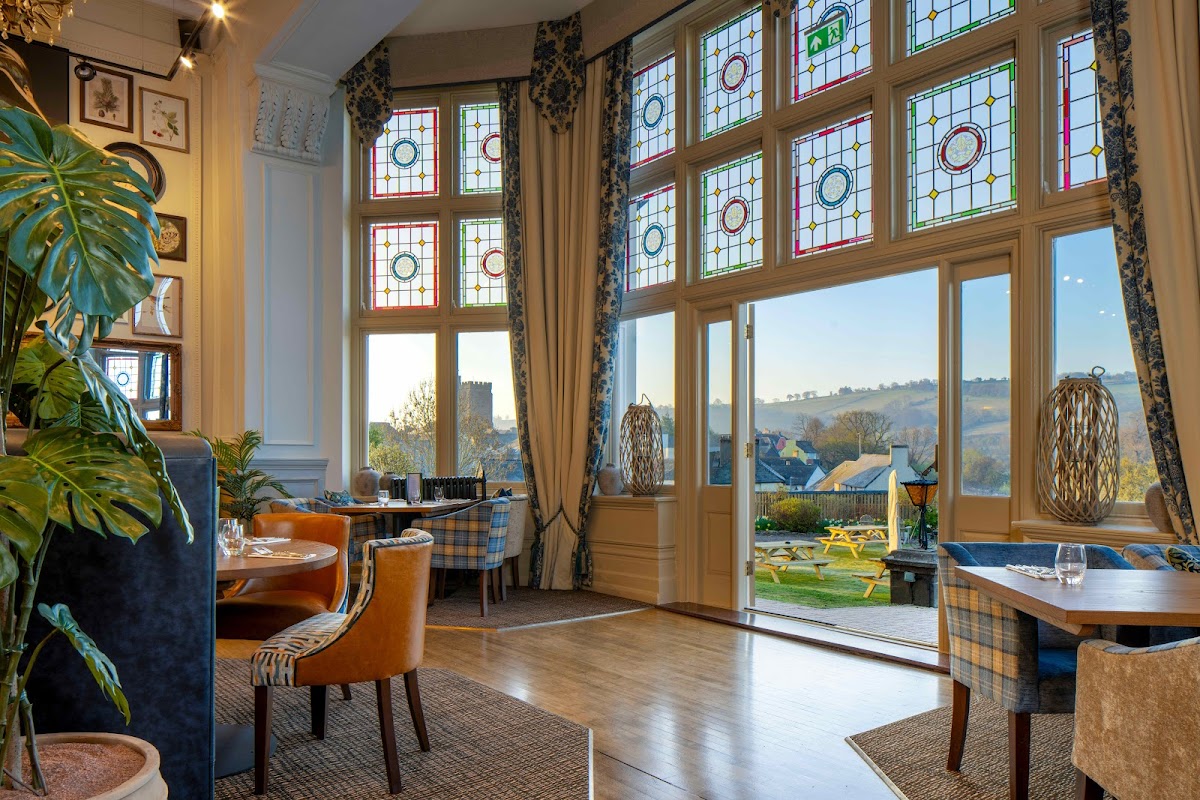
By the end of the Georgian period, Brecon Castle was largely ruinous. Sir Charles Morgan of Tredegar House began renovations in 1809, and the former castle site was converted into a hotel. The hotel still occupies part of the site. The ruins are protected as a Grade I listed building and a Scheduled Monument, while the remains of the Great Hall are separately recorded under the official name “Remains of the Great Hall of Brecon Castle.”
Remains
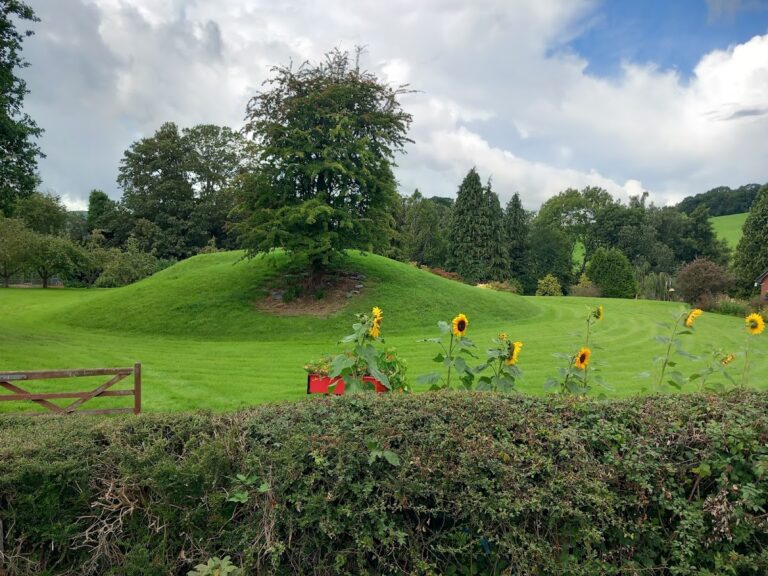
Brecon Castle occupies a hill above the confluence of the River Usk and the River Honddu in the centre of Brecon. The wider site lies within a valley. Its surviving layout includes earthworks, the castle mound, remnants of medieval stone defenses, and structures incorporated into the Castle Hotel. The former motte now lies within the Bishop’s Palace garden of Swansea and Brecon, while the outer bailey extends southward in a triangular plan.
The mound and early fortress
Bernard de Neufmarché’s original castle combined a raised motte with an enclosed bailey. It was built in wood and stone, with stone taken from the Roman town of Caer Badden. The earthworks and castle mound remain part of the surviving archaeological core, preserving the form of the early Norman stronghold.
Stone defenses
Shell keep
A stone shell keep, a walled enclosure built on a castle mound, was constructed toward the end of the twelfth century. It formed the later stone core of the fortress and survives in a fragmentary state among the earthworks and other medieval defenses.
Ely Tower
The ivy-covered Ely Tower is one of the most recognizable surviving structures. Its name comes from the tradition that John Morton, Bishop of Ely, was held prisoner there after taking part in Henry Stafford’s conspiracy against Richard III.
Bailey wall and towers
A stone wall enclosing the bailey was built in 1233. The site also retains a round tower from the thirteenth century and a semi-octagonal tower from the early fourteenth century, representing later stages in the strengthening of the castle’s defenses.
Hall and residential buildings
A hall block was added around 1300. Its surviving residential-hall remains are incorporated into the Castle Hotel, together with a two-storey wall containing four pointed lancet windows. An adjoining tower dating from the fourteenth century forms part of this surviving group of medieval structures.
Outer bailey and later building
The outer bailey lies south of the castle mound and has a triangular plan. Since 1809, the Castle Hotel has occupied this part of the former castle site, incorporating the surviving medieval structures into the later building and preserving elements of the castle within its present form.