Gregans Castle: A Medieval Tower House and Georgian Country House in Ireland


Site at a Glance
- Rating
- 4.7
- Popularity
- Low
- Country
- Ireland
- Primary era
- Early Modern
- External website
- Open
- Eras represented
- Medieval, Early Modern, Modern
- Civilizations
- British, Irish
- Site type
- Domestic
- Remains
- Manor House
On this page11 sections
History
Gregans Castle in Ireland comprises a 15th- or 16th-century medieval tower house and a later Georgian country house near Ballyvaughan in County Clare. The tower house was the seat of the O’Lochlainn, or O’Loughlen, family, whose chief was known as the “Prince of Burren.” The Georgian residence, built about 1750 and enlarged in the 19th century, forms the later phase of the estate’s development.
The O’Loughlen estate
Until the end of the 16th century, the surrounding district was known as the Barony of Gragans. The name probably came from an Irish word meaning mountain bog, a reference suited to the hanging bogs that still occur on the hills west of the castle. Gregans stood within the Burren, a karst region of County Clare marked by limestone landscapes and a dense concentration of archaeological and historical remains.
Owney More O’Loughlen owned Gregans in 1641, when an Irish uprising began. Following the Cromwellian Settlement after 1654, a redistribution of land under Oliver Cromwell’s regime that dispossessed many Catholic and Gaelic landholders, Owney was deprived of the property. The land and castle were then granted to the Martyn family.
The Martyn succession and Georgian expansion
The relationship between the O’Loughlen and Martyn families is not entirely clear. Turlough O’Loughlen married Alice Martyn in 1632. She was the daughter of George Martyn, Mayor of Galway in 1632–1633, and their son George Oge used the Martyn surname and received the lands. A genealogy by Martin J. Blake instead identifies George Oge as George Martyn’s eldest son.
The Martyns apparently built another fortified structure beside the older tower house and stopped using the tower as their residence. They later moved into a two-storey house on the site of the present hotel. The Georgian country house dates from about 1750 and was associated with both the Martyn and O’Lochlainn families.
A member of the Martyn family was killed at the Battle of Aughrim in 1691, a decisive engagement in the Jacobite wars, which were conflicts over the restoration of James II and his heirs. Later Martyns became prominent lawyers and lived mainly in Dublin. Gregans remained a summer residence, while most of its approximately 2,000 acres, or 8.1 square kilometres, were leased.
The estate in the nineteenth and twentieth centuries
In 1866, Captain John Gregory Martyn J.P., meaning Justice of the Peace, moved permanently to Gregans after entering a highly profitable marriage. He supported Charles Stewart Parnell and the Home Rule movement, which sought an Irish parliament and substantial domestic autonomy within the United Kingdom. During this period, the country house was considerably enlarged.
After John Gregory Martyn’s death, his son Francis Florence Martyn remained at Gregans and farmed a much-reduced estate. Economic depression contributed to the deterioration of the house. Francis, who was unmarried and regarded locally as eccentric, died in 1956. During the 1940s he had unsuccessfully tried to operate an inn and had obtained a bar licence.
Francis’s housekeeper, Miss Crowe, continued to live in the house after his death. The estate’s trustees eventually sold the property for conversion into a hotel, and the house opened as the Gregans Castle Hotel in 1967. The Georgian residence continues in that use, while the tower house was restored from its ruinous condition and is identified as a private residence, although its restoration remains partial.
Remains
The castle buildings
The medieval tower house
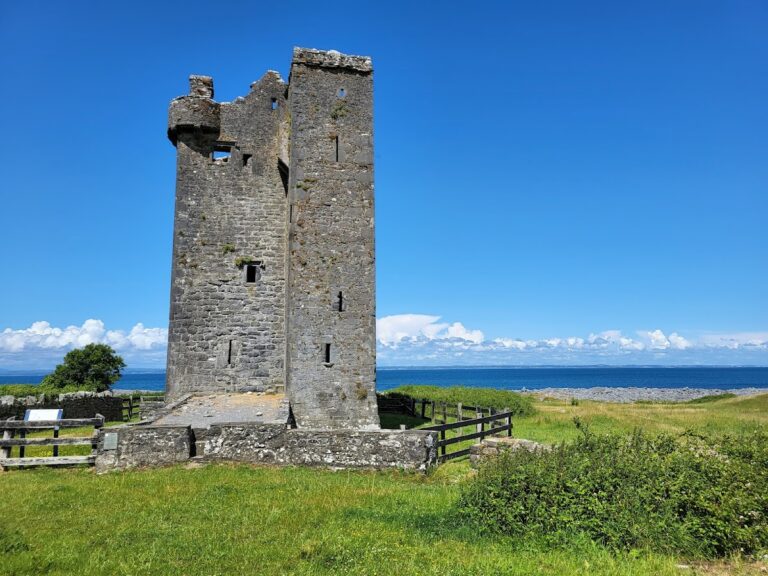
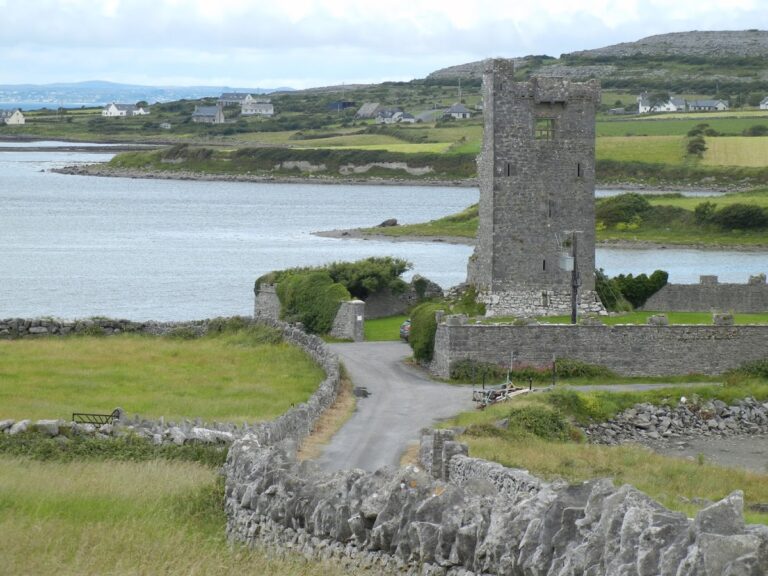
The medieval tower house stands across the road from, or opposite, the modern hotel. Dated to the 15th or 16th century, it was built as a fortified stone residence, with defensive and domestic rooms arranged vertically. After the Martyns constructed another fortified structure nearby, the tower ceased to serve as their dwelling. Its ruinous fabric was later partly restored, and the building is now identified as a private residence.
The Georgian country house
The Georgian country house is a two-storey building dating from about 1750. Its formal proportions and classical character belong to the Georgian period, the architectural era associated in Britain and Ireland with the Hanoverian kings George I through George IV. The house was substantially extended during the 19th century, particularly around 1866, and now accommodates the hotel.
The oldest surviving feature of the country house is its former kitchen fireplace. Its keystone bears the Martyn crest, and the fireplace is located in the room now called the Martyn Suite. The feature preserves a direct physical connection between the later residence and the family that occupied and enlarged the estate.
The Burren setting
Limestone terraces and vegetation
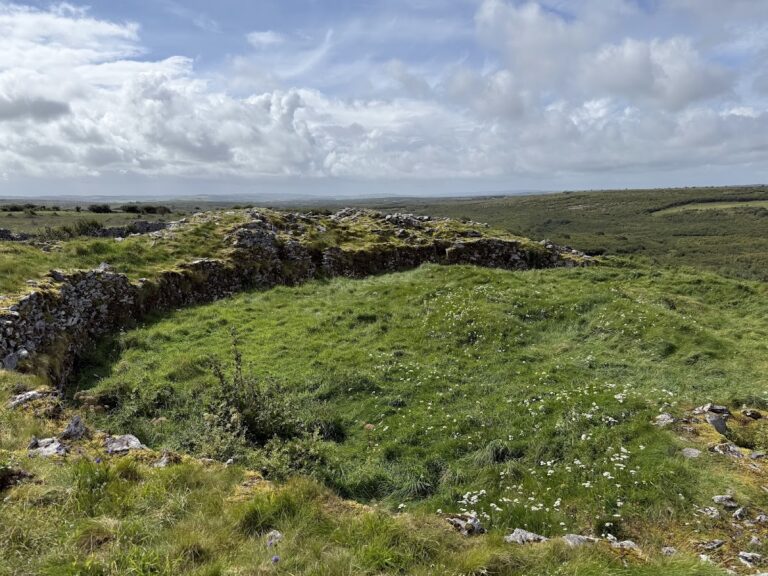
Gregans lies in the Ballyvaughan valley amid the grey limestone terraces of the Burren. The surrounding landscape supports alpine, Mediterranean and Arctic plant species, including orchids. Near the hotel, the grounds include a park, a garden and a flowerbed.
Archaeological landscape
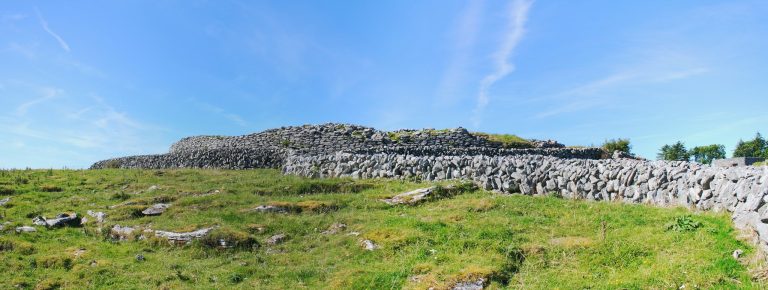
The wider Burren contains ancient graves, stone forts, churches and castle ruins. These remains form the archaeological and historical setting of Gregans Castle, linking the medieval tower house and later country house to a landscape with a long record of settlement and religious and defensive construction.