Poulnabrone Dolmen: A Neolithic Portal Tomb in Ireland
Site at a Glance
- Popularity
- Very High
- Country
- Ireland
- Primary era
- Stone Age
- Eras represented
- Stone Age
- Civilizations
- Unclassified
- Site type
- Burial
- Remains
- Tomb
On this page11 sections
History
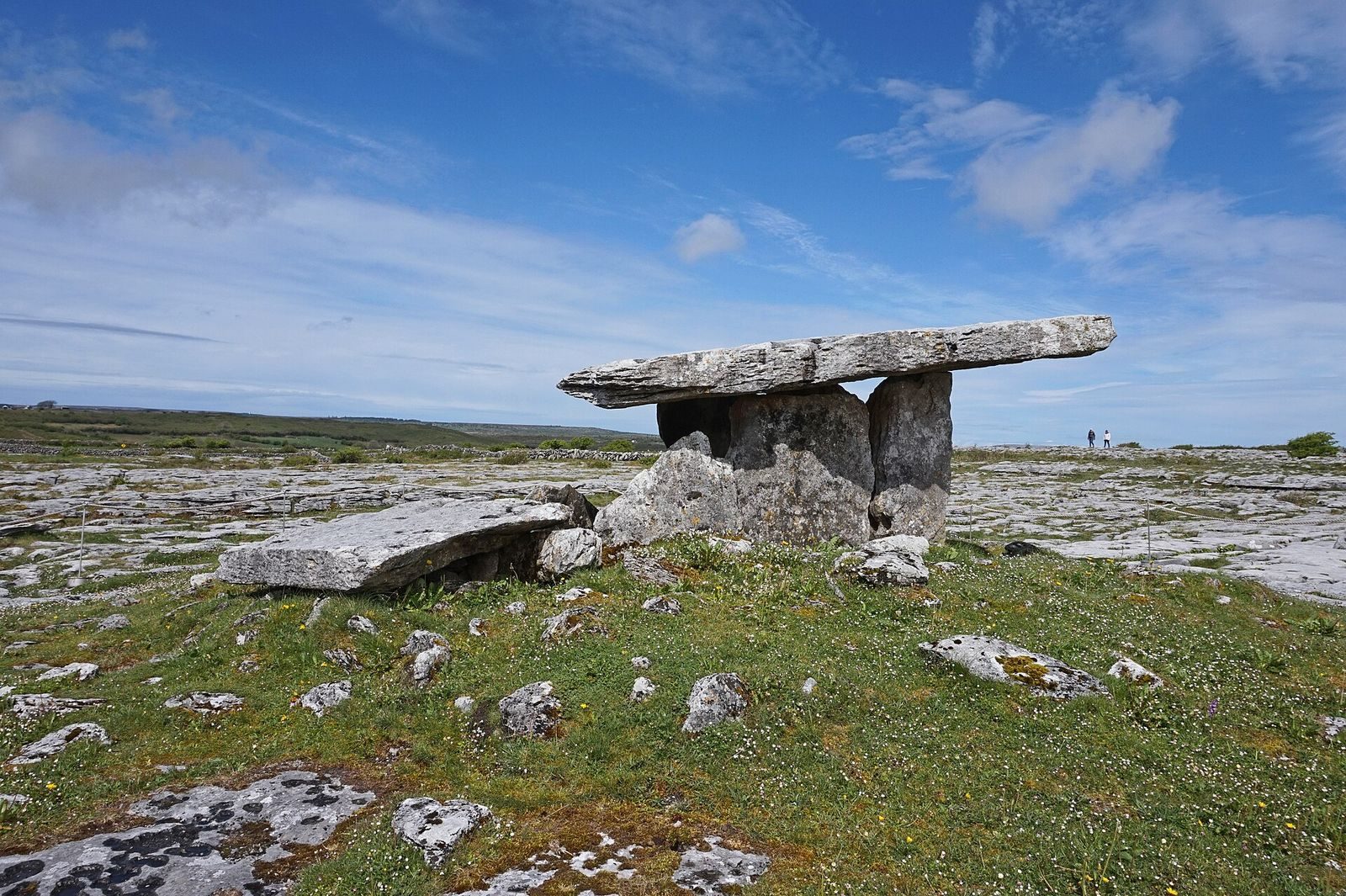
Poulnabrone dolmen is an early Neolithic portal tomb in County Clare, Ireland, built by a farming community around 3800–3200 BC. A portal tomb, also called a dolmen, is a burial monument formed by upright stones supporting a large capstone. Poulnabrone served as a communal burial place for people from successive generations.
The tomb may also have functioned as a ritual centre or territorial marker. Its open, visible position near a north–south route may have helped mark the northern edge of a local community’s territory. Poulnabrone is an English rendering of the Irish name Poll na Brón, understood as either “Hole of the Quernstone” or “Pool of the Quernstone.” A quernstone is used to grind grain by hand. The alternative “Hole of Sorrows” comes from a different reading of the name.
Burial activity continued after the main Neolithic use. A later burial was made just outside the entrance around 1750–1420 BC, during the Bronze Age, the period following the Neolithic that takes its name from the widespread use of bronze. Ritual use may also have continued into this period, and the tomb may have remained in use into the early medieval era.
Conservation and guardianship
A survey in the 1950s noted a crack in the eastern portal stone. The damage had worsened by the early 1980s, raising concerns about the tomb’s stability. Excavation and conservation followed in 1986 and 1988, led by Ann Lynch, an archaeologist with the Irish government’s National Monuments Service.
During the 1986 work, a wooden pyramid-shaped scaffold was used to lift the capstone, easing pressure on the damaged stone and allowing the chamber to be excavated safely. The fractured portal stone was replaced. Poulnabrone passed from private ownership into the guardianship of the Irish state in 1986 and is a National Monument of Ireland. It is among the country’s best-known dolmens and is described as Ireland’s largest portal tomb after Brownshill Dolmen in County Carlow.
Remains
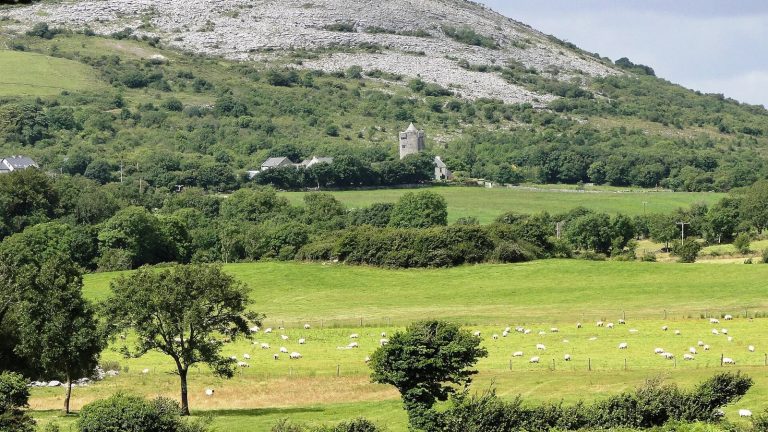
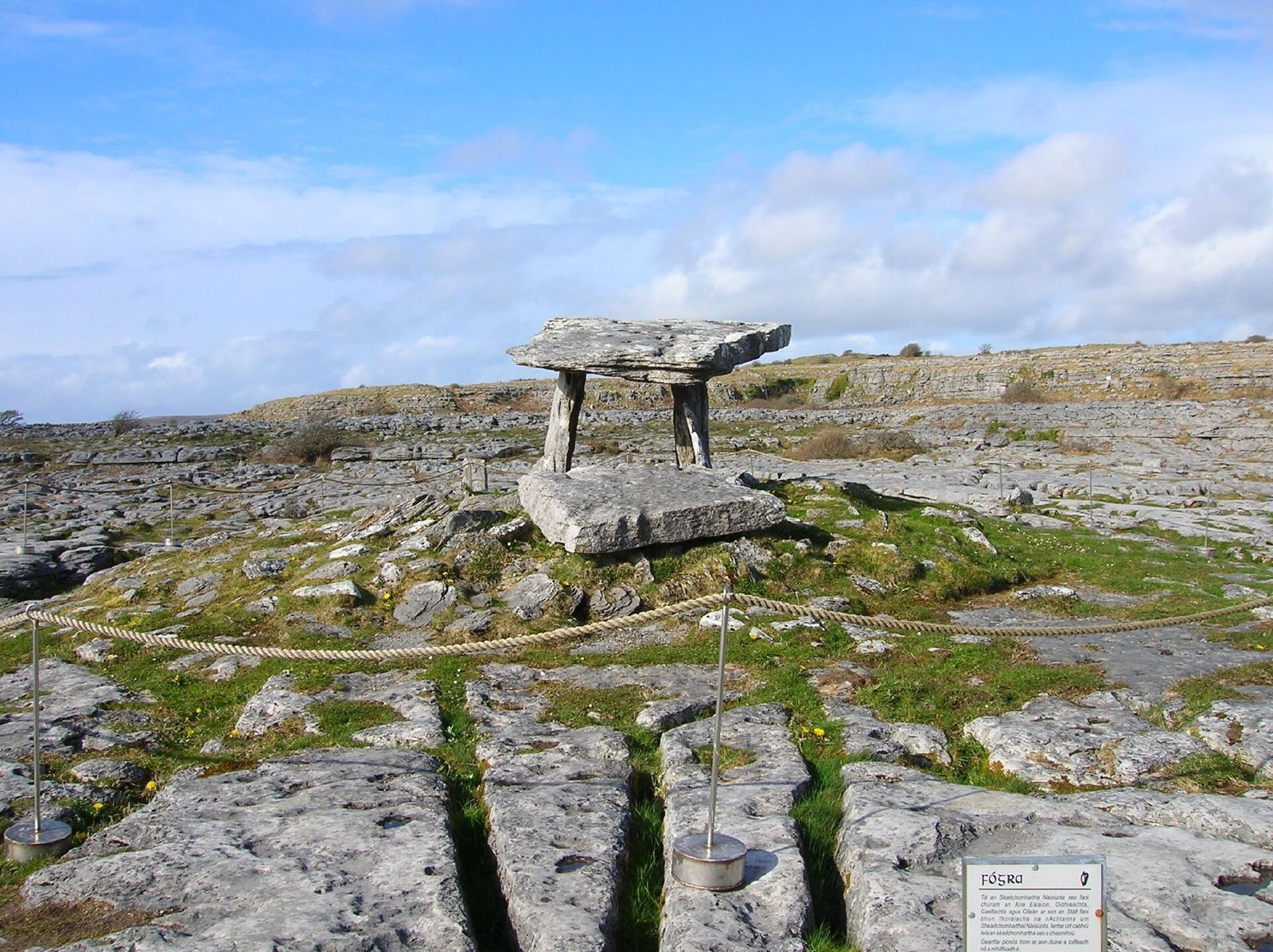
The monument stands on a low, circular mound about 10 metres in diameter in the Burren’s limestone karst, a landscape shaped by the dissolution and erosion of soluble rock. It lies east of the Poulanine and Glensleade valleys, with the Baur and Poulnabrucky hills beyond them; rocky terraces rise about 54 metres to the northeast. The surviving stones are the remains of a larger tomb probably once partly covered by earth and a cairn, a mound of stones sometimes mixed with earth. The cairn extended an average of about 3 metres from the burial chamber.
Stone structure
Capstone and chamber
A large, trapezoidal limestone slab forms the capstone. It measures about 3.9 metres long, 2–3 metres wide and 0.3 metres thick, and rises toward the west. This upward slope occurs in other dolmens in County Clare but is unusual elsewhere in Ireland. Two pairs of supporting stones, arranged on the chamber’s north and south sides, carry the slab. The supports stand about 2 metres high directly on the limestone bedrock, and their arrangement indicates they would not have stood higher in the Neolithic period. Together they form a chamber about 2.8 metres long that narrows eastward as the supports differ in height. Some stones have fallen or shifted over time.
Entrance and forechamber
Two portal stones frame the north-facing entrance beneath the lower end of the capstone. In front of it, a threshold stone crosses an east–west fissure in the limestone. Three stones immediately before the threshold form a small front chamber filled with earth and stone.
Burial evidence
Human remains and health
Excavation recovered about 6,000 human bone fragments, representing at least 28 people and probably around 33–36. At least 17 were adolescents or younger, and the remains included roughly equal numbers of males and females. Researchers identified 4,169 fragments as particular types of human bone, along with 486 loose teeth; distinguishing individual people was often difficult. The remains point to substantial physical labour and a largely plant-based, abrasive diet with limited animal protein. Many bones show arthritis or upper-body wear, while some suggest that people carried heavy loads on their heads or backs. Children’s teeth show signs of illness and malnutrition. Most identified adults were under 30, and only one appears to have lived beyond 40.
Injuries and an infant burial
Two individuals show evidence of serious injury. A young or middle-aged man had a healed, oval depression in his skull, probably caused by a projectile rather than a fall; a sling stone, a small missile thrown from a sling, is one possibility. Another person had an unhealed triangular stone projectile tip embedded in a hip bone, apparently from a shot delivered from behind. Genetic analysis published in 2020 identified an infant of about six months with Down syndrome, among the earliest known archaeological evidence of the condition. The infant had been breastfed before death.
Burial treatment
Some people may have decomposed elsewhere before their bones were brought to the tomb. Scorch marks on some bones may relate to ritual burning. The remains were deposited as bones rather than intact skeletons, and they were mixed in chronological order while still lying in their original layers.
Excavated objects
Finds include pottery, a stone axe, weapons, and ornaments made from bone and quartz, as well as other stone and bone objects. Most pottery came from the main chamber, with smaller fragments from the entrance area and cairn. It survives in badly disintegrated pieces. Some fragments fit an early Western Neolithic pottery tradition, an archaeological category associated with early farming communities in western Europe, dated to about 3750–3600 BC. The human remains and objects are held at Clare Museum in Ennis on loan from the National Museum of Ireland.