Longtown Castle: A Norman Motte-and-Bailey Stronghold in Herefordshire


Site at a Glance
- Rating
- 4.4
- Popularity
- Low
- Country
- United Kingdom
- Primary era
- Medieval
- External website
- Open
- Eras represented
- Medieval
- Civilizations
- Norman
- Site type
- Military
- Remains
- Castle
On this page11 sections
History
Longtown Castle is a ruined Norman motte-and-bailey fortress in Longtown, Herefordshire, United Kingdom, established during the medieval period beside the River Monnow. It occupied a strategically important position in the Welsh Marches, the contested borderlands between England and Wales where marcher lords exercised substantial authority and built fortified settlements. In earlier usage, the castle was also called Ewias Lacey Castle, using the name of the surrounding lordship. Ewias referred to the wider district and meant “sheep district.”
Before and after the Norman conquest
Before the Norman castle was built, the site contained a Roman fort beside a Roman road running through the borderlands. The square fort was defended by a ditch and timber palisade, and its defences may have been strengthened around 1055 after a Welsh attack on Hereford. Earlier Iron Age or Anglo-Saxon fortifications have also been proposed. After the Norman conquest, a smaller castle was begun at Pont Hendre, close to the present site, to guard a river crossing. Roger de Lacy, Pain FitzJohn, and Walter de Lacy have all been associated with its foundation, although its builder or patron remains uncertain.
Welsh attacks led to the abandonment of the Pont Hendre castle and its replacement by a new fortress at Longtown, built on the former Roman fort site. The date and patron of the first Longtown castle are uncertain. One tradition attributes it to Walter de Lacy in the eleventh century, while another places its construction around 1175 under Hugh de Lacy. Hugh had acquired the surrounding Ewias Lacey lordship during the 1160s and early 1170s. The new stronghold stood beside the Monnow, an important transport route, even though higher and more defensible ground existed nearby. The surrounding region remained unsettled during the later twelfth century because of Welsh revolts against Anglo-Norman rule.
The de Lacy and de Verdun inheritance
The early castle was mainly built of timber, with some stone that was later reused. Under the de Lacys it was rebuilt in stone. The work cost about £37 and was financed through the creation of a new borough beside the castle. A medieval borough was an incorporated town or settlement intended to encourage trade and produce revenue. The settlement initially prospered, while the castle continued to serve as a military stronghold.
The de Lacy family controlled Longtown until Walter de Lacy died in 1234. John FitzGeoffrey then acquired the castle during a period of intensified conflict between the Welsh princes Llywelyn the Great and Dafydd ap Llywelyn and the English marcher lords. The property later returned to the de Lacy inheritance and passed through Margery de Lacy’s marriage to John de Verdun.
The de Verdun family faced local lawlessness and continuing Welsh revolts. King Edward I temporarily confiscated the castle and its estates from Theobald de Verdun, 1st Baron Verdun. When Theobald’s son, Theobald de Verdun, 2nd Baron Verdun, died in 1316 without surviving male heirs, the inheritance passed through his daughter Elizabeth to her husband, Bartholomew Burghersh, 1st Baron Burghersh. In 1317, orders were issued for a garrison of 30 men.
Decline, reuse, and conservation
Longtown’s military importance later declined. The castle passed to the Despensers in 1369 and then to the Beauchamps, neither of whom used it. Henry IV temporarily refortified it in response to the Owain Glyndŵr uprising in 1403. Owain Glyndŵr was a Welsh leader who directed a major revolt against English rule in the early fifteenth century. The property was acquired by the Nevilles during the fifteenth century and remained under the Lords of Abergavenny until the 1970s.
The Black Death caused a sharp fall in Longtown’s population. The protected area north of the castle was abandoned, and by the sixteenth century the settlement was no longer a functioning trading centre. The castle’s precise role in the English Civil War of 1642 to 1645 is uncertain, although cannonballs from the period were found within the ruins. Local tradition holds that the fortress was slighted, or deliberately damaged, during the war.
From the seventeenth century, stone from the castle was reused in local buildings. An eighteenth-century house, shop, yard, and garden occupied the eastern bailey, and a gallows operated at the castle until 1790. By the end of the nineteenth century, a school and Castle Lodge had been built within the grounds, while other structures stood against the castle walls. The Ministry of Works acquired Longtown Castle in the 1970s, when it was in poor condition, and undertook extensive restoration, including the removal of many later buildings that encroached on the walls. English Heritage maintains the central ruins in the twenty-first century, while the wider earthworks extend beyond the central maintained area. The castle is protected as a scheduled monument, a legally protected archaeological or historic site considered nationally important.
Remains
Longtown Castle occupies high ground beside the River Monnow and follows a motte-and-bailey plan. This type of fortress combined a raised earth mound, or motte, with enclosed baileys used for buildings, storage, settlement, and defence. The motte rises about 10 metres. The unusually rectangular bailey measures approximately 125 by 110 metres, covering about 1.21 hectares, and was divided into three independently defensible parts, comprising two western baileys and one eastern bailey. Two circuits of earthworks extended north and south and may have carried timber palisades, enclosing the early settlement of Longtown.
Early earthworks and timber defences
The twelfth-century castle was primarily timber-built, although it included some stone construction. Stone from this early phase was reused in the later rebuilding. The earthworks preserve the broad defensive organization of the castle and its settlement, with the raised motte forming the principal stronghold and the baileys providing enclosed areas around it.
Western stone complex
Circular keep
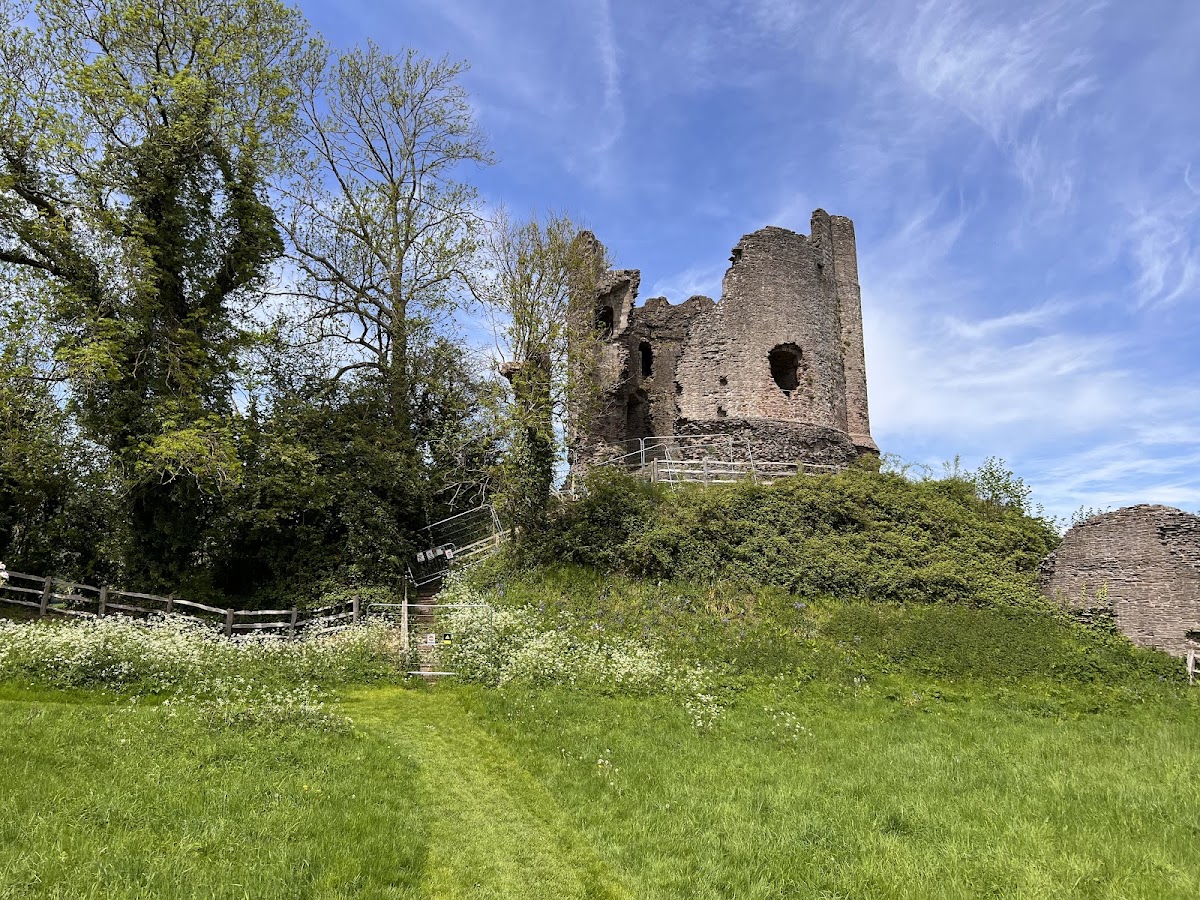
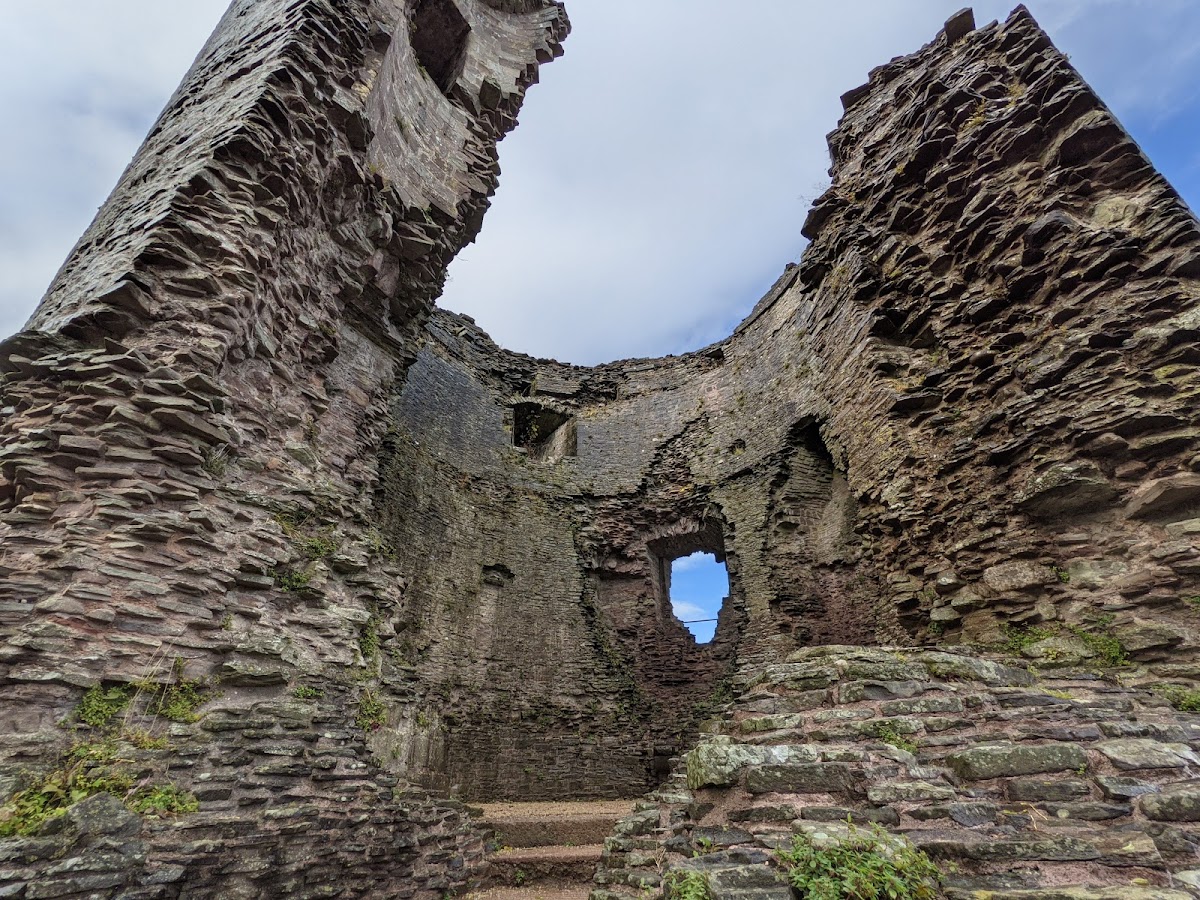
The principal stone keep, or great tower, stands on the motte. It is circular and built from sandstone rubble with finely cut ashlar detailing, the dressed masonry used for visible architectural features. Its walls are approximately 4 to 5 metres thick in places, although the foundations are extremely shallow. Three evenly spaced external turrets project from the tower, which contained a hall on its first floor. Circular great towers of this kind occur elsewhere in the Welsh Marches, including at Skenfrith and Caldicot. The military reason for this design remains unclear, since it appears to have offered few advantages.
Inner gatehouse
A simple stone gatehouse controlled access from the western outer bailey to the western inner bailey. It had two small turrets and appears to have contained a portcullis, a heavy gate that moved vertically to secure a fortified entrance.
Bailey walls and service buildings
A surrounding wall approximately 2 metres thick enclosed the remainder of the western inner bailey. Another stone wall appears to have protected the western outer bailey. The western inner bailey contained the castle’s great hall and other service buildings. The surviving central complex brings together the ruined circular keep, the inner gatehouse, and fragments of the curtain wall, while the wider earthworks extend beyond this group.
Eastern bailey and later buildings
The eastern bailey was later occupied by an eighteenth-century house, shop, yard, and garden. Further building took place within the castle grounds and against the castle walls, including a nineteenth-century school, Castle Lodge, and additional lean-to structures. Many later buildings that encroached on the walls were removed during twentieth-century restoration. Cannonballs dating from the English Civil War period have also been found within the ruins.