Château de Vallery: A French Renaissance Residence and Former Fortress
Site at a Glance
- Rating
- 4.8
- Popularity
- Low
- Country
- France
- Primary era
- Early Modern
- External website
- Open
- Eras represented
- Medieval, Early Modern
- Civilizations
- French
- Site type
- Domestic
- Remains
- Castle
On this page18 sections
History
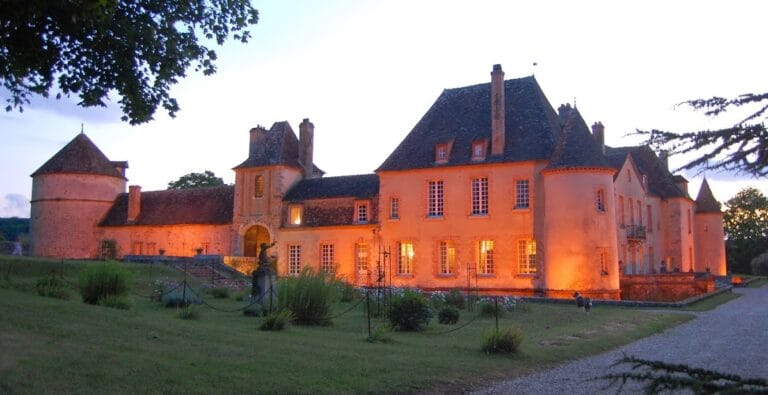
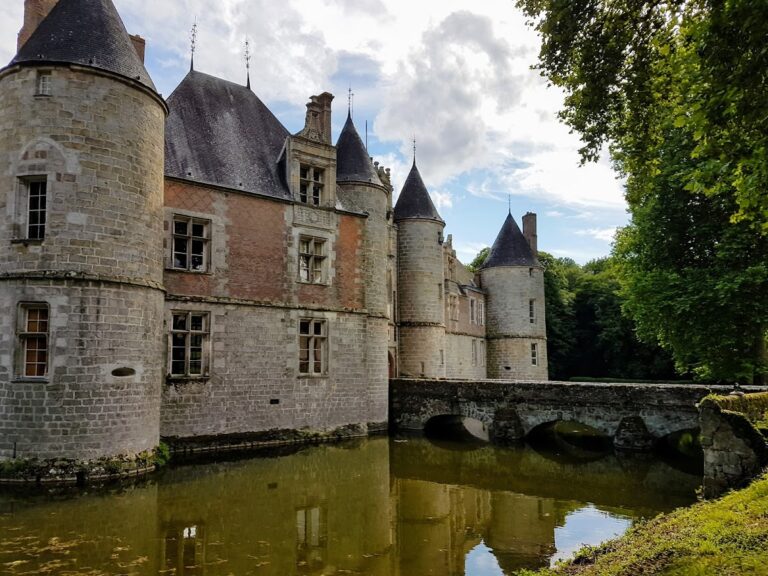
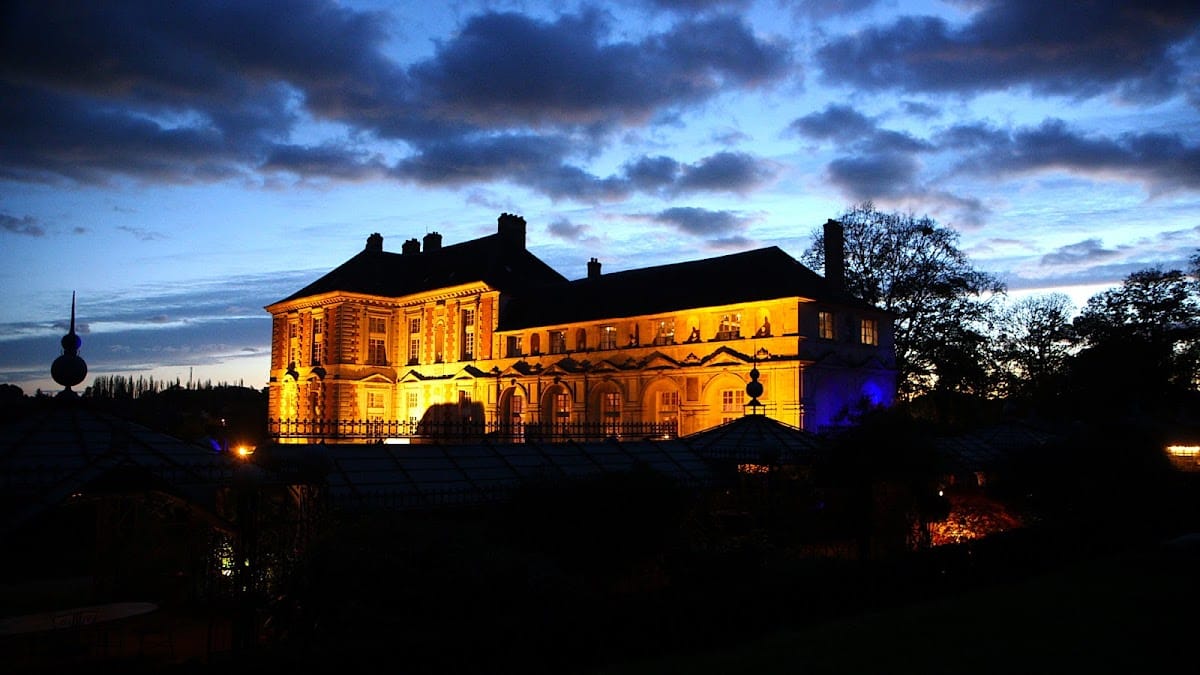
Château de Vallery, also known as Château des Condé, is a Renaissance residence built on a medieval fortress site in Vallery, France. Its transformation began in the sixteenth century in the French Renaissance manner, combining classical forms with French building traditions. The estate later became a possession of the House of Condé and a place associated with Protestantism and the burial of several Condé princes and princesses.
Medieval lordship
Vallery was probably a principal center of the Viscounts of Sens during the twelfth century. In the thirteenth century, the lordship passed through the Vallery family, including Jean I, Hugues, and the soldier Érard de Vallery. Around 1277, the Thianges family inherited Vallery and retained it for approximately two centuries. The Poisieu family owned the lordship in the fifteenth century.
Saint-André and the Renaissance rebuilding
On 16 April 1548, Jacques de Poisieu sold Vallery to Jacques d’Albon de Saint-André for 95,000 livres. Saint-André was Marshal of France and a favorite of Henry II. He commissioned a new residence on the medieval fortress site, retaining parts of the earlier fortified enclosure while introducing the ordered façades, arcades, pilasters, and contrasting brick-and-stone colors associated with the French Renaissance.
The exact construction date is not fully established. Work was planned after 1549, and the west range and corner pavilion were built before the south range, which began only from 1555. The works were directed by Pierre Lescot, a leading French Renaissance architect also known for the Renaissance portions of the Louvre Palace, together with Léonard Fontaine, master of the king’s works, and the mason Guillaume Marchant. Saint-André died in 1562 before the residence was complete, and carpentry remained unfinished in 1563.
Vallery nevertheless hosted important members of the royal court during the building campaign. Henry II and his court stayed in the old château from 18 to 21 March 1550, when sumptuous festivities were held. The king returned in 1556, and his son Francis II visited in 1559. Francesco Primaticcio was present in 1555, probably in an expert capacity.
The House of Condé
In 1564, Saint-André’s widow, Marguerite de Lustrac, transferred the estate to Louis I de Bourbon, Prince of Condé. The House of Condé, a powerful branch of the Bourbon dynasty, retained Vallery for nearly two centuries. Louis I was an important Huguenot leader during the French Wars of Religion, the conflicts between Catholics and Protestants that divided France in the second half of the sixteenth century. The estate’s later identity was closely connected with the Condé family and its Protestant associations.
The Condé family used the parish church of Saint-Thomas of Canterbury for family burials. The church was built in 1614 at the wish of Henry II de Bourbon, the seventeenth-century Prince of Condé and father of Louis II de Bourbon-Condé, known as the Grand Condé. In 1646, the Grand Condé commissioned Gilles Guérin to create a marble mausoleum for his father in the church’s Saint Louis chapel.
Later ownership and alteration
Élisabeth-Alexandrine de Bourbon-Condé, known as Mademoiselle de Sens, inherited Vallery and demolished the south wing. On 12 November 1747, she sold the estate to Jacques-René Cordier de Launay. His granddaughter, Renée-Pélagie Cordier de Launay de Montreuil, lived at Vallery for a time with her husband, the Marquis de Sade.
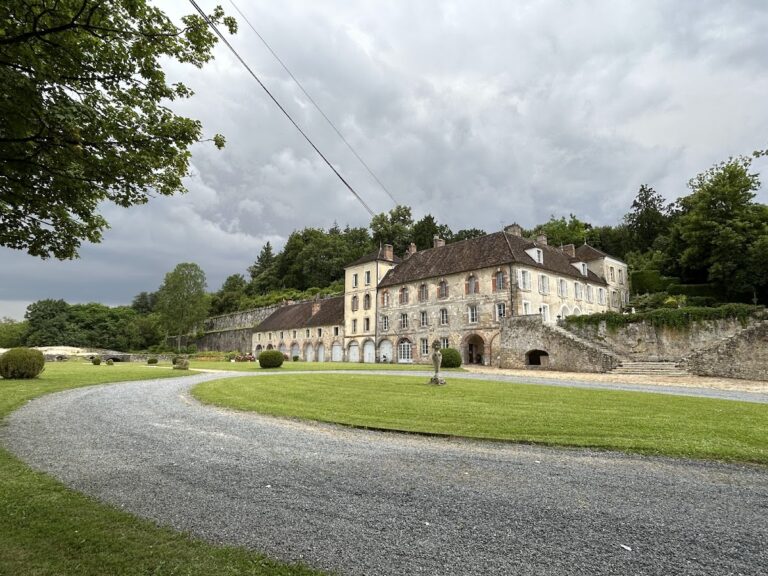
The Launay family sold the château on 30 March 1822 to General Louis-Marie Lévesque de la Ferrière. He became mayor of Vallery and was buried at the estate in 1834. During the eighteenth century, the buildings underwent progressive alterations. In the early nineteenth century, Charles-Michel Cordier demolished the northern part of the west wing, lowered the gallery, removed the upper storey and attic of the corner pavilion, and rebuilt the roofs at a lower level. He also added historical-looking elements to the façades, while later interior work divided the gallery into separate rooms.
Protection and restoration
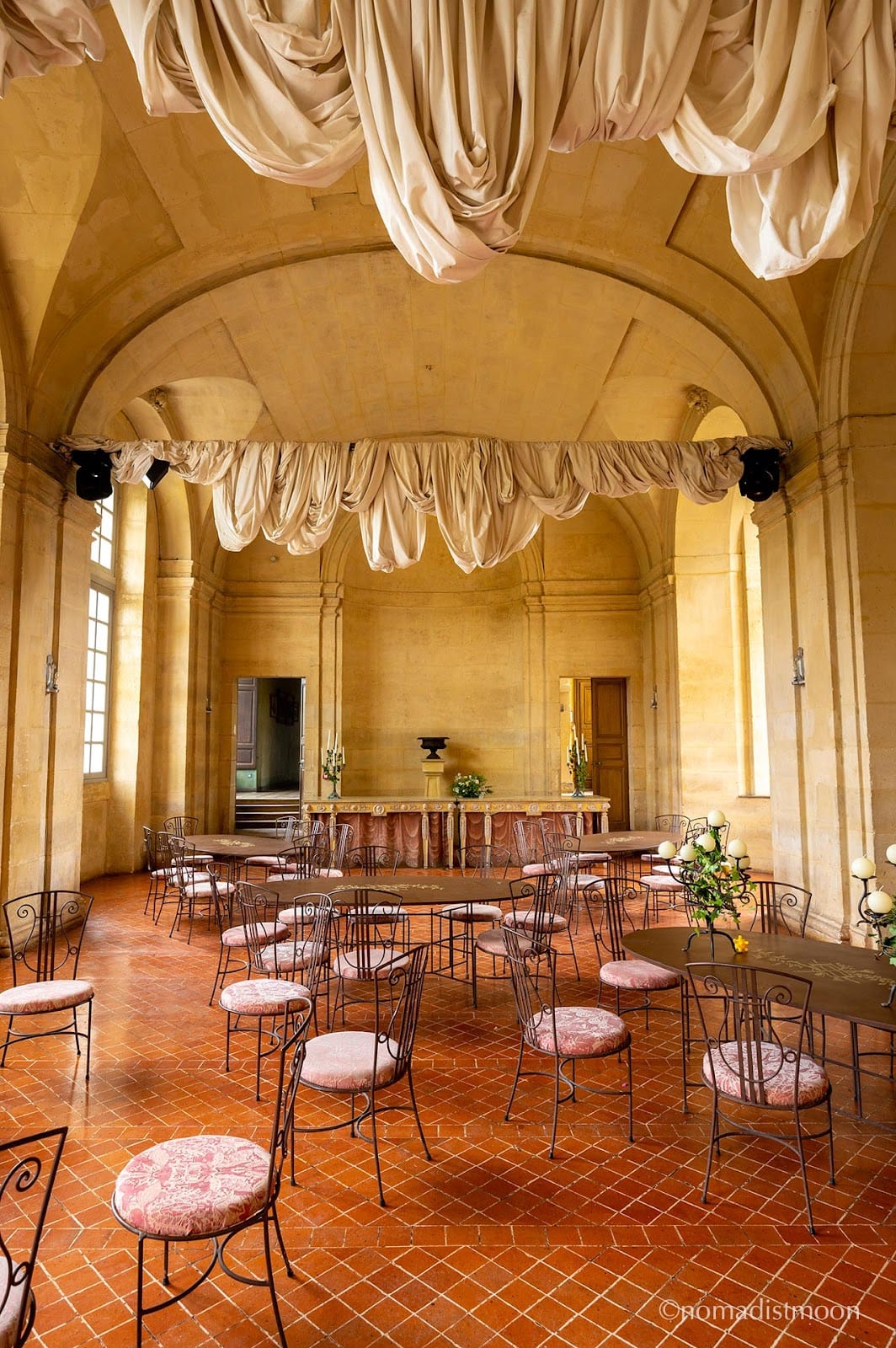
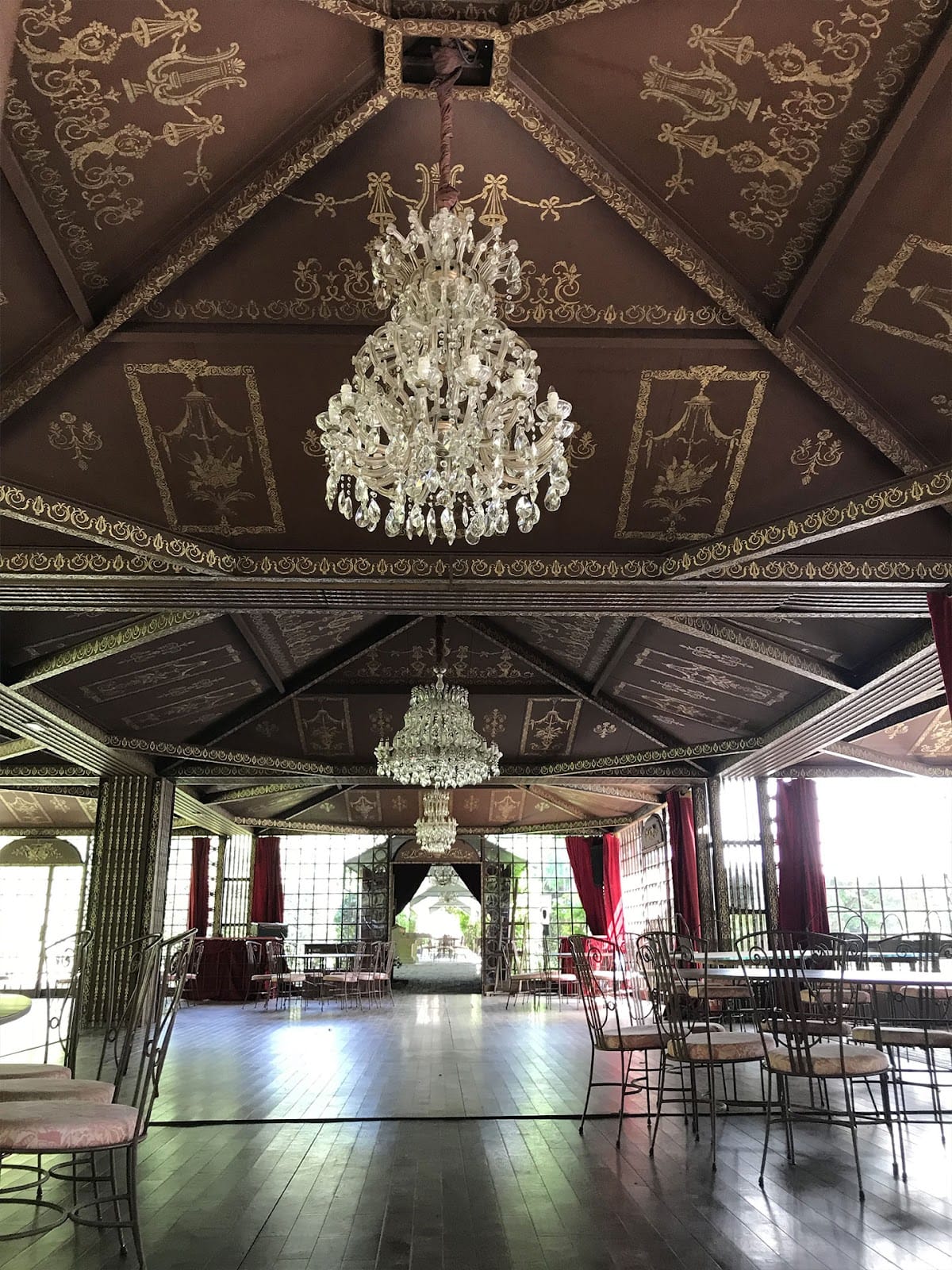
The château deteriorated through much of the twentieth century. Since 1989, a private company has used it as a venue for weddings and receptions. The architect Patrice Vansteenberghe bought the property in 1990 and began restoration under the guidance of France’s historic-monuments service. The pleasure garden and orchard received protection as historic monuments on 12 July 1946. On 4 October 2001, protection was extended to the château and its dependencies, including the fortified enclosure, entrance structure, towers, moats, and belvedere, replacing an earlier designation dating from 1911.
Remains
Fortress and Renaissance residence
Medieval enclosure
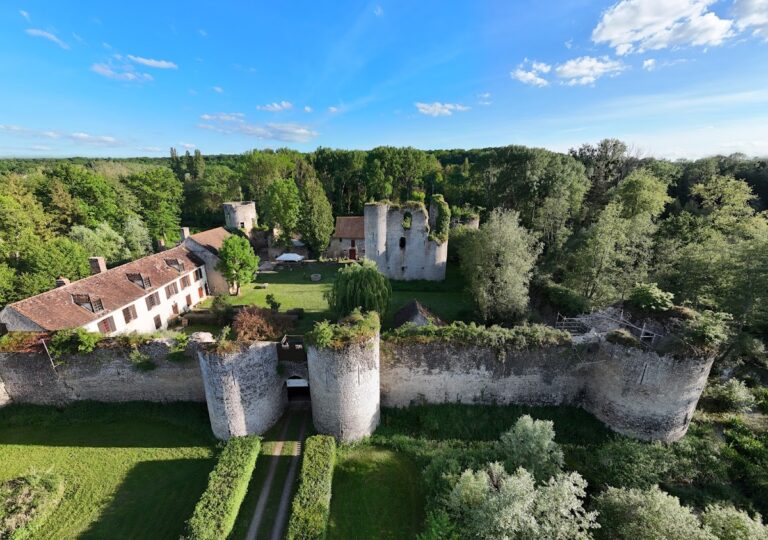
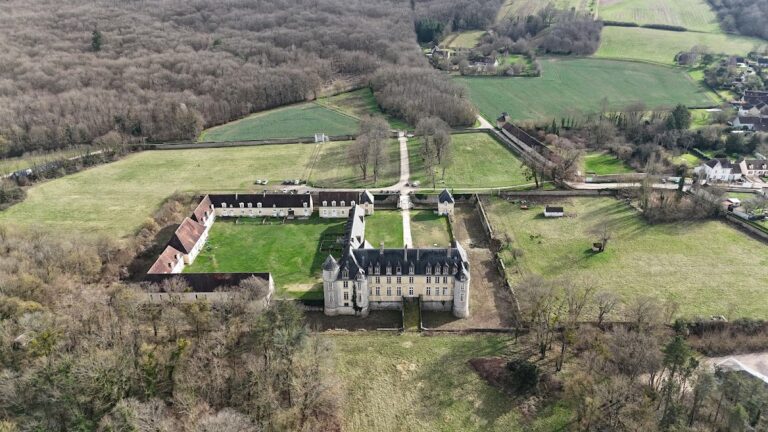
The surviving medieval structure includes the curtain walls, circular towers, cellars, and fourteenth-century châtelet, a fortified entrance structure. The curtain wall enclosed the castle and divided the estate into a main courtyard and a lower courtyard. A separating wall stood between the two areas. Because the site occupies a steep slope, the lower courtyard lay at a different level and contained stables set apart from the residence. The fortified enclosure and its related earthworks remain part of the complex.
West range
The Renaissance plan consisted of two ranges set at right angles and joined by a corner pavilion. Only the west range, south range, and pavilion were completed. The south range was built against the fourteenth-century entrance gatehouse. The west range had a basement, a principal storey, an upper storey, and an attic lit by dormer windows.
Its wall facing the moat was built from rough limestone and flint rubble. On the courtyard side, brick was combined with stone, and a hewn-stone portico opened through five round-headed arcades. The arcades are now filled with windows. Above them, a barrel vault includes lunettes, which are curved sections opening into the vault. Paired Tuscan-order pilasters, flat supports based on the plainest classical Roman order, separate the arcades. Coloured marble discs decorate the spaces above them, while the façades carry mascarons, carved ornamental faces representing male and female fauns.
Corner pavilion
The corner pavilion was built in brick and stone. It originally rose an additional storey and attic beneath a high pavilion roof with dormer windows, but these upper elements were later removed. Its windows have curved, triangular, or straight pediments according to their position. On the moat-facing elevations, the windows and corner blocks have a roughened, rusticated finish. The courtyard elevations feature carved scrollwork friezes and marble inlay.
The residence used white stone and brick both inside and outside. Stone was reserved for windows, corner blocks, mouldings, doors, and other decorative elements, while red and black polychrome marble originally enriched the façades. This combination became an influential model for seventeenth-century château architecture. Jacques Androuet du Cerceau, a sixteenth-century architectural designer and writer, compared the design with the contemporary Louvre while noting that the two buildings differed in both materials and plans.
Grande Galerie
The Grande Galerie was altered in the nineteenth century, when it was lowered and divided into separate spaces. Later restoration returned it to its original dimensions, recovering an important part of the Renaissance arrangement.
Gardens and waterworks
Pleasure garden
Pierre Lescot laid out the sixteenth-century pleasure garden for Saint-André, probably between 1548 and 1556. The regular design contained sixteen square compartments arranged around a long rectangular basin within a walled enclosure. The garden complex covered approximately 120 metres on a side.
To the east, a dyke bordered an artificial pond fed by the Orvanne, the river of the Vallery region. A central canal linked the pond with the basin and followed the river’s axis. The canal served as a long reflecting pool. A grassed terrace extended westward toward a ground-floor gallery of twenty-nine arcades between two pavilions. The gallery and garden pavilion have disappeared, while the alder grove, basin, and canal survive.
Orchard, vineyard, and estate water system
A separate walled enclosure of seventeen arpents, a traditional French land measure whose size varied by locality, was planted with Orleans, Coucy, Beaune, Muscat, and Anjou vines. The wider park also included a heron aviary, an orchard, a kitchen garden, a portico, a garden pavilion, a dyke, an irrigation basin, and an irrigation canal.
The garden changed substantially over time. A flood in 1626 damaged the dyke and destroyed the garden pavilion. The portico was dismantled during the seventeenth century, the alder grove was replaced by an orchard, and the pond was filled. The pleasure garden subsequently became a kitchen garden, while the central basin was dug out again in the late eighteenth century.
Ancillary buildings and funerary monument
Dovecote
The estate’s dovecote stands at the highest point of the site, set back from the river. A dovecote is a building fitted with nesting holes for pigeons. The walls are approximately 1.15 metres thick and contain 2,844 nesting holes. Its capacity conventionally corresponds to an estate of more than 180 hectares.
Mausoleum of Henry II de Bourbon
In the Saint Louis chapel of the parish church, the mausoleum of Henry II de Bourbon is a marble work made by Gilles Guérin in 1646. It shows the prince reclining in the manner of a Renaissance funerary effigy above four caryatids, sculpted female figures used as architectural supports. The figures represent the cardinal virtues of prudence, justice, temperance, and courage.