Nyborg Castle: Denmark’s Medieval Royal Residence and Parliamentary Stronghold
Site at a Glance
- Rating
- 4
- Popularity
- Low
- Country
- Denmark
- Primary era
- Medieval
- External website
- Open
- Eras represented
- Medieval, Early Modern
- Civilizations
- Danish
- Site type
- Military
- Remains
- Castle
On this page13 sections
History
Nyborg Castle in Denmark was established around 1170 by Knud Prislavsen, a nephew of Valdemar the Great, and had entered royal possession by 1193. Archaeological evidence places the completion of its moat system and the earliest castle construction in 1209–10, during the medieval period. Built beside the Great Belt, the castle became a royal stronghold controlling important routes across the kingdom and a major centre of Danish political life.
Royal stronghold and political centre
Nyborg’s position gave it control over the north–south sea route linking Denmark and Norway with Lübeck, as well as the east–west land route between eastern and western Denmark. The castle helped defend the kingdom against internal power struggles and external enemies, while also supporting Danish expansion in the Baltic. Its original design was conceived as a unified fortified complex, rather than as a collection of unrelated buildings added over time.
From the thirteenth century until 1413, Nyborg was the legally established annual meeting place of the Danehof, Denmark’s medieval representative assembly and an early form of parliament. The assembly also met elsewhere, but the castle remained its principal venue for much of this period. In 1282, King Eric V Klipping signed Denmark’s first constitution, known as the Charter, at Nyborg in the original Danehof hall.
The Danehof held another important meeting at Nyborg in 1377, when Margrete I secured confirmation of the election of her six-year-old son Oluf as king of Denmark. This helped establish the dynastic union of Denmark and Norway and represented an early step toward the later Kalmar Union, the late medieval union of Denmark, Norway, and Sweden under one monarch. A seventeenth-century clerical report later connected the construction of Nyborg’s Church of Our Lady with Margrete’s gratitude for the victory at the Battle of Åsle in 1389, which enabled her to bring Sweden under her rule. That connection is a later tradition rather than a contemporary account of the building’s foundation.
Royal residence and Renaissance transformation
In 1481, King Hans and Queen Christine established a more permanent residence at Nyborg Castle, while a royal mausoleum was created at the Greyfriars Monastery in Odense. Christian II was born at the castle in 1483. After Christian II was deposed by the Danish council of state, Nyborg Castle and the town were designated in 1525 as the residence of the new king, Frederik I.
Under Frederik I and his successors, the medieval fortress was transformed into a Renaissance residence. The work included enlarged windows and new interior decoration. After the Count’s Feud of 1533–36, a power struggle that accompanied the Reformation and helped make Denmark a Protestant kingdom under royal control, Christian III expanded both the castle and the town. He planned a large new banqueting hall, strengthened the fortifications, and added other improvements, although the wider project was not completed after royal attention shifted to castles such as Koldinghus.
Further work took place in 1607, when the architect Domenicus Badiaz added features including a spire to the main tower, Knudstårnet. The spire was designed to resemble that of Copenhagen’s Blue Tower. Nyborg therefore continued to combine medieval defensive structures with the ceremonial and residential requirements of a Renaissance court.
Decline as a residence and military reuse
As royal administration became concentrated in Copenhagen and later monarchs gave greater attention to estates in Zealand, Nyborg lost much of its residential importance. The castle was severely damaged during the Dano-Swedish wars, and after 1659 it was no longer regarded as a suitable royal residence.
For approximately the next 250 years, the damaged castle served as a military centre, storage complex, and gunpowder magazine for the Nyborg garrison. Continued military use, together with the expansion of the surrounding fortifications, helped preserve parts of the medieval complex. Under Frederik III, Nyborg was developed into a royal fortress and citadel with new bastions, projecting fortifications designed for artillery defence, and other works based on contemporary Italian models. As the new fortress expanded, the medieval castle became less strategically important.
From the eighteenth century, a shortage of bricks led to systematic dismantling. The high curtain wall, parts of the north wing, and buildings in the castle courtyard were demolished, with their materials reused in the earthwork fortifications and their covered gates. Bricks from the castle were also used under Frederik IV for riding schools and for enlarging Baroque Odense Palace. Stone from the north wing was reused when houses in Nyborg were rebuilt after the major town fires of the 1790s. The royal wing and the lower part of the main watchtower were retained for military storage.
Nyborg, together with Fredericia and Copenhagen, formed the backbone of Denmark’s defence from the 1660s. The fortress function was gradually dismantled from the 1870s, when the southern ramparts were breached to permit urban development. The garrison was abolished in 1913.
Excavation, restoration, and modern interpretation
Archaeological clearance and investigation of the castle courtyard began in the 1890s. After the garrison departed, the National Museum of Denmark undertook further investigations and extensive restoration under Mogens Clemmensen, a Danish architect and restoration specialist. Work continued until funding ended in 1925, leaving parts of the north wing and some interior details unfinished.
Following the restoration, Nyborg Castle became a museum. It is now operated as Nyborg Castle within Østfyns Museums, the regional museum organization responsible for museums in eastern Funen. The site has been state-owned since 1849 and is administered through the Ministry of Culture and the Agency for Culture and Palaces. Queen Margrethe became the castle’s patron in 2016. Nyborg Castle is recognized as an important Danish cultural-heritage monument and is regarded as Denmark’s oldest surviving royal residence.
Extensive archaeological investigations on Castle Island from 2009 to 2018 were the first major scientific excavations there since the early twentieth century. Investigations on the town square began in May 2019. In 2011, Nyborg’s municipal council adopted a vision of presenting the town and castle as a potential world-heritage site.
A redevelopment project developed between 2012 and 2019 combined restoration, new exhibition space, improved links between the castle and town, and archaeological research. Official permissions were granted in 2019, but four complaints against the dispensations were upheld on 17 December 2020, preventing the planned construction from proceeding. The A. P. Møller Foundation withdrew its financial support and left the partnership in February 2022. Criticism of the project focused on the possible effects of new construction on authenticity, archaeological remains, historic town views, and the relationship with the medieval town. Two historically valuable nineteenth-century garrison buildings on Castle Island were nevertheless demolished in 2017–18 to make space for the planned redevelopment.
Remains
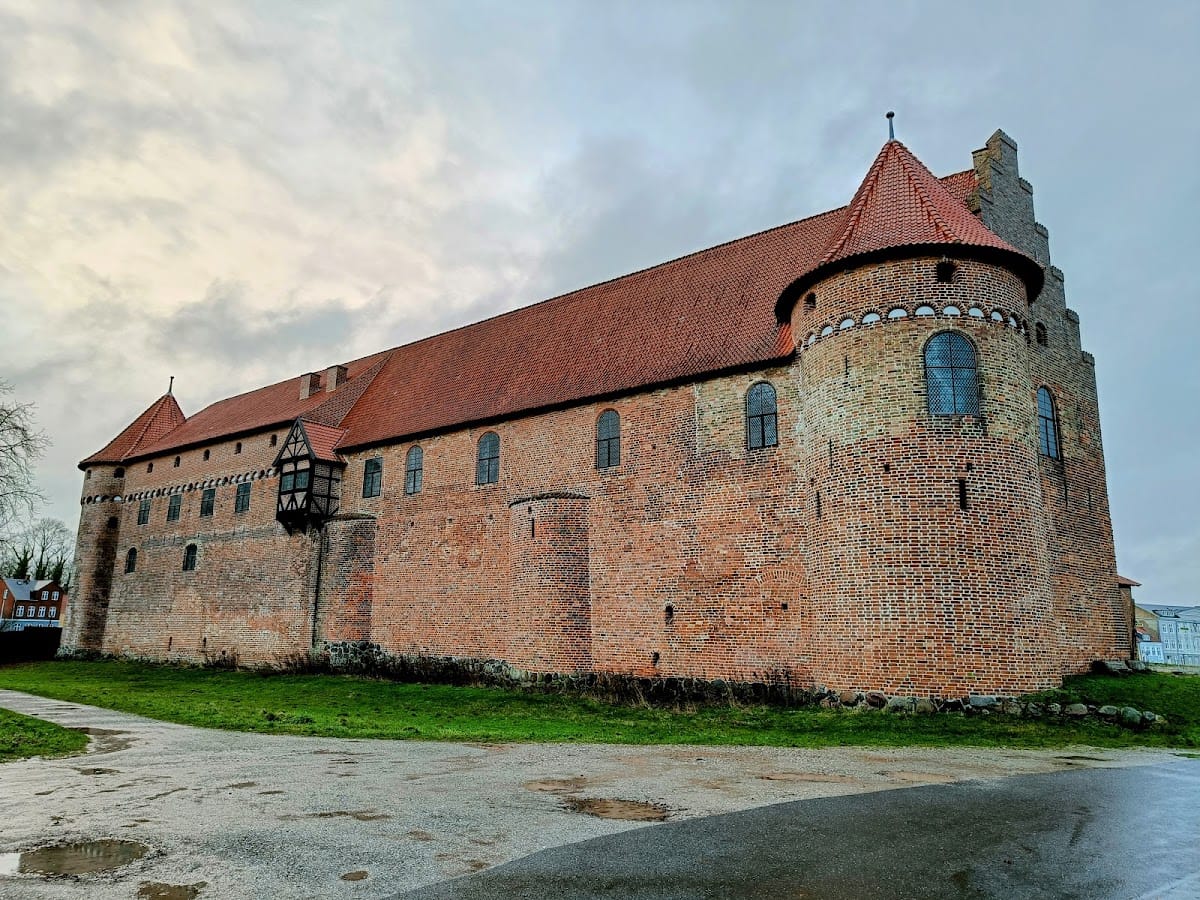
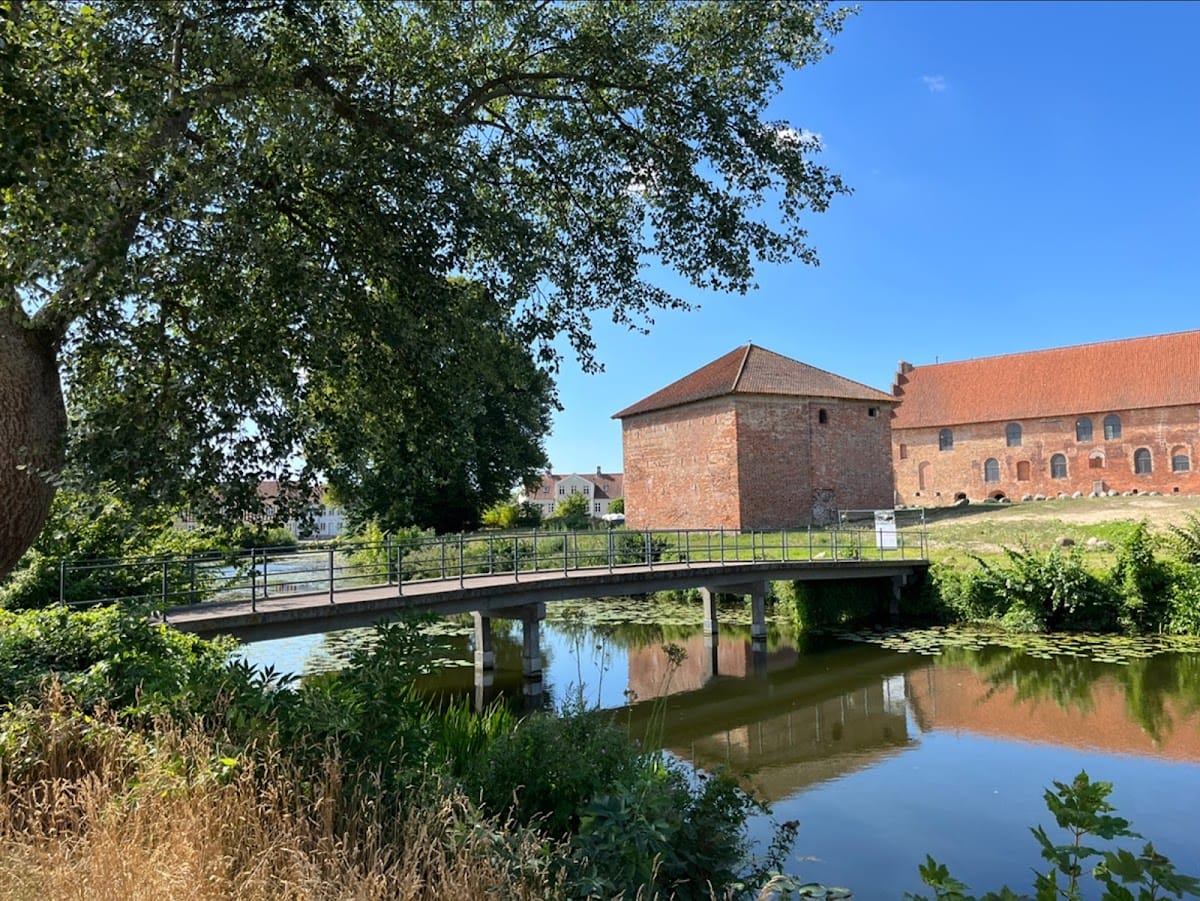
The original castle was approximately square, with corner towers linked by a curtain wall, a defensive wall connecting towers or other fortified structures. Its ring walls rose about 10 metres and included projecting flanking towers along the long sides. The complex formed part of a wider fortified landscape of towers, stone buildings, moats, canals, sluices, and embankments. An engineering system carried water from the Vindinge River, about 5 kilometres from Nyborg, to the moat around both the castle and the developing town.
Medieval castle buildings
Royal residence and main tower
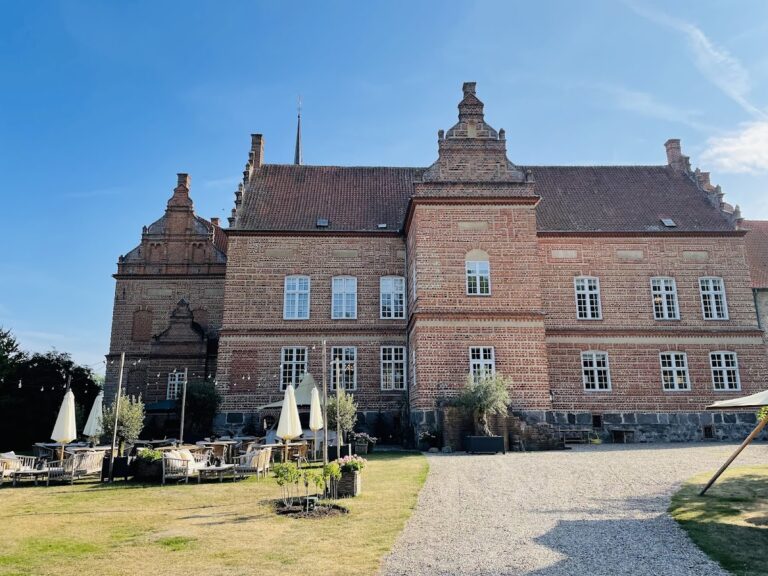
A residential palatium, the principal living building in a medieval royal or aristocratic castle, stood beside the west wall from the mid-thirteenth century. The surviving royal wing retains medieval and later structural fabric, including elements shaped by its transformation into a Renaissance residence. The east wall contained a strong main tower, attributed archaeologically to the reign of Erik Menved. Its lower section survives as part of the present complex.
Christian III’s alterations brought large new windows, interior decoration with a characteristic boss-patterned wall surface, a large banqueting or knights’ hall, and an additional tower. In 1607, Domenicus Badiaz added further work, including the spire of Knudstårnet, whose form recalled the spire of Copenhagen’s Blue Tower. The surviving royal wing and lower watchtower later received practical adaptations for grain storage and gunpowder storage.
North wing and courtyard structures
Archaeological evidence shows that a north wing formed part of the original unified castle complex rather than being entirely a later addition. Most of the wing was subsequently dismantled, and its stone was reused in rebuilding houses in Nyborg after the eighteenth-century fires. Buildings in the courtyard also supplied material for the later fortress.
Excavations announced in 2016 revealed the remains of a previously unknown courtyard building. It has been interpreted as a temporary kitchen constructed after a fire in the castle’s northeastern corner during the fourteenth century. A large sewer from the first half of the sixteenth century was also found. It is larger and slightly older than a sewer discovered in 2017 beneath present-day Christiansborg.
Fortress earthworks and surviving defences
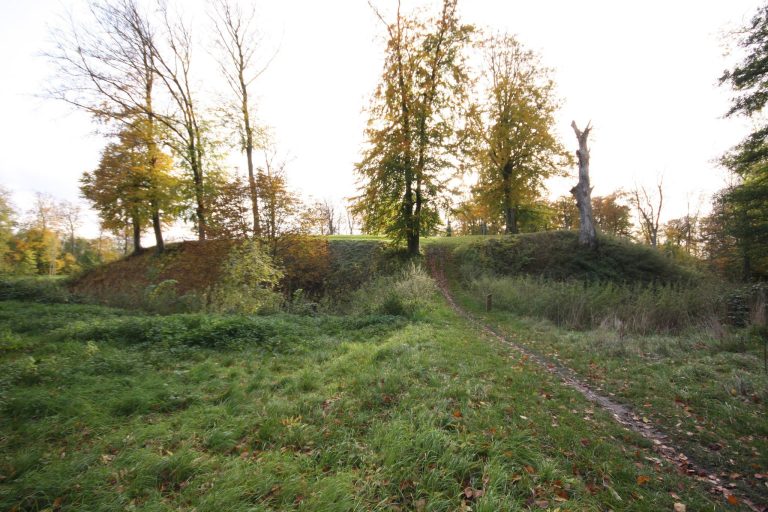
The later fortress surrounding the castle included broad earthworks, bastions, and covered gates known as poternes, protected gates or passages through a fortification. The new defensive landscape was built as Nyborg developed into a royal fortress and citadel under Frederik III. The surviving royal wing and lower watchtower were incorporated into military storage, while the surrounding works continued to shape the site after the castle ceased to function as a royal residence.
Interiors and archaeological evidence
Historic rooms and banqueting halls
After the twentieth-century restoration, rooms were furnished with historic furniture acquired from various manor houses. The castle contains three historically themed banqueting halls. The Danehof Room is associated with the medieval parliamentary meetings, Margrethe’s Hall represents meetings of representatives of the Kalmar Union, and Christian III’s Hall presents the period when Nyborg served as the country’s capital until 1560.
Moat and courtyard discoveries
Excavations in 2012 recovered an oak pile used to secure the edge of the moat or an earthwork. Its dating provided the evidence for placing completion of the moat system and the earliest castle construction in 1209–10. Together with the canals, sluices, and water supply from the Vindinge River, this find helps clarify how the castle’s defensive landscape was engineered.
The earthwork ramparts surrounding the castle also provide habitat for the rare spider Atypus affinis. The surviving masonry, reused building materials, storage adaptations, archaeological discoveries, and later fortifications together reflect the castle’s long transition from royal stronghold to military complex and museum.