Antvorskov: Hospitaller Headquarters and Royal Castle in Denmark


Site at a Glance
- Rating
- 3.9
- Popularity
- Low
- Country
- Denmark
- Primary era
- Medieval
- Eras represented
- Medieval
- Civilizations
- Danish, Knights Hospitaller
- Site type
- Religious
- Remains
- Monastery
On this page10 sections
History
Antvorskov is a ruined religious and royal complex near Slagelse in Denmark, founded by the Catholic Order of Saint John of Jerusalem, also known as the Hospitallers, around 1170. King Valdemar the Great granted land there to the Order in 1165, during the time of Eskil, archbishop of Lund. The exact foundation year is unknown. Antvorskov became the Order’s principal Scandinavian house and headquarters, probably the first Hospitaller settlement established in the Nordic region.
The Hospitaller settlement
The Hospitallers were a Catholic religious and military order originally associated with caring for pilgrims and the sick. Their headquarters later moved from the Holy Land to Rhodes and then Malta, while regional houses such as Antvorskov managed property and charitable responsibilities. Antvorskov was a hospital and an Order settlement rather than a monastery in the strict sense, since its brothers were not monks.
The settlement first supported pilgrims traveling to the Holy Land and increasingly assisted local people, particularly those suffering from leprosy. Its prior stood under the authority of the Order’s senior officer in Germany, the grand master on Rhodes and later Malta, and the pope. Before the Reformation, the prior often sat on Denmark’s Council of the Realm, the kingdom’s principal political council.
Antvorskov grew into one of Denmark’s major landowners during the thirteenth and fourteenth centuries. People seeking a quasi-religious retirement sometimes donated all or part of their property, while families gave land in exchange for perpetual prayers for deceased relatives or burial places inside the abbey church. The settlement eventually controlled farms and estates across Denmark and as far south as Rügen, a German island in the Baltic Sea. A daughter abbey was established at Maschenholt there in 1435.
The Order’s central administration repeatedly reprimanded Antvorskov for failing to send the required surplus to the mother house, first on Rhodes and later on Malta. The settlement may have been the wealthiest of the Order’s Danish houses. It was governed by a hospital prior and a church prior, with the hospital prior senior. The community probably consisted mainly of priests and serving brothers rather than knights, although Danish knights are considered unlikely. Its connection with the nobility made it especially attractive to aristocrats seeking admission in old age.
Late medieval rebuilding
Henrik of Hohenscheid advised Kings Erik V and Erik VI, who rewarded the institution with numerous profitable holdings. Between 1468 and 1490, the complex was rebuilt under Jep Mortensen, who also added a chapel to the abbey church. Eskil Thomesen, the last Catholic prior, was allowed to wear episcopal vestments, the distinctive garments associated with a bishop, and to perform episcopal functions, although he had not been ordained as a bishop.
Antvorskov was connected directly with the religious conflicts that transformed Denmark in the sixteenth century. Hans Tausen lived there as a brother before being sent abroad, where he became strongly influenced by Martin Luther. After Tausen returned, Thomesen sent him to the Hospitaller house at Viborg. Thomesen opposed Lutheran teaching and had Tausen imprisoned there after Tausen preached on Good Friday in 1525. The sermon helped trigger the Reformation in Denmark, the sixteenth-century religious transformation that established Lutheran churches across much of northern Europe.
Reformation and royal conversion
Thomesen refused to ratify Christian III’s election as king in 1534 because of his opposition to him. After Count Christopher of Oldenburg failed to restore Christian II, Christian III persecuted Thomesen and the institution, while also demanding money from the monastery to repay debts incurred in securing his election. At the Reformation, Antvorskov’s property passed to the crown with other ecclesiastical goods. The prior continued to administer the institution for a time, but as the brothers died, its revenues went to the royal treasury. In 1580, a secular fief-holder was appointed and the institution was secularized.
Frederik II then decided to use Antvorskov as a royal residence. A fief was an estate granted by a ruler in return for service or administration, and in 1580 the king granted Antvorskov to the Mecklenburg nobleman Peder Reedtz, who also received Sorø Monastery. The former religious complex began to be converted into a royal castle. Its position suited the king’s journeys through the Danish provinces after crossing the Great Belt from Nyborg, and the surrounding game-rich forests may also have influenced the choice.
The conversion had advanced enough by July 1584 for a session of the Danish national assembly to meet at Antvorskov. Frederik II later stayed there while supervising the education of his son, Prince Christian, who had been acclaimed at Ringsted and placed at school in Sorø. In an open letter issued in April 1585, the king prohibited the property from being called a monastery or by any name other than Antvorskov Castle. The stated penalty for using the forbidden designation was a live ox.
Antvorskov’s period as a royal residence ended with Frederik II’s death there on 4 April 1588. It subsequently became a royal household fief, supporting the monarch’s household and expenses. Christian IV generally stayed only while passing through or when epidemics made residence elsewhere on Zealand inadvisable. For that reason, a national assembly was held at Antvorskov in 1619.
Disrepair, secular administration, and dissolution
The complex fell into serious disrepair late in Christian IV’s reign and suffered further damage during the Swedish War of 1657–1660. From 1662, Antvorskov was the residence of the official governing Antvorskov County. The fief-holders from 1580 to 1662 were Peder Reedtz, Christian Friis, Ebbe Munk, Ernst Nordmand, Wentzel Rothkirch, and Hugo Lützow. Lützow later served as county official from 1662 to 1693.
In 1703, Frederik IV made the fief a county for his morganatic wife, Elisabeth Helene von Vieregg. After her death in 1704, it passed to her son and heir, Frederik Gyldenløve, who died on 9 March 1705. The county then reverted to the crown. Between 1717 and 1763, Antvorskov formed one of Denmark’s twelve cavalry districts. Such districts used their revenues to support the national army, while troops were quartered in the old castle. The church reopened for services in 1722, although it had been closed in 1684 and its congregation directed to Saint Peter’s Church in Slagelse.
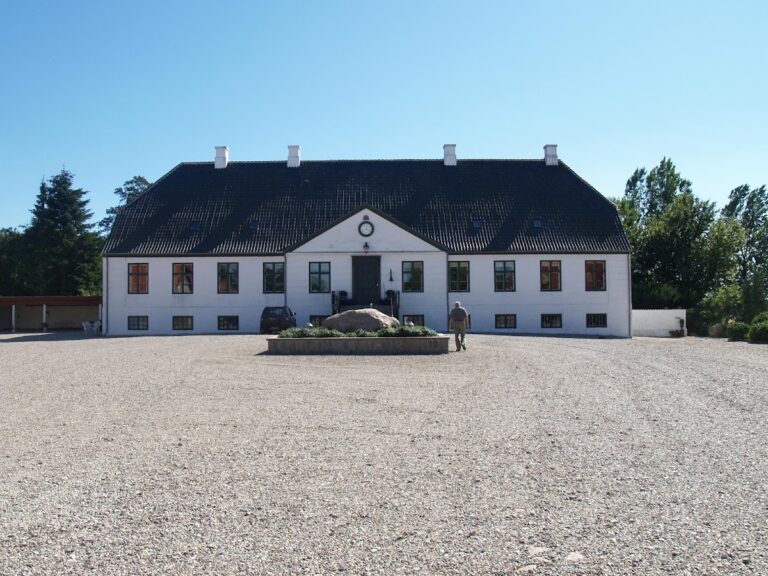
In 1774, the property was sold at auction as private property to Georg Ditlev Frederik Köes. He ordered the church demolished and its materials reused in rebuilding his manor at Falkenstein. The lands were divided into nine large estates that passed to local noble families. The remaining estate was divided into four parcels and sold in 1799 by State Minister Bruun. One estate retained the name Antvorskov until 1806, when it was divided into smaller units.
Several fixtures from the former settlement, including an altar and a baptismal font, were transferred to nearby Saint Peter’s Church. The last ancient buildings were demolished in 1816. Antvorskov subsequently became a picturesque reminder of the distant past. Hans Christian Andersen mentioned excursions to its ruins in his autobiography and referred to Antvorskov in A String of Pearls. Archaeological work by the National Museum in 1888 investigated the ruins, while excavations had also brought substantial remains of the older buildings to light.
Remains
Antvorskov survives as the ruin of a former Hospitaller settlement and royal complex about one kilometre southeast of Slagelse on Zealand, Denmark’s largest island. The original layout included an abbey church, a hospital, and other buildings associated with the Order. Medieval brick buildings dating from the twelfth century were rediscovered in 1887, and their ruins remain on the site. Excavation areas investigated by the National Museum in 1888 revealed substantial remains of the earlier complex.
Religious and medieval buildings
Abbey church and chapel
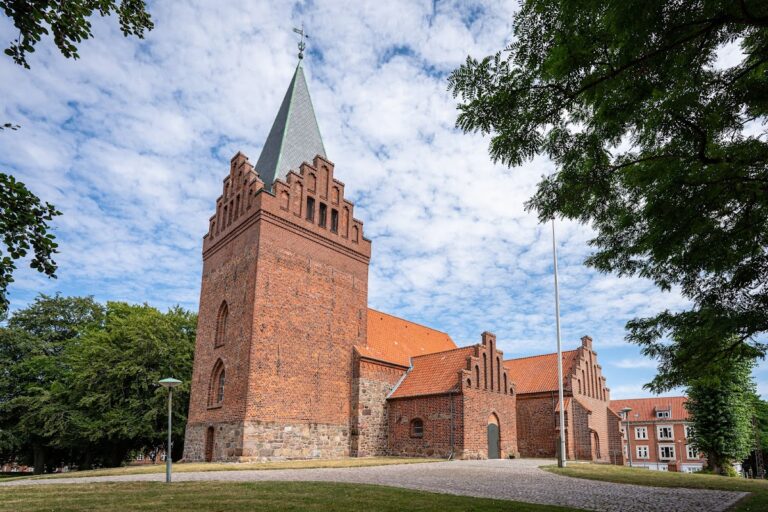
The abbey church formed one of the principal elements of the Hospitaller settlement. Jep Mortensen’s rebuilding between 1468 and 1490 included a new chapel attached to the church. During the later conversion into a royal castle, the church tower received a very tall spire. The church was eventually demolished, and its materials were reused at Falkenstein. An altar and a baptismal font from the former religious complex were transferred to Saint Peter’s Church in Slagelse.
Hospital and settlement buildings
The hospital and associated buildings served the Hospitaller community’s religious and charitable functions. The surviving medieval brickwork belongs to buildings dating from the twelfth century, and excavation exposed substantial parts of the older structures. The former monastic buildings were progressively dismantled during the royal conversion and later decline, leaving ruins that preserve the archaeological layout of the religious settlement.
Archaeological remains
The National Museum’s excavation area on the property was examined in 1888. The ruins uncovered there were displayed in the museum building on Kongevejen in Slagelse. Together with the remains rediscovered in 1887, the excavated structures provide the principal physical evidence for Antvorskov’s medieval buildings and their later transformation.