Stafford Castle: A Norman Motte-and-Bailey Fortress and Medieval Stronghold


Site at a Glance
- Rating
- 4.5
- Popularity
- Medium
- Country
- United Kingdom
- Primary era
- Medieval
- External website
- Open
- Eras represented
- Medieval, Modern
- Civilizations
- British, English, Norman
- Site type
- Military
- Remains
- Castle
On this page9 sections
History
Stafford Castle is a fortified site in Stafford, United Kingdom, begun by the Normans as a timber castle during the 1070s. It became the seat of the powerful Stafford family and developed from an early motte-and-bailey fortress into a medieval stone castle, a Royalist stronghold during the English Civil War, and a nineteenth-century Gothic Revival reconstruction on medieval foundations.
Mercian and Norman origins
A tradition recorded by the Staffordshire historian Robert Plot, who cited the Anglo-Saxon Chronicle, attributes an earlier castle and adjacent fortified town at Stafford to Æthelflæd in 913. Æthelflæd was the Mercian ruler who defended and expanded Mercia during the early tenth century. The precise location of this probably wooden fortification is unknown.
Shortly before the medieval castle was built, the Saxon leader Eadric the Wild led a failed rebellion against Norman rule. The conflict ended with the Anglo-Saxon defeat at the Battle of Stafford in 1069. During the following decade, the Norman magnate Robert de Stafford, also known as Robert de Tosny, built a timber castle at the site. William the Conqueror had granted him 131 manors, mainly in Staffordshire. This landed power enabled Robert to control and tax the native Anglo-Saxon population and helped prepare for the Norman invasion of Wales in 1081.
From the Norman Conquest, Stafford Castle was the seat of the family that took its name from the town. The family began as the de Tosnys and continued through a female line as the de Staffords. By 1086, the castle was recorded as part of this authority in the Domesday Book, William the Conqueror’s survey of landholding and resources. Members of the family later became feudal barons of Stafford, Barons Stafford by writ in 1299, Earls of Stafford in 1351, and Dukes of Buckingham in 1444.
The stone castle and the Stafford dynasty
In 1347 Ralph de Stafford contracted a master mason to construct a stone castle on the existing motte. About three years later, Ralph became Earl of Stafford after serving as one of the king’s leading commanders during the first phase of the Hundred Years’ War, the long conflict between the English and French crowns. The new stone fortress reached its height under his descendant Humphrey Stafford, who became the first Duke of Buckingham in 1444.
Humphrey was killed at the Battle of Northampton in 1460. His grandson Henry Stafford, 2nd Duke of Buckingham, initially supported Richard III but rebelled in 1483 in support of Henry Tudor’s attempted invasion. The rebellion failed, and Henry Stafford was executed. His son Edward Stafford, 3rd Duke of Buckingham, survived and was later restored to his lands by Henry VII. Henry VIII regarded Edward’s royal ancestry as a threat and had him executed in 1521.
Edward’s execution caused the Stafford estates, including Stafford Castle and its deer parks, to escheat to the Crown. In English law, escheat meant the reversion of property to the Crown after forfeiture or the failure of an eligible succession. Royal auditors praised the castle’s deer and considered the site a possible stopping place during royal progresses, the formal journeys made by monarchs through parts of their kingdoms.
The castle and a small parcel of land were later returned to the Staffords, but the family did not regain its former wealth or status. Poor maintenance allowed the keep to deteriorate. In 1603 Edward Stafford, 3rd Baron Stafford, described it in a letter as “my rotten castle of Stafford.”
Civil War, destruction, and ruin
During the English Civil War, the seventeenth-century conflict between Parliamentarian forces and the Royalists who supported Charles I, Stafford Castle was held for the Royalists by Lady Isabel Stafford. She was a Roman Catholic and the widow of Edward Stafford, 4th Baron Stafford.
Parliamentarian forces captured Stafford town on 15 May 1643. Part of the defeated Royalist garrison withdrew to the castle, intending to use it as a bridgehead for an attempt to retake the town. Colonel William Brereton demanded Lady Stafford’s surrender, but she refused. Parliamentarian troops then burned many residential and service buildings after fire-setting failed to force a capitulation. The defenders shot some of their own men and horses.
A relief force led by Colonel Hastings arrived on 5 June. Lady Stafford was subsequently persuaded to leave, while a small garrison remained in the castle. In late June, the remaining Royalists fled after learning that a large Parliamentarian army with siege artillery was approaching. The castle passed to Parliament, and on 22 December 1643 the Parliamentarian Committee of Stafford ordered its demolition.
By 1698, when Celia Fiennes visited Stafford, the castle was ruinous and the overgrown fortified trenches were the only features visibly remaining on the hill. By the 1790s, just a low wall stood above ground. Workmen underpinning it discovered buried basements and foundations, leading Sir William Jerningham to order the mound cleared and these remains exposed.
Reconstruction and archaeological investigation
The Jerningham family began partly rebuilding the castle in the early nineteenth century. The reconstruction used the foundations of the medieval castle and much original medieval stonework, but followed the Gothic Revival, a nineteenth-century revival of medieval Gothic architectural forms. The reconstructed keep was intended as a residence and remained inhabited into the twentieth century. Financial difficulties and the family’s elevation to the peerage contributed to the partial halt of the work.
In the early postwar period, woodland around the keep was felled, possibly increasing the buildings’ exposure to high winds. Masonry fell from the towers in 1949, and the buildings were declared unsafe. The last caretakers, Mr and Mrs Stokes, left that winter. The site subsequently suffered vandalism, and in 1961 Lord Stafford transferred the keep to the local authority.
In 1962 the towers and surviving north wing were reduced and secured to the height of the north facade. Professional excavations began in 1978, revealing the complexity of the site’s archaeology. The work continued for many years and employed large numbers of young people during the severe economic depression of the early 1980s. A reconstructed medieval herb garden was created during the excavations. In 1988 the site’s public opening was accompanied by a heritage trail with interpretation and improved paths, followed by a purpose-built museum below the mound in 1992. Stafford Castle is a Grade II listed historic building, a category identifying special architectural or historic interest and providing statutory protection.
Remains
Stafford Castle occupies a modified glacial deposit shaped into a timber-and-earth motte-and-bailey fortress. The medieval complex included two baileys, or defended courtyards, and a village beyond them. Its surviving mound, banks, ditches, and other earthworks remain legible across more than four hectares, while associated woodland covers about 6.4 hectares. Three medieval deer parks once extended beyond the earthworks.
Earthworks and defensive layout
The artificial motte platform remains clearly defined, with many of the surrounding ditches and earthwork outlines still visible. These features preserve the basic defensive arrangement of the early Norman castle, in which the raised mound supported the principal fortified position and the baileys provided enclosed areas beside it. The woodland may originally have been cleared to accommodate livestock. A heritage trail uses archaeological illustrations and watercolours to interpret the surviving banks, ditches, and earthworks. Within the grounds, a reconstructed medieval herb garden represents another element of the site’s archaeological presentation.
The medieval keep and Gothic Revival reconstruction
The medieval stone keep was built on the motte after Ralph de Stafford’s 1347 building contract. It had a rectangular plan and originally carried a tower at each corner. A fifth tower was later added at the centre of the north wall, which in fact faces west.
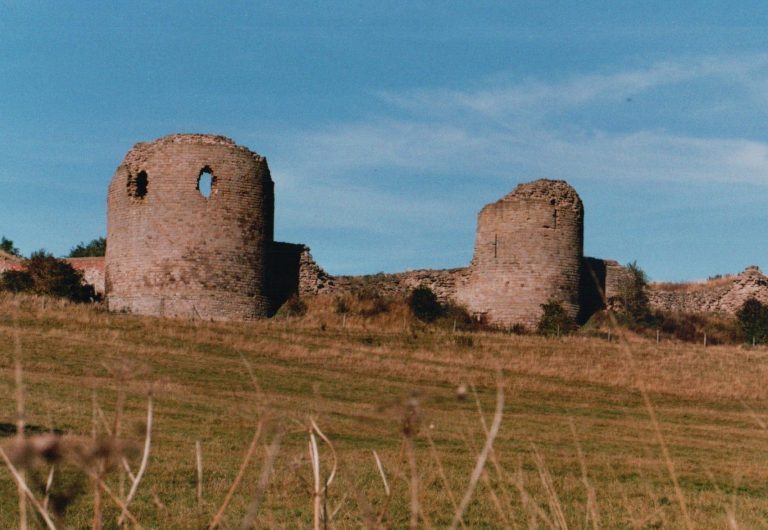
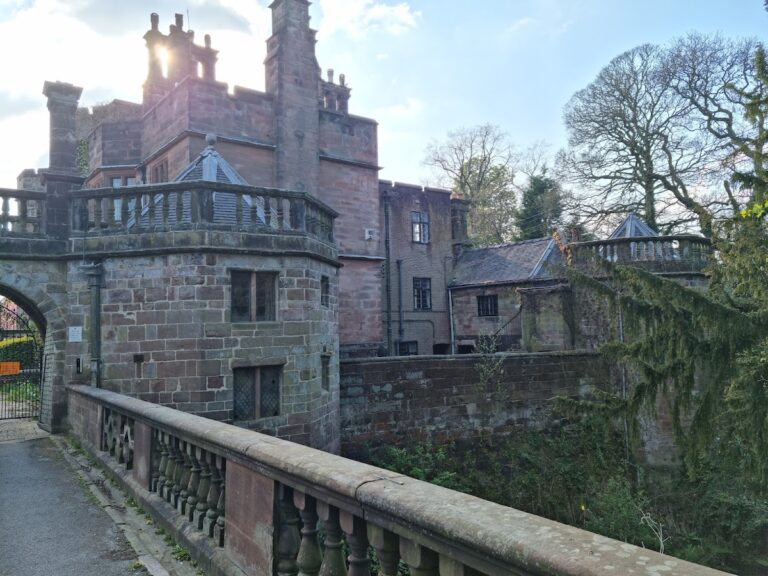
The standing stone keep is an early nineteenth-century Gothic Revival reconstruction raised on the medieval foundations. It incorporates much of the original medieval masonry and is an important early example of a Gothic Revival donjon, meaning a castle’s principal fortified tower or keep. The postwar work reduced the towers and the surviving north wing, securing them to the height of the north facade. The remaining masonry therefore combines medieval fabric, nineteenth-century reconstruction, and twentieth-century safety measures.
Museum and archaeological interpretation
The museum opened near the castle mound in 1992. Its displays include a scale model showing how the castle may have appeared under the Normans, along with a cabinet containing finds, objects, and documents associated with the site. Together with the heritage trail, these displays interpret the relationship between the reconstructed keep and the surviving archaeological earthworks.