Stone Priory: A Religious House in Staffordshire
Site at a Glance
- Popularity
- Medium
- Country
- United Kingdom
- Primary era
- Medieval
- Eras represented
- Medieval, Early Modern
- Civilizations
- British, English
- Site type
- Religious
- Remains
- Monastery
On this page11 sections
History
Early foundation and legend
Stone Priory was an early medieval religious foundation in Stone, Staffordshire, United Kingdom, established around 670 and later refounded as an Augustinian priory. Many descendants of its medieval refounder, Robert de Stafford, were buried there.
The foundation story centres on Wulfad, a local seventh-century Christian martyr traditionally described as a son of Wulfhere, king of Mercia. In the legend, Wulfhere had become Christian before taking the throne but later returned to paganism. He killed Wulfad and his brother Rufin after they converted to Christianity, and their mother, Queen Ermenilda, founded the priory at their grave. The story identifies Ermenilda as a daughter of Eorcenberht, king of Kent. It may have drawn on an episode Bede, an early medieval monk and historian, placed elsewhere, more than ten years after Wulfhere’s death.
Augustinian priory and Stafford family
In the Middle Ages, Robert de Stafford, an Anglo-Norman nobleman and Stafford’s first feudal baron, re-established the house as a priory for Augustinian canons. These clergy lived in community according to the Rule of Saint Augustine. Robert was an ancestor of the Earls of Stafford and Dukes of Buckingham, and many of his descendants were buried at the priory.
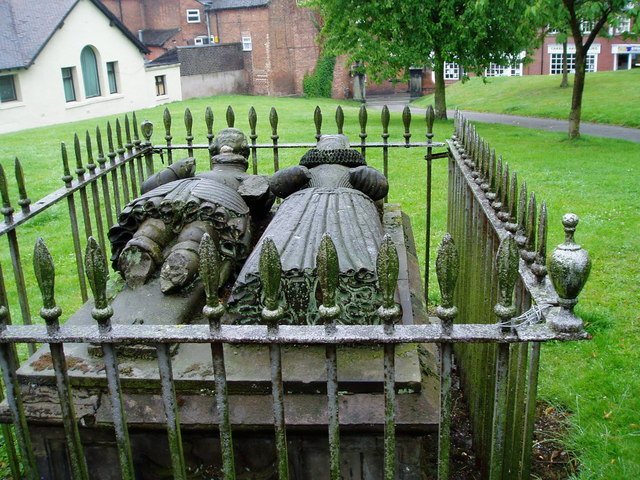
Among those interred there were Hugh de Stafford, 2nd Earl of Stafford (1342–1386), whose bones were brought to the priory after he died on crusade in Rhodes. His wife, Philippa de Beauchamp, was buried beside him, as was their son and heir, Thomas Stafford, 3rd Earl of Stafford (c. 1368–1392). A mid-15th-century verse work, The Rimed Chronicle of Stone Priory, recounts the foundation legend and names Stafford patrons through 1403 and their burial places. It was found at the priory during the Dissolution of the Monasteries.
Dissolution and later change
After Henry VIII’s suppression and closure of religious houses in England, known as the Dissolution of the Monasteries, the priory was bought by William I Crompton, a Stafford merchant who had made his fortune in London. The medieval buildings collapsed during the 1750s and were demolished. St Michael and St Wulfad’s Church took their place.
Remains
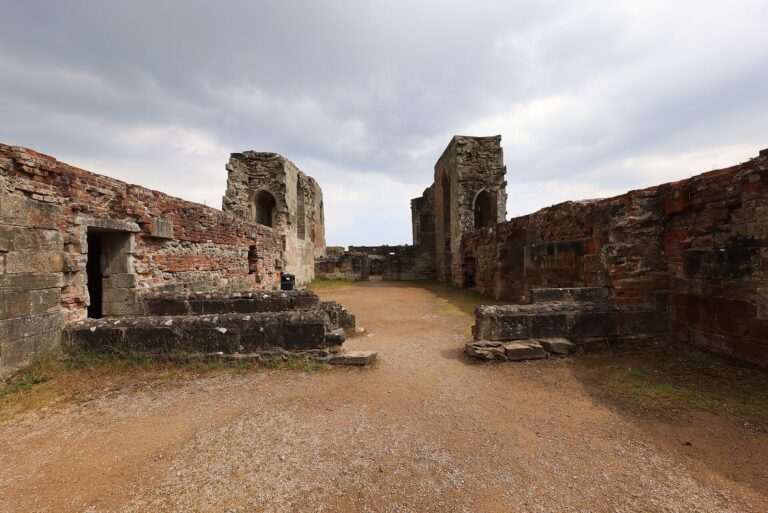
Stone was the priory’s building material. Its surviving remains are found in the church on Lichfield Street, fragments of an old wall in Abbey Street, a vaulted lower level incorporated into Priory House, and slight traces in the garden east of the house.
Buildings and structural remains
St Michael and St Wulfad’s Church
The church stands on Lichfield Street, and much of the stone from the priory buildings was reused in its construction.
Undercroft and Priory House
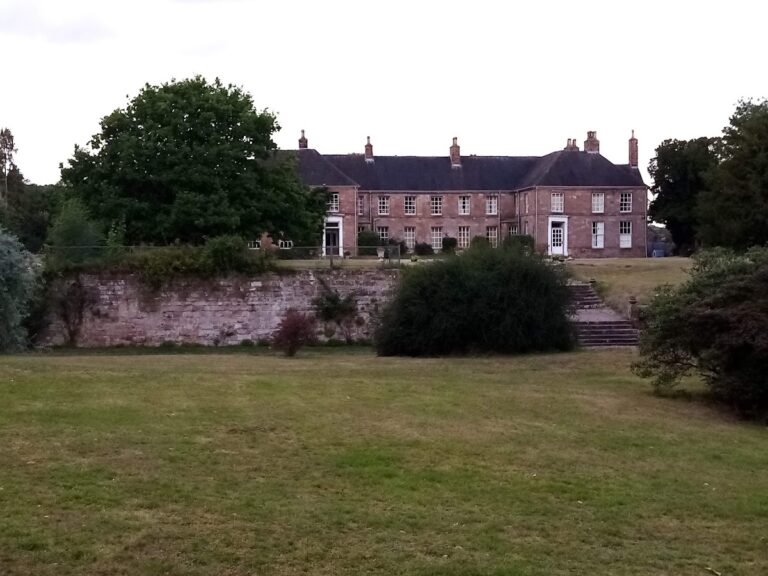
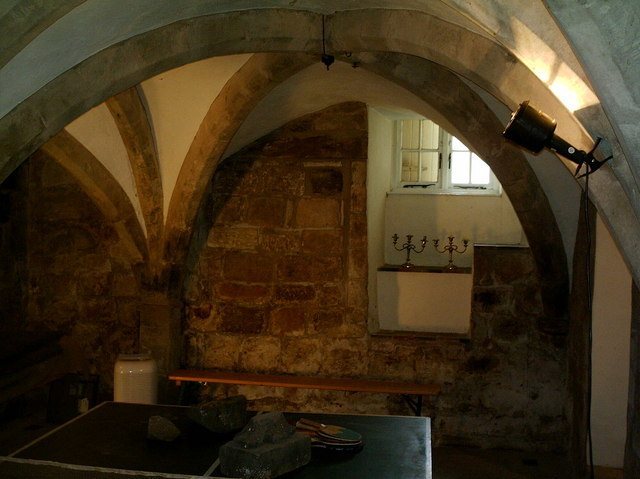
Part of the priory’s western range survives beneath Priory House, also known as The Priory. The post-1750 house may have been built as a rectory. Its cellar contains a rib-vaulted undercroft, a vaulted lower level with intersecting arched ribs, comprising four or more sections. An 18th-century wall inside the house blocks part of the former crypt.
Wall in Abbey Street
Fragments of an ancient wall remain in Abbey Street.
Possible chapter-house remains
Slight traces in the garden east of the house may belong to the chapter house, the room where a monastic community met for formal business. They include part of a large pier with four lobes in cross-section and hollows between them. The pier probably dates to the early 14th century.
Bronze seal
A bronze seal used by the priory’s prior in the 13th century was found by a metal detectorist in a field near Cobham, Surrey, in August 2011. The prior pressed it into wax to seal legal documents. The almond-shaped seal depicts the seated Virgin Mary holding a palm frond associated with martyrdom, with the haloed infant Christ on her knee. Christ holds an object that may be a bound Gospel book or a model of the priory church, and raises two fingers in blessing. Its inscription translates as “Seal of the church of Saint Mary and Saint Wulfad, Martyr, of Stone.” Fundraising secured its permanent display in Stone.