Chartley Castle: A Medieval Fortress in Staffordshire


Site at a Glance
- Rating
- 4.4
- Popularity
- Very Low
- Country
- United Kingdom
- Primary era
- Medieval
- Eras represented
- Medieval
- Civilizations
- English
- Site type
- Military
- Remains
- Castle
On this page8 sections
History
Chartley Castle is a medieval castle ruin in the United Kingdom, north of Stowe-by-Chartley in Staffordshire. One of the early Earls of Chester built it around 1100 as a secure overnight stopping place on journeys to locations including Tutbury. Its principal rebuilding came in 1220, when Ranulph de Blondeville, the 4th Earl of Chester, reconstructed the castle in stone.
The Earls of Chester and Ferrers
Ranulph died in 1232, after which Chartley passed by marriage to William de Ferrers, the 5th Earl of Derby. The Ferrers family retained the castle for more than two centuries. In 1453, it passed through Anne de Ferrers, the Ferrers heiress, to her husband Walter Devereux. Through his wife, Walter acquired the title Baron Ferrers of Chartley in 1461. He was killed at the Battle of Bosworth in 1485, the battle that ended the Wars of the Roses and brought Henry Tudor to the English throne.
Abandonment of the castle
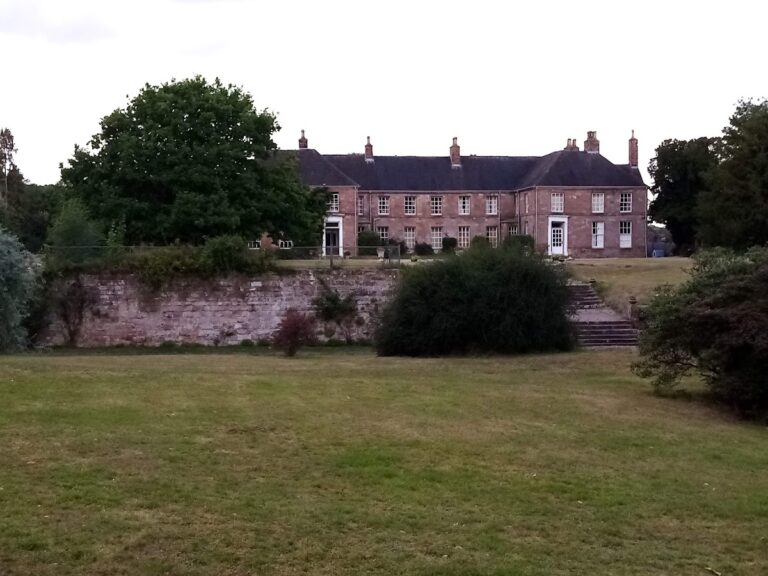
After 1485, Chartley Castle ceased to serve as a residence. A nearby moated and battlemented timber mansion, Chartley Manor, was built in its place. The manor later became one of the final places where Mary, Queen of Scots, was imprisoned. The manor house was destroyed by fire in 1781. The building now called Chartley Manor was known as Chartley Manor Farm until the 1980s.
Mary, Queen of Scots at Chartley Manor
Chartley Manor belonged to Robert Devereux, the 2nd Earl of Essex, when it was used to hold Mary, the Catholic queen of Scotland who was imprisoned in England during Elizabeth I’s reign. In September 1585, Amias Paulet, Mary’s jailor, visited from Tutbury Castle and judged the house barely large enough for both households. He considered its deep moat, narrow in places, useful for security. It also allowed Mary’s laundry to be washed without her maids leaving the house. Paulet thought the low, water-surrounded setting might nevertheless be unpleasant for Mary because she was sensitive to damp conditions.
Paulet planned to move Mary the approximately twelve miles from Tutbury to Chartley before Christmas 1585, avoiding the busy market town of Uttoxeter. She spent almost a year at Chartley, and her health improved there. In June, she was carried outside to watch duck hunting on the ponds around the house.
In August 1586, Francis Walsingham devised a plan connected with the Babington Plot, a Catholic conspiracy intended to remove Elizabeth I and place Mary on the English throne. The plan involved removing Mary from Chartley under the pretence of taking her hunting while her leading household members were arrested and her papers seized. On 11 August 1586, Mary was arrested while riding and hunting with a crossbow. Her party included her secretaries Claude Nau and Gilbert Curle, Bastian Pagez, her doctor Dominique Bourgoing, and others. Armed soldiers took them to Tixall.
On 25 August, Walsingham wrote to Paulet from Windsor Castle that Elizabeth I had ordered Mary not to leave Tixall. Paulet nevertheless returned her to Chartley that same day. Claude Nau, Gilbert Curle, and the cipher clerk Jerome Pasquier were arrested and questioned about Mary’s involvement in the Babington Plot. Mary was removed from Chartley to Fotheringhay Castle in Northamptonshire on 21 September 1586 and was executed there on 8 February 1587.
Protection and interpretation
The castle remains and associated earthworks have been protected as a Scheduled Monument since 1925. This designation provides legal protection for an archaeological or historic site in England. The castle itself is also a Grade II* listed building, a category reserved for buildings of particularly important architectural or historic interest.
Remains
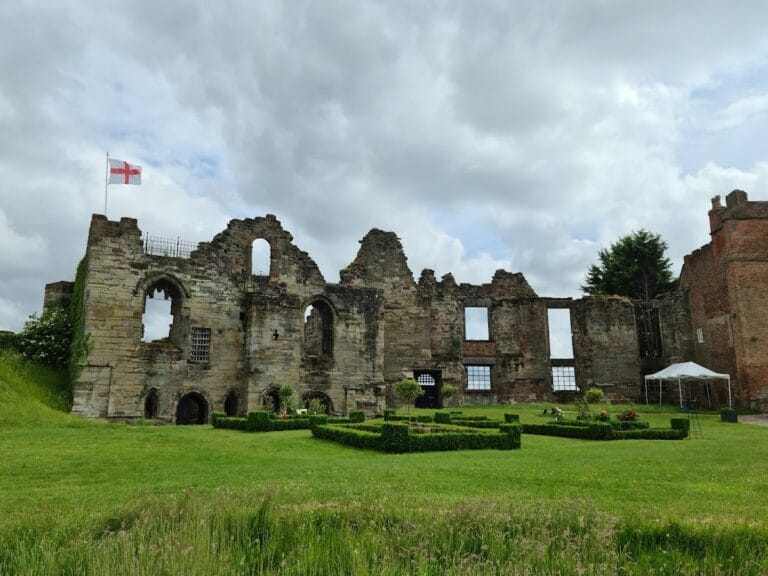
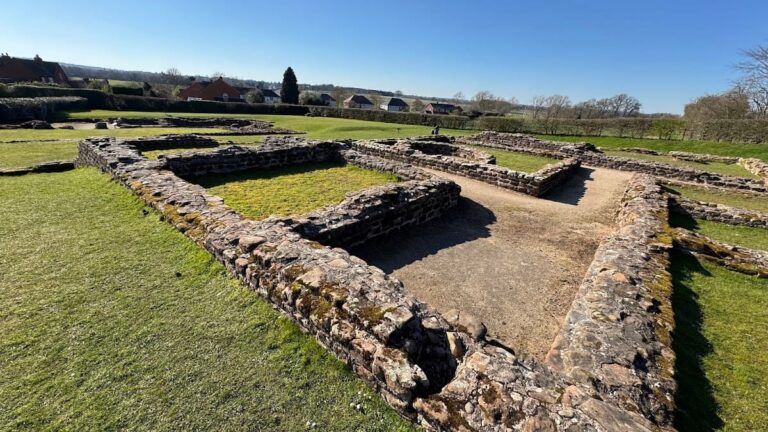
Chartley Castle survives as a medieval ruin with substantial masonry and associated earthworks. Its principal elements include a rare cylindrical keep, a curtain wall connecting defensive towers, a twin-towered gatehouse, and an angled tower. A nineteenth-century survey measured five towers at approximately 35 to 41 feet in external diameter and recorded the keep as approximately 50 feet across.
Fortification plan
The curtain wall, a defensive wall joining towers, formed part of the castle’s fortified circuit. Two half-round towers flanked it, while the twin-towered gatehouse controlled the main entrance. The rare cylindrical keep, the principal fortified tower, stood within the plan alongside the other towers, including the angled tower. The arrangement has been compared with the Château de Montlhéry near Paris, which Ranulph de Blondeville may have known. M. W. Thompson also identified numerous architectural similarities between Chartley, Bolingbroke Castle in Lincolnshire, and Beeston Castle in Cheshire, all thought to have been built under de Blondeville.
Chartley Manor
The nearby Chartley Manor was a low-lying timber mansion surrounded by a moat and equipped with battlements. Its moat was deep but narrow in places and enclosed the house. The building was destroyed by fire in 1781, leaving the castle ruin as the surviving medieval fortification associated with the site’s earlier history.
Nearby sites