Château de Najac: A Medieval Fortress in France


Site at a Glance
- Rating
- 4.6
- Popularity
- Medium
- Country
- France
- Primary era
- Medieval
- Eras represented
- Medieval
- Civilizations
- County of Toulouse
- Site type
- Military
- Remains
- Castle
On this page11 sections
History
Château de Najac is a medieval fortress in France, in the village of Najac, built and enlarged under the counts of Toulouse and later royal authorities. First mentioned at the end of the eleventh century, it occupied a commanding position above the lower Aveyron Valley and became a major strongpoint in the western Rouergue during the political conflicts of southern France.
Origins and the Counts of Toulouse
The surrounding lands were associated with the Najac family by the late tenth century, while the family’s presence at the site is known from the twelfth century. The fortress itself appears in the Book of the Miracles of Sainte Foy, which refers to a castellum, or fortified place, called Najac. The earliest castle was probably built around 1100 and consisted of a Romanesque square tower. Its construction is attributed to Bertrand of Saint-Gilles, son of Raymond IV, count of Toulouse.
The base of this tower belongs to the twelfth-century fortress associated with the counts of Toulouse, who held the county of Rouergue. After 1112, they greatly strengthened Najac because it formed a strategic lock in the lower Rouergue. This followed the transfer of certain Toulouse rights to the counts of Barcelona, who acquired the territories that became the viscounty of Millau and the county of Rodez. Najac stood on a route between Rodez and Saint-Antonin and helped maintain Toulouse influence along the Aveyron and Viaur against Trencavel positions to the south and Barcelona interests to the east.
Regional Conflict and Toulouse Authority
Najac was drawn into the conflicts that shaped the region during the twelfth and early thirteenth centuries. In 1141 and 1142, Count Alphonse Jourdain of Toulouse was defeated by Roger I Trencavel. Several co-lords of Najac were connected to the Trencavel network, linking the fortress to the rival noble alliances of southern France. In 1182, Raymond V of Toulouse received royal authorization to hold Najac and Posquières as an increase of fief. Three years later, Richard the Lionheart and Alphonse of Aragon met at Najac to conclude an alliance against the count of Toulouse.
During the early thirteenth century, Najac’s co-lords repeatedly acknowledged Toulouse authority. Eight châtelains, officials responsible for administering and defending a castle, rendered homage to Raymond VI in 1208. In 1219, Guilhem-Bernard, lord of Najac, witnessed a donation by Raymond VI. In 1222, he swore loyalty to Raymond VII and promised not to make a separate peace with the king of France, the Church, or another enemy. The other co-lords made a similar oath in 1227.
King Louis VIII stopped at Najac in 1226, and King Philip III later passed through the settlement while travelling from Albi towards Figeac. On 6 July 1229, Raymond VII received the homage of Guilhem-Bernard of Najac, Géraud de Cadoule, and other local lords for the castrum of Najac. The term referred to a medieval fortified settlement or lordship.
Comital Administration and the Thirteenth-Century Reconstruction
In 1246, Raymond VII bought out the Cadoule family’s share, installed a comital châtelain and bailiff, and made Najac one of the three bailiwicks of Rouergue. A bailiff administered a local territorial district. The Treaty of Lorris had required the count of Toulouse to surrender Najac and several other castles for five years from 1243, but Louis IX ordered their restoration in February 1248 and required supplies and arms from those strongholds to be transferred to Carcassonne.
After Raymond VII died in September 1249, local lords feared that his son-in-law Alphonse of Poitiers would seize Najac. Led by Guilhem de Lavalette, they compelled the châtelain and comital bailiff to surrender the keys of the tower. They then met secretly at Laguépie to seek support from Blanche of Castile. On 3 January 1250, Sicard Alaman, acting for Alphonse while he was in the East, gained entry to the tower after negotiations. Alphonse later secured the remaining feudal rights and the homage of the co-lords.
Alphonse of Poitiers was the brother of Louis IX, also known as Saint Louis. Through his marriage to Joan of Toulouse, daughter and heir of Raymond VII, he became count of Toulouse and acquired authority over Najac. He reorganized his territories through seneschalies and consular institutions, encouraged markets and new settlements, and founded Villefranche-de-Rouergue in 1252. He also ordered Najac to be rebuilt, both to consolidate his authority in the pacified region and to strengthen his lands against nearby Plantagenet territories. The Plantagenets were the ruling dynasty of England, which held extensive lands in southwestern France.
Construction of the new fortress began in 1253 under Jean d’Arcis, seneschal of Rouergue, and continued until 1266. The earlier square tower was incorporated into a larger Gothic fortress of the Philippian type. This style of royal French fortification was associated with Philip II and used strong enclosing walls with projecting round towers and tightly organized defensive planning.
Royal Fortress and Later Conflicts
Najac became a royal fortress and the seat of a royal viguerie. A viguier exercised delegated royal judicial or administrative authority. The fortress remained the chief town of the important seneschalie of Rouergue until 1370, when the seneschal’s seat was permanently transferred to Villefranche-de-Rouergue. Najac retained a viguier and was formally established as a viguerie in 1369.
During the Hundred Years’ War, the conflict between the English and French crowns and their allies, English forces occupied the territory and held the castle for approximately ten years. Najac’s inhabitants eventually entered the fortress by a stratagem, killed the English garrison, and recovered control.
During the Wars of Religion, a series of sixteenth-century conflicts between Catholics and Protestants in France, the castle was held by the Protestant lord of Morlhon. Catholic forces commanded by François de Buisson de Bournazel besieged it. After several months, the defenders capitulated when their supplies of food and water ran out.
The Croquant Revolt and Decline
In summer 1643, peasants taking part in the Croquant revolt seized the castle. Led by Bernard Calmels, also known as Lafourque, the revolt involved more than 10,000 peasants and had failed before Villefranche-de-Rouergue. Troops commanded by the Count of Noailles, governor of Najac, recovered the fortress. Calmels and two lieutenants, Ferrier and the weaver Mathieu Vergnes, were arrested, condemned, and executed in October 1643. Calmels’s head was displayed on a pike on a tower at Marcillac, where the revolt had begun.
After the seventeenth century, the castle lost its military and residential importance and deteriorated. In 1794, it was sold as national property for twelve francs to a local innkeeper, who used it as a stone quarry for nearby houses. Demolition apparently stopped after an accident in the mid-nineteenth century killed three workers, after which the fortress was abandoned.
Rescue and Restoration
The Cibiel family rescued the castle from ruin. The Abbé Brunis partly renovated it at the end of the nineteenth century before selling it to Alfred Cibiel. His family and heirs carried out extensive restoration, and the property later passed to the Montaliva family, which continued the work. The ruins and the second enceinte, an enclosing defensive wall or circuit, were classified as historic monuments by decree on 3 July 1925. The castle is now partially restored.
Remains
Rocky Spur and Defensive Layout
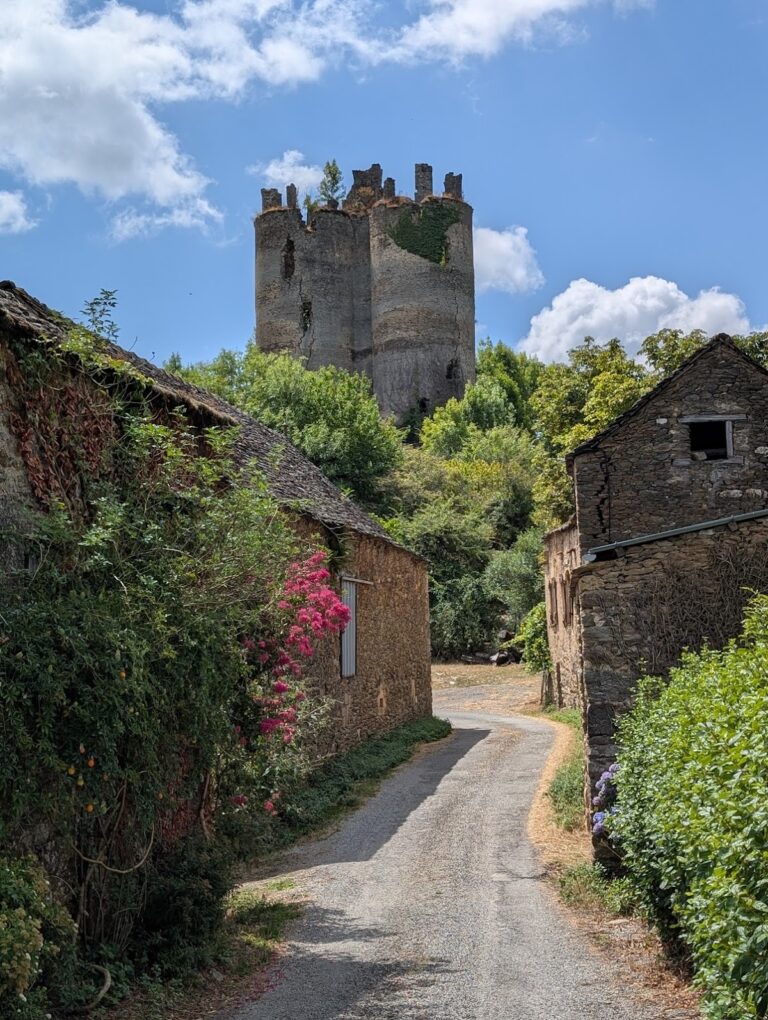
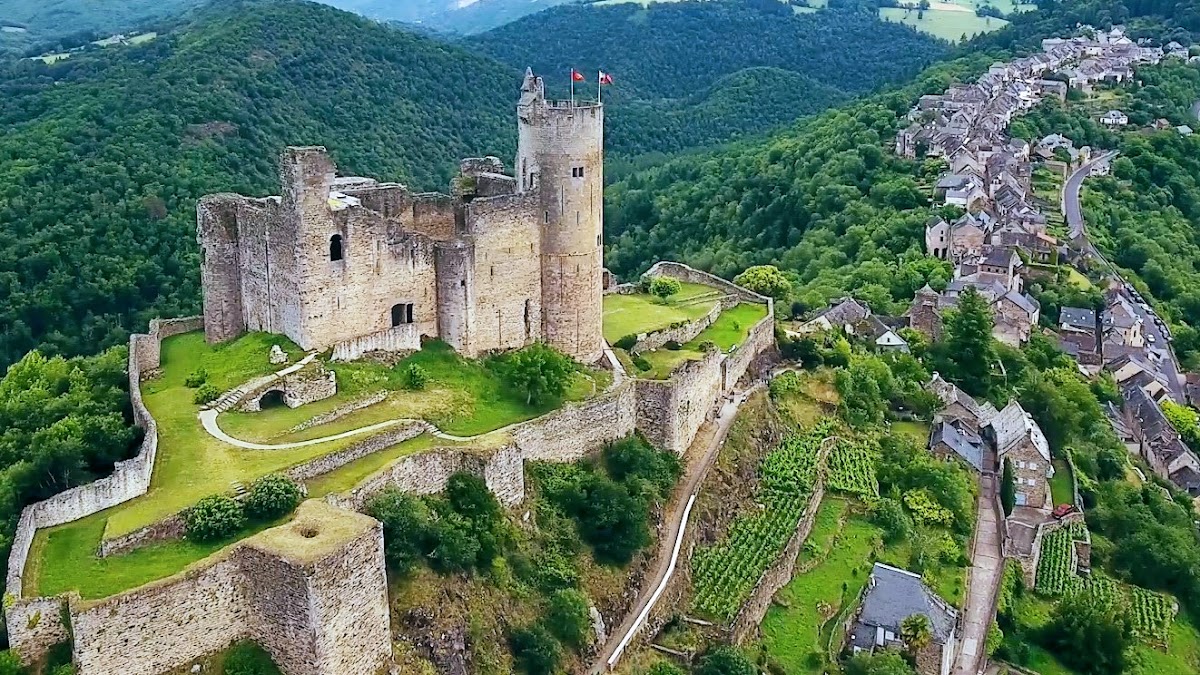
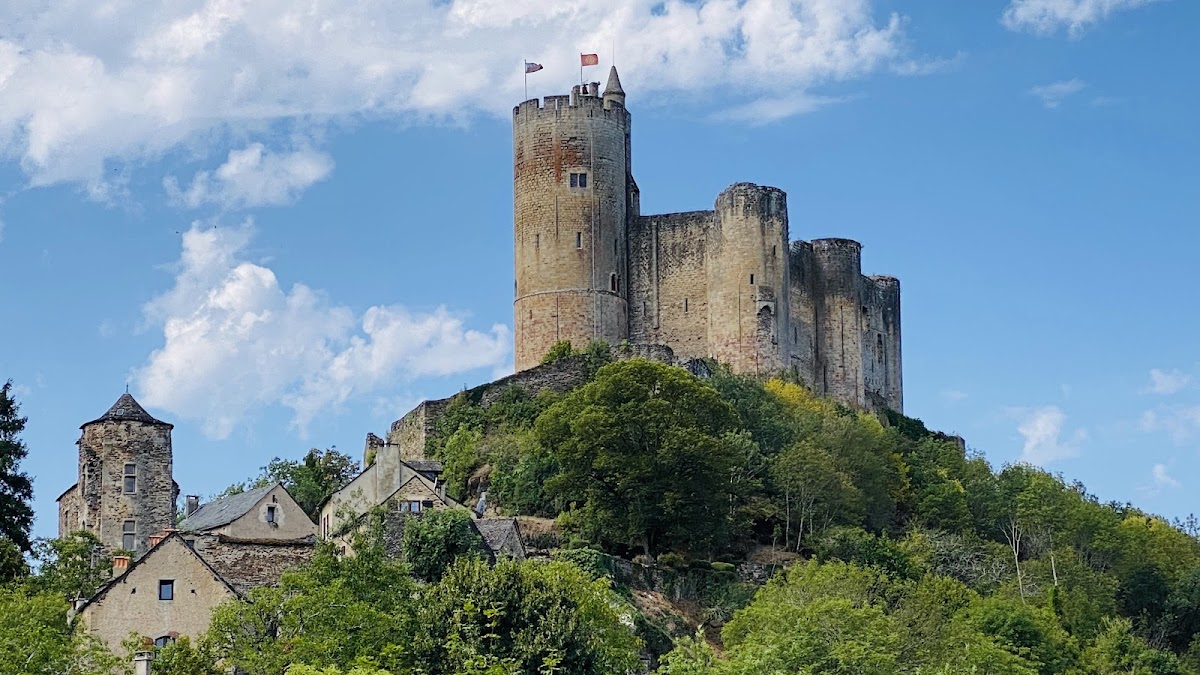
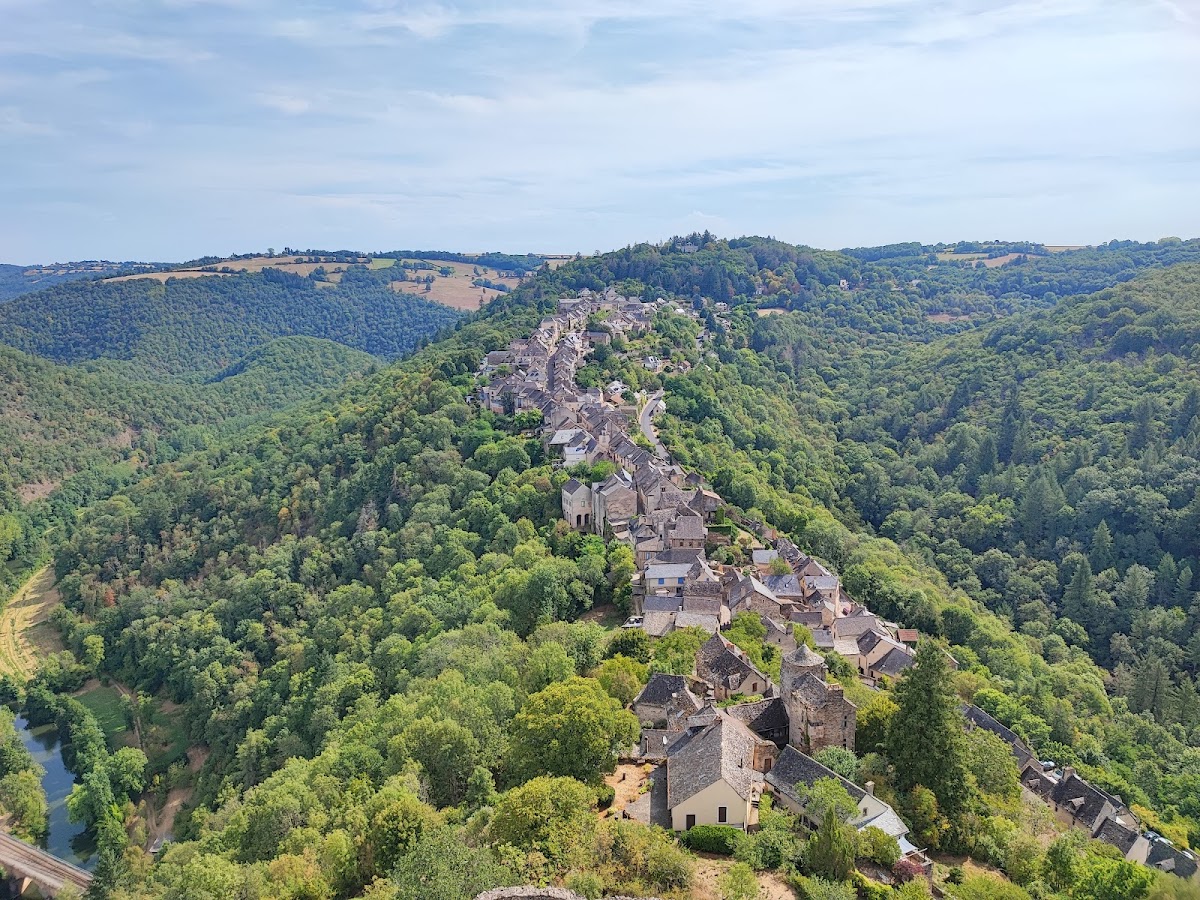
The fortress occupies a narrow, steep rocky spur on a high hill formed by a bend of the Aveyron. The river surrounds it on three sides, and the castle rises approximately 200 metres above the water. The inner enceinte forms a rectangle whose longer side measures about 40 metres. Several defensive lines organize the complex, which includes the earlier square tower, round towers set directly on the rock, and a large central donjon. The village below functioned as a foreburg, a settlement clustered around and supporting a fortress, on the rocky slopes.
The curtain walls rise approximately 25 metres, making them difficult to reach with assault ladders. The steep, narrow spur and the successive defensive lines made approach dangerous and bombardment difficult, while the rocky foundations hindered attempts to undermine the walls. Entry was possible from only one side, across a drawbridge. The gate was protected by defensive openings and an observation structure.
The Donjon and Archer Openings
The central donjon, the principal fortified tower of a medieval castle, rises approximately 39 to 40 metres. Its terrace provided a position from which other strongpoints in the region could be signalled. Standing about 200 metres above the Aveyron, it also occupied the fortress’s commanding position over the river and surrounding territory.
The castle’s tall archer openings measure 6.80 metres. They are described as exceptionally high, even as a world record. Wooden platforms arranged one above another enabled three archers to use the openings at the same time and fire in different directions. These openings formed part of the fortress’s defensive system within the massive masonry.
Earlier Tower and Internal Features
The earlier Romanesque square tower was remodelled and incorporated into the thirteenth-century Gothic complex. A concealed passage within the walls connected it to the chapel in the donjon. The lower part of one tower contains a dungeon. Foliage and heads decorate the corbels of the first armoury and chapel, while traces of painted decoration survive in the chapel.
Rainwater was conveyed from the roofs to a cistern through a stone conduit attached to a wall. Together with the multiple enclosing walls, towers, elevated position, and controlled entrance, this water system formed part of the fortress’s surviving physical organization. The castle remains ruined but partly restored.