Mouzieys Castle: A Historic Defensive Outpost in France


Site at a Glance
- Rating
- 4.3
- Popularity
- Very Low
- Country
- France
- Primary era
- Medieval
- Eras represented
- Medieval, Early Modern
- Civilizations
- County of Toulouse
- Site type
- Domestic
- Remains
- Castle
On this page8 sections
History
Mouzieys Castle is a medieval defensive residence in Mouzieys-Panens, France, probably built during the twelfth century when the village and castle served as an outpost defending Cordes under Raymond VI, Count of Toulouse. Its history reflects the transfer of authority from the counts of Toulouse to the French Crown, followed by ownership disputes, religious conflict, and later domestic alterations.
From the Counts of Toulouse to the Royal Domain
Raymond VI granted the castle as an appanage, a grant of land or revenue to a dependent of a ruling lord, to his vassal Guillaume de Cadolhe. Through Guillaume’s daughter Laure, who married into the Alaman family, the castle later came into the possession of Alphonse of Poitiers. A Capetian prince and the last Count of Toulouse after the Raymondin dynasty, Alphonse brought the property into the succession that followed the end of that ruling line. After his death, Mouzieys entered the royal domain.
The French Crown subsequently ceded the castle to the Penne family. On 29 April 1502, Pons de Penne sold it to the chapter of Albi Cathedral for 5,000 livres, with the purchase taking effect on 1 May. Micheline de Penne challenged the transaction, and the cathedral chapter resold the property in 1506 for 4,500 livres to Bernard de Rabastens, Viscount of Paulin.
Ownership Dispute and Religious Conflict
Although the castle officially belonged to the Rabastens family, members of the Penne family continued to occupy it. Some of their rights were recognized on 13 September 1532. Bernard de Rabastens eventually secured possession on 30 January 1566, six decades after his purchase.
During the French Wars of Religion, the late-sixteenth-century conflicts between Catholic and Protestant forces in France, Mouzieys served as a Catholic stronghold, a fortified place used for defense and military control. In 1573, Catholic volunteers assembled by Philippe de Rodolphe, Bishop of Albi, were lodged at the castle while preparing to drive Protestant forces from Varen.
Protestant troops captured and burned the castle in 1587, at a time when the lordship of Mouzieys had once again returned to royal ownership. The building was remodeled after the fire and altered again during the eighteenth century. Jean-Baptiste de Monestiés, a priest and noble owner, lived in the castle and held it during the second half of the seventeenth century. Shortly before the French Revolution, ownership belonged to Jacques-Victor de Genton, Baron of Villefranche.
Municipal Use
The castle is now owned by the commune of Mouzieys-Panens and serves as the village town hall, giving the historic building a continuing civic function.
Remains
Defensive Setting
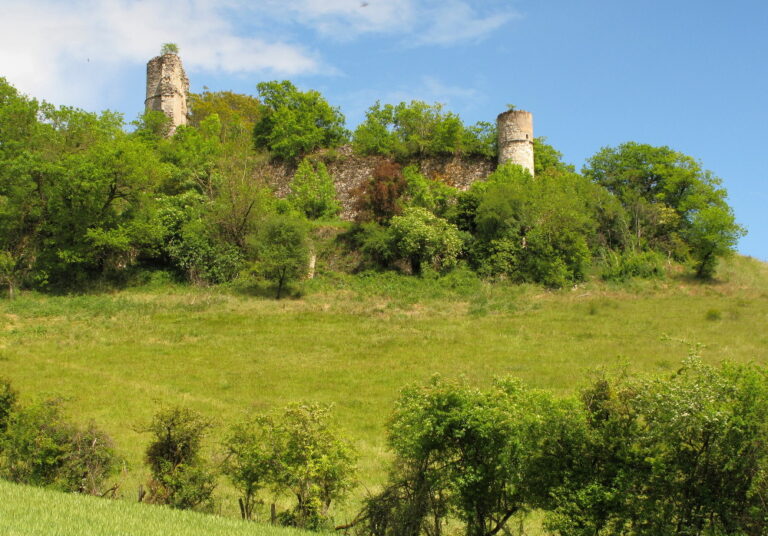
Mouzieys Castle stands on the summit of a small hill and is approached by an access ramp. The ramp once led to a barbican, an advanced defensive structure protecting an entrance, although that feature has disappeared. The elevated position and former entrance arrangement reflect the building’s original role as an outpost defending Cordes.
Main Residential Block
The principal structure is a quadrangular residential block with four storeys. A round tower occupies its southeast corner, but the tower has been reduced to the level of the roof. The facades originally had a martial character, while large eighteenth-century windows later altered their appearance. These windows are arranged in five bays on the upper storeys and three bays on the lower storey.
Courtyard and Interior
A small courtyard at the rear is enclosed by buildings that contain mullioned windows, which are divided into separate openings by vertical stone members. Inside, the castle retains a substantial staircase and cellars covered by vaulted ceilings, curved structural coverings that survive as part of the building’s interior fabric.