St Cynhaearn’s Church: A Former Parish Church in Gwynedd
Site at a Glance
- Rating
- 4.9
- Popularity
- Very Low
- Country
- United Kingdom
- Primary era
- Medieval
- Eras represented
- Medieval, Early Modern, Modern
- Civilizations
- British, English, Kingdom of Gwynedd
- Site type
- Religious
- Remains
- Church
On this page17 sections
History
St Cynhaearn’s Church is a former parish church near Pentrefelin in Gwynedd, United Kingdom, dedicated to Cynhaiarn, a fifth-century Welsh saint. Its nave dates from the twelfth century, and the church served the surrounding area before Porthmadog was established. It belongs to the Church in Wales, the Anglican church in Wales.
Medieval and Early Modern Development
The nave is the church’s earliest surviving part. A north transept, the crosswise arm of a church, was added in the sixteenth century, followed by the south transept in 1622. Together, these phases established the church’s present cross-shaped plan.
People and Local Memory
David Owen, who lived from 1712 to 1741, was a blind local composer and harpist from Garreg Wen Farm. Known as Dafydd y Garreg Wen, or David of the White Rock, he is associated with the tune “Dafydd y Garreg Wen.” Tradition says he composed it on his deathbed after asking for his harp. The poet, literary critic, and antiquarian Ellis Owen of Cefnymeysydd lived with his mother and sisters at a nearby farm and wrote a verse in David’s memory. The poet John Williams, also known as Ioan Madog, was buried at the church.
John Ystumllyn, also known as Jack Black, was a Black African man brought from Africa by a member of the Wynne family, who lived at Ystumllyn House, visible from the church. Formerly enslaved, he later received a home of his own, married into a local family, and had seven children. Cadw identifies him as the first Black person to come to Wales, and local people have claimed him as an ancestor.
James Spooner, a surveyor who built the Ffestiniog Railway, and members of his family are commemorated at the church. They include his daughter Louisa Matilda Spooner, a novelist.
Deconsecration and Care
The church was deconsecrated in 2003 and placed in the care of the Friends of Friendless Churches, a charity caring for churches no longer in regular use. The charity has undertaken repairs since then. Cadw, the Welsh government’s historic-environment service, designated the building Grade II* in 1971. During the 2010s, the removal of mortar from the west wall exposed finely worked stonework.
Remains
The church has a compact plan, with a short nave, north and south transepts, and a short chancel. Stone rubble forms the main structure, while later finishes and fittings reflect the building’s changing use over several centuries.
Setting and Exterior
The Former Island and Causeway
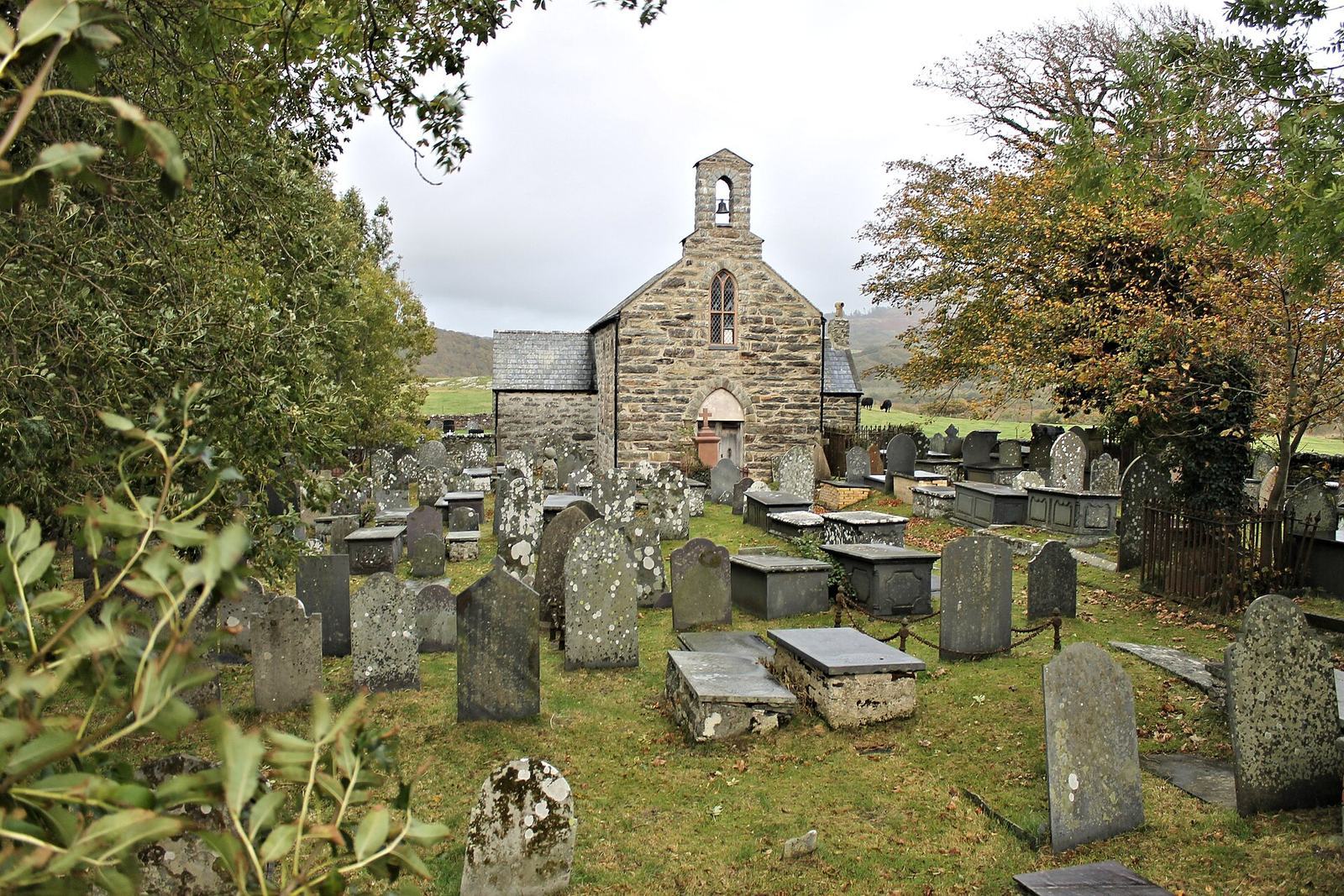
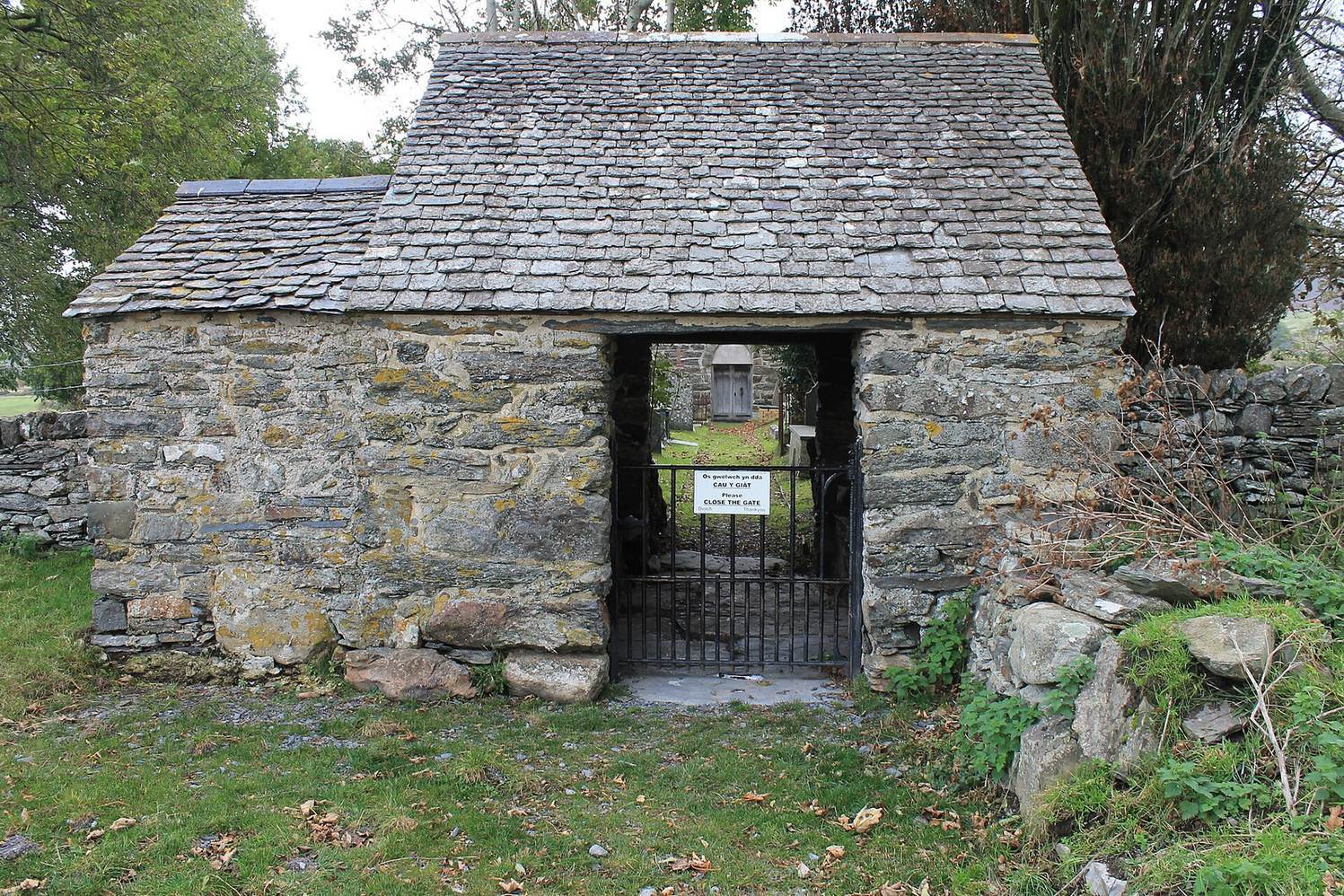
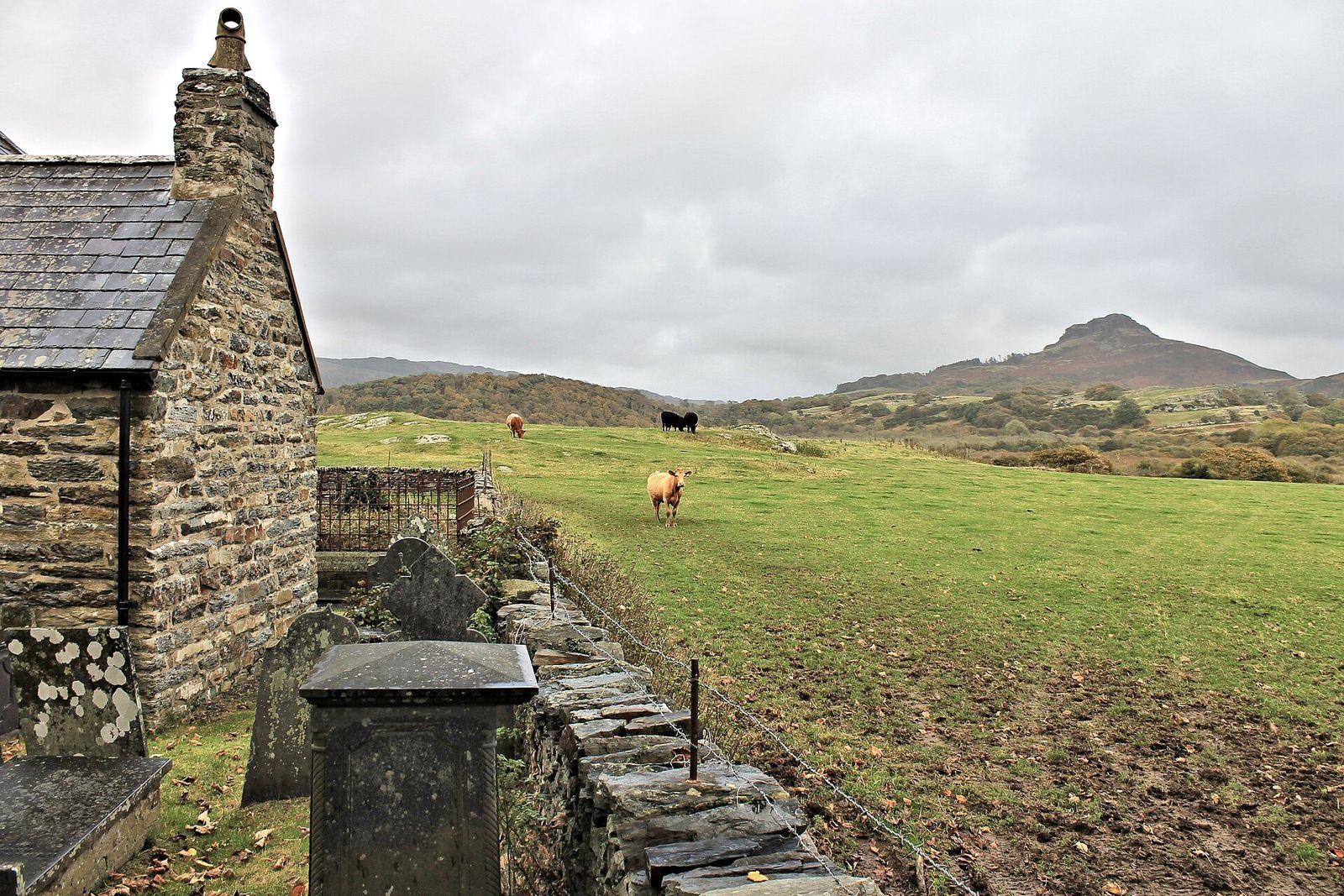
The church stands on a slight rise on what was once an island in Llyn Ystumllyn. An ancient causeway approaches from the village, following the edge of the former lake and running just above the fields. Remains of early medieval longhouses lie southwest of the church.
Church Fabric
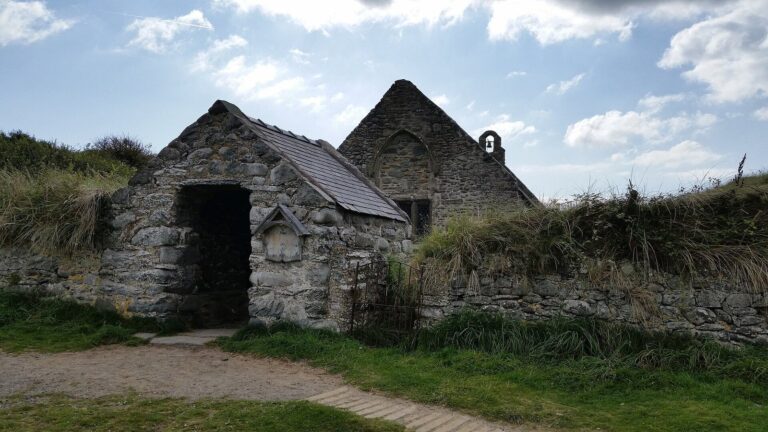
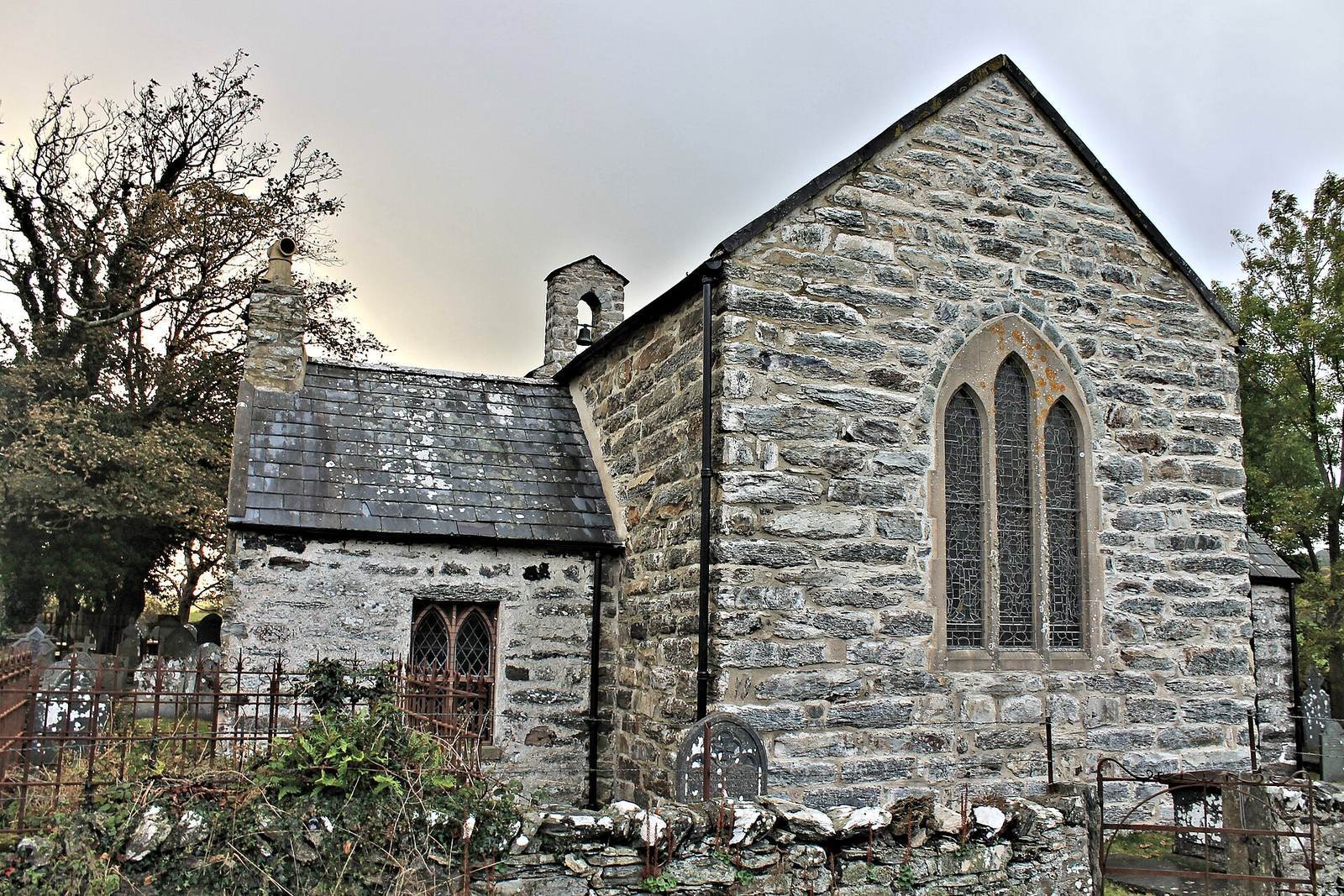
The nave walls and the east side of the chancel have a stucco finish, a plaster-like coating, and the roofs are covered with modern slate. A small bellcote, a structure that houses a bell, stands at the west end beside the entrance. The nave and transepts have windows divided into two openings each; three tall, narrow windows with pointed arches are set at the east end.
Church Hall
A small hall designed in 1937 by Clough Williams-Ellis, a Welsh architect and town planner, forms part of the church’s later architectural history.
Interior and Fittings
Wall Finishes and Floors
Inside, the walls are plastered above a timber dado, a lower wall section finished differently from the area above it. The church body has a stone-flagged floor, while the sanctuary floor is painted.
Pulpit and Seating
Most of the interior fittings date from 1832 and are Georgian in style, a period associated with the reigns of British kings George I to George IV. The three-decker pulpit has stacked levels for preaching and reading and is reached by nine steps. A lectern with a reading shelf and a reader’s desk stand beneath it. Enclosed box pews, or private seating spaces, are positioned on both sides of the altar.
Gallery and Organ
Slender columns support the gallery at the west end. It holds a chamber organ, a compact organ for indoor use, made by Flight and Robson in 1834. Mrs Walker gave the instrument, which cost £30; it was moved from Tremadog in 1854. Its case is Gothic in style. Six steeply sloping pews stand on each side of the organ. Many carry the names of the families who used them, and one is screened by a curtain for mothers feeding their babies.
Font and Stained Glass
The font installed in 1900 stands on an octagonal limestone pillar. Stained-glass windows commemorate former members of the church and sailors. One depicts the harp-playing “Sweet Singer of Israel,” the traditional epithet for the biblical King David, in memory of the Welsh poet Alltud Eifion, who was born in the parish. Another shows Cynhaiarn. Windows by James Powell and Sons date from 1899 and 1906.
Churchyard Memorials
David Owen’s Gravestone
David Owen’s slate gravestone bears a small carved harp. Its epitaph names him as Dafydd y Garreg Wen and states that he was buried at the age of 29.
Other Graves and Memorials
The churchyard includes the graves of Ellis Owen and John Williams, as well as a grave or memorial for John Ystumllyn. A stone-urn memorial to James Spooner and his family stands beside the boundary wall, about six metres south of the church door, enclosed by iron railings. Other graves commemorate local tradespeople, including a baker and a confectioner.