Court Church in Innsbruck: A Habsburg Memorial Church
Site at a Glance
- Popularity
- High
- Country
- Austria
- Primary era
- Early Modern
- Eras represented
- Early Modern
- Civilizations
- Habsburg, Habsburg Austria, Holy Roman Empire
- Site type
- Religious
- Remains
- Church
On this page16 sections
History
Foundation and memorial plan
The Court Church in Innsbruck, Austria, was commissioned by Emperor Ferdinand I, a Habsburg ruler from a European dynasty whose members ruled Austria and held the Holy Roman imperial title. Construction began in 1549 and finished in 1553, in the German hall-church tradition, with side aisles nearly as high as the central worship space. Andrea Crivelli of Trento designed the church, and Nikolaus Turing served as its general contractor. It remains a Roman Catholic church used for regular worship.
Ferdinand planned the church as a memorial to his grandfather, Emperor Maximilian I. Maximilian’s will called for his burial in the castle chapel at Wiener Neustadt, but the large monument he envisioned was impractical to build there. As executor of the will, Ferdinand planned a new church and monastery in Innsbruck for the memorial. Maximilian’s remains stayed at Wiener Neustadt, making the monument in Innsbruck a cenotaph, a memorial for someone buried elsewhere.
Later phases
The Silver Chapel was consecrated in 1578. An earthquake in the seventeenth century damaged the church’s main vault, which was rebuilt in the Baroque style. The church also holds the tomb of Andreas Hofer, a Tyrolean patriot and leader of the 1809 uprising against Bavarian and French rule.
Remains
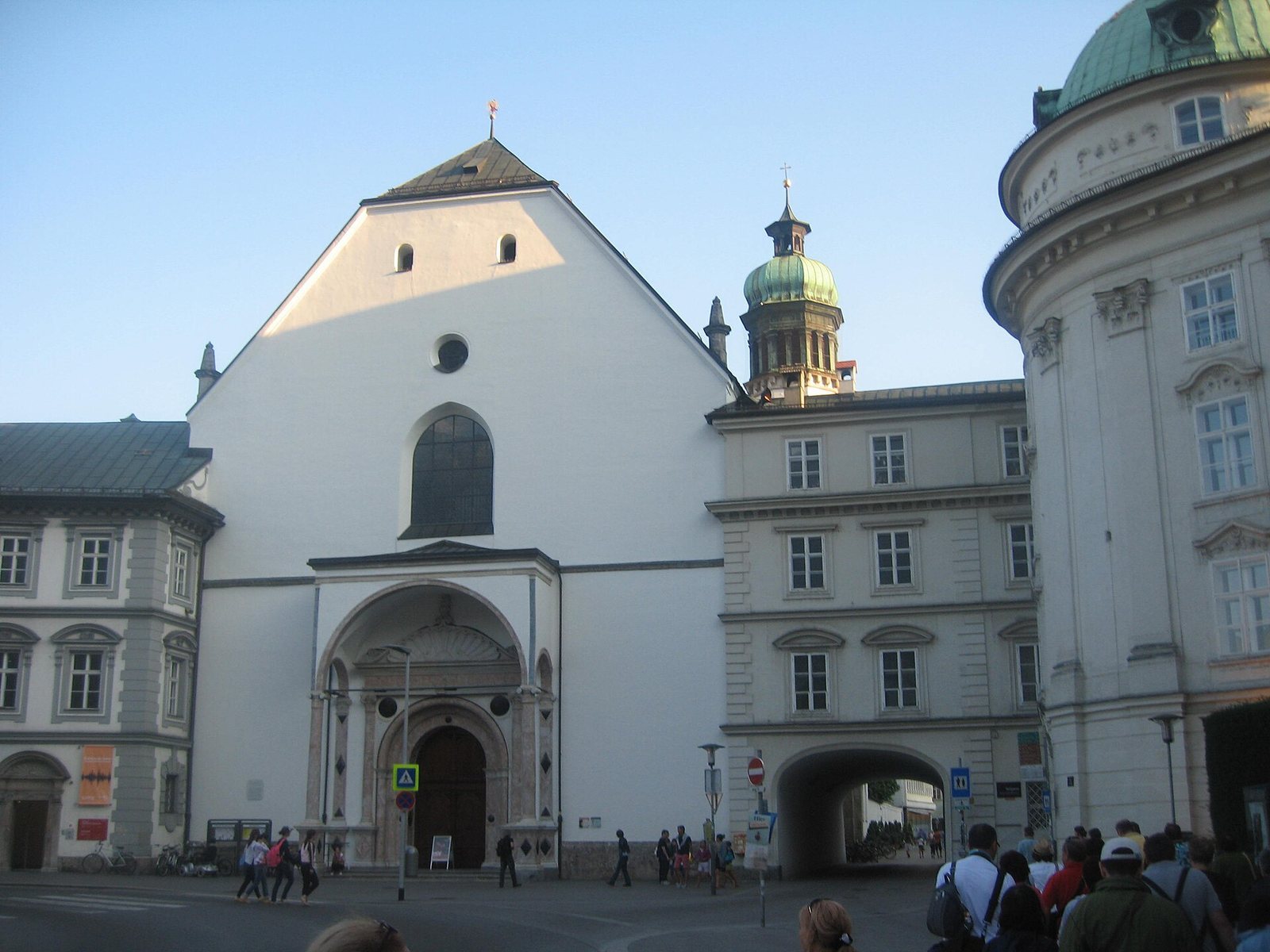
Beside the Hofburg, Innsbruck’s former imperial palace, the church has a broad hall-like plan with three lengthwise sections and a recessed, three-sided choir, the area containing the sanctuary. Its surviving fabric brings together Renaissance and German late Gothic features, alongside a Baroque vault.
Church fabric and interiors
Exterior
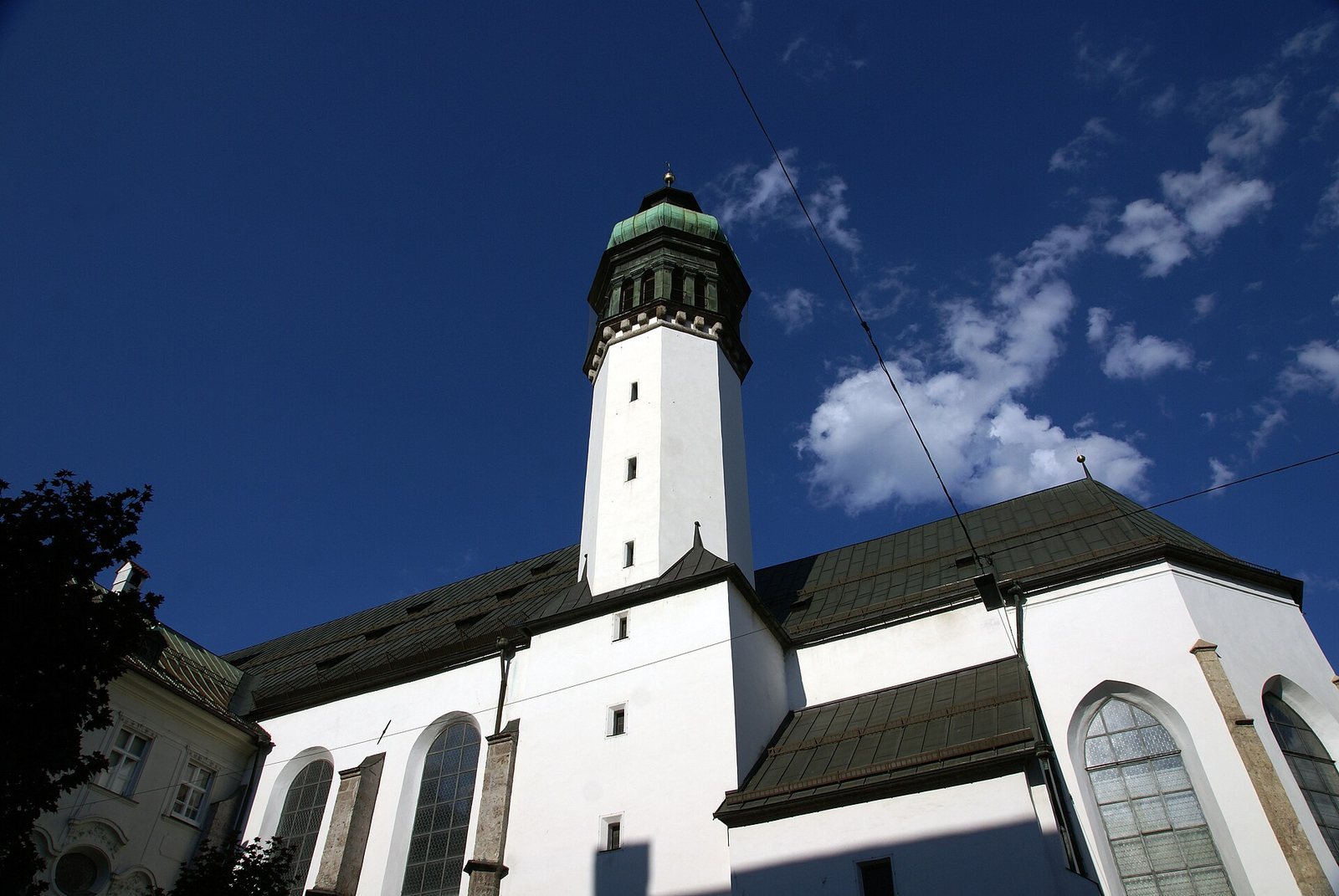
The façade faces north-northeast. Three naves, the church’s lengthwise spaces, lead toward the set-back choir. The exterior has both round- and pointed-arch windows and a steep roof with a broken hip profile. Layered buttresses, external wall supports, combine Renaissance design with German late Gothic work. Stonemasons Hieronymus de Longhi and Anton de Bol carved the Renaissance portal.
Interior
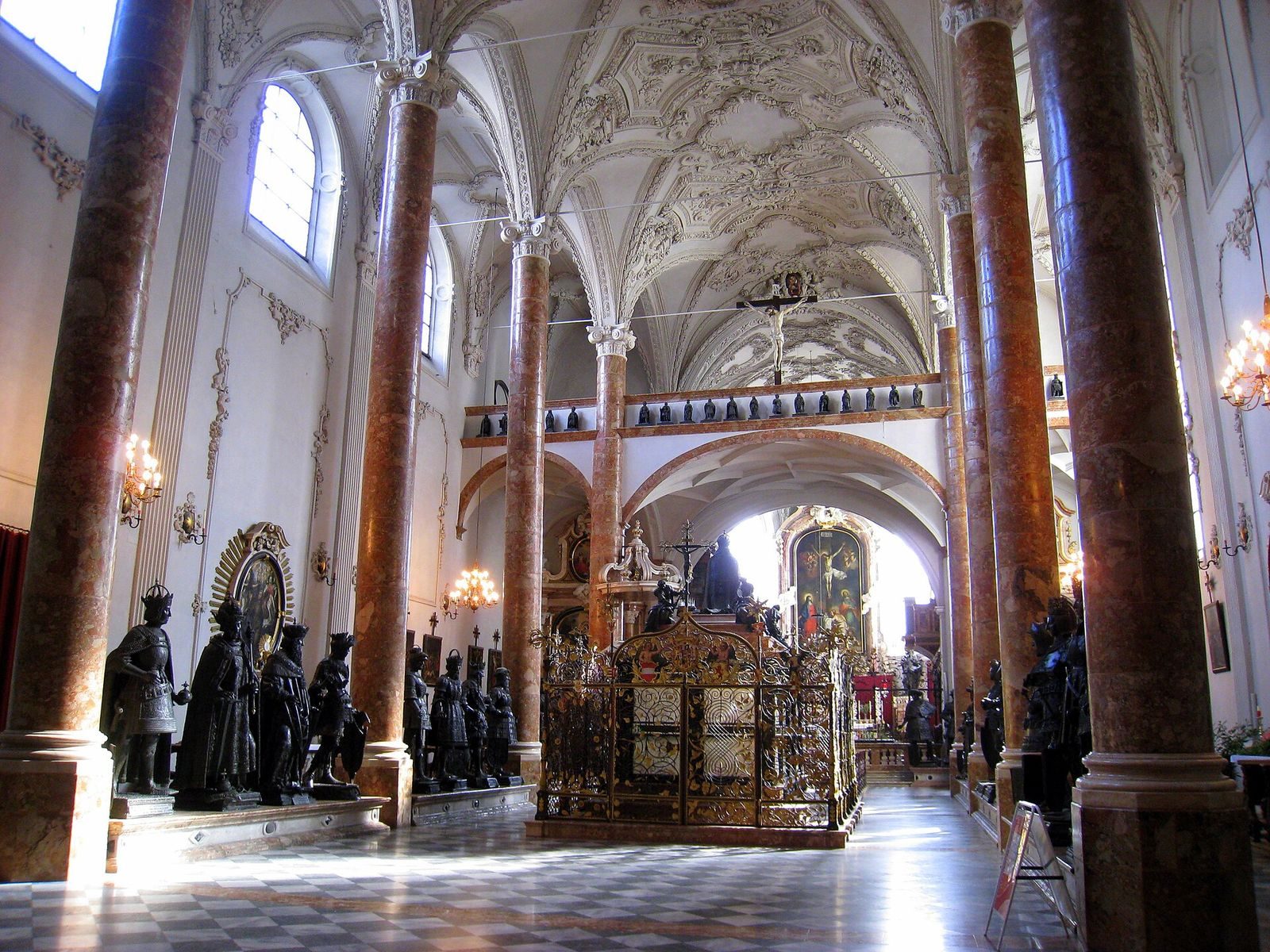
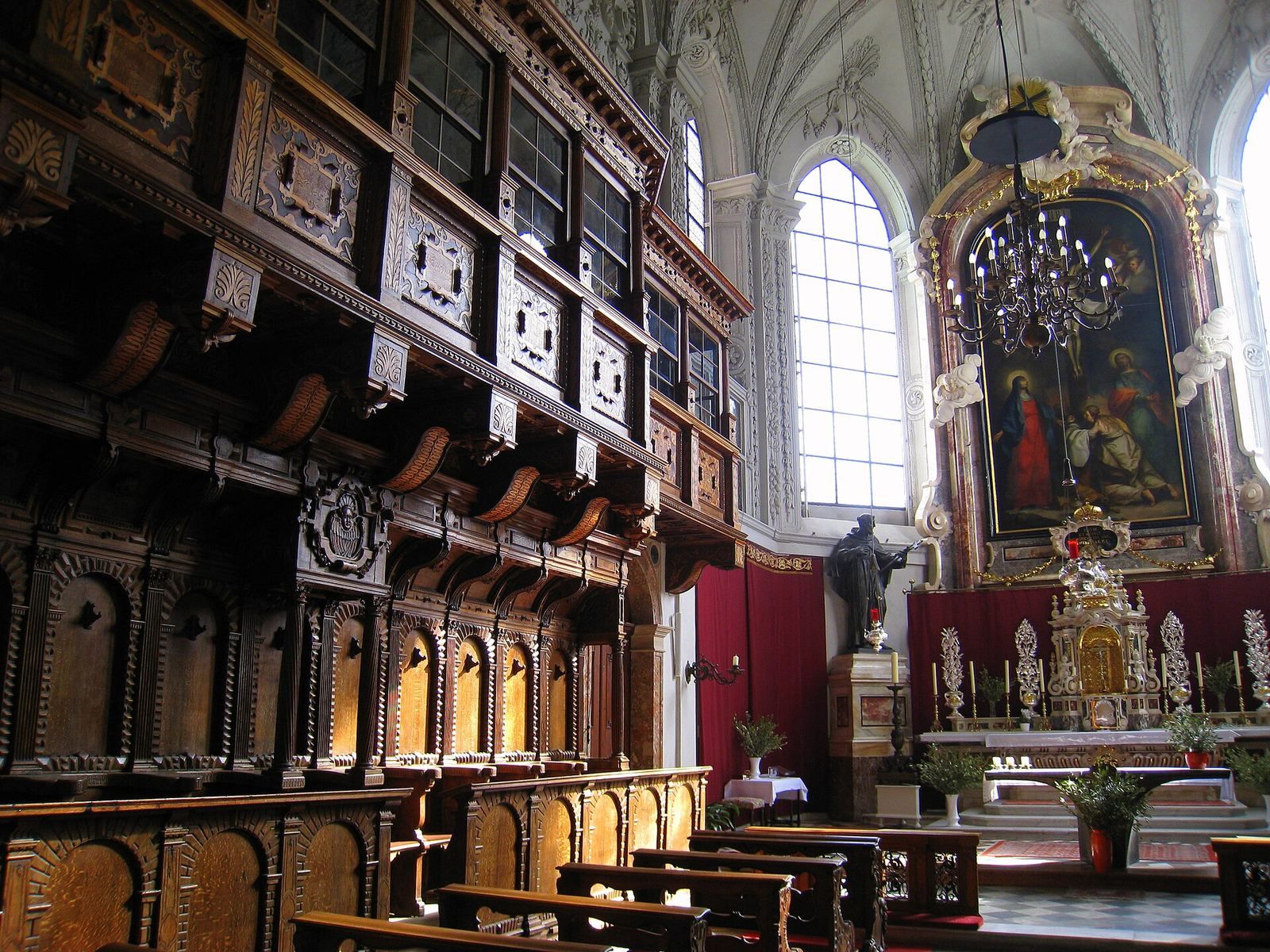
Galleries line the interior, which also contains tall, slender columns of red marble, a lectern, and white, stylized Corinthian capitals, the leafy tops of columns. The original gallery ribs, made from Mittenwald sandstone, survive. The church’s main vault is Baroque.
High altar and organ
Viennese court architect Nikolaus Pacassi designed the high altar in 1755. It includes a Crucifixion by Johann Carl Auerbach and bronze statues of Saint Francis of Assisi and Saint Teresa of Ávila, made by Balthasar Moll in 1768. The Renaissance organ dates to 1560 and was made by Jörg Ebert of Ravensburg; Domenico Pozzo of Milan painted its panels.
Silver Chapel
The Silver Chapel contains an altar dedicated to the Virgin Mary, made with three elephant tusks and 300 kilograms of ebony. It also holds the tombs of Archduke Ferdinand II, a member of Austria’s ruling house, and his wife Philippine Welser. Alexander Colyn made both tombs.
Maximilian’s cenotaph
Monument and ironwork
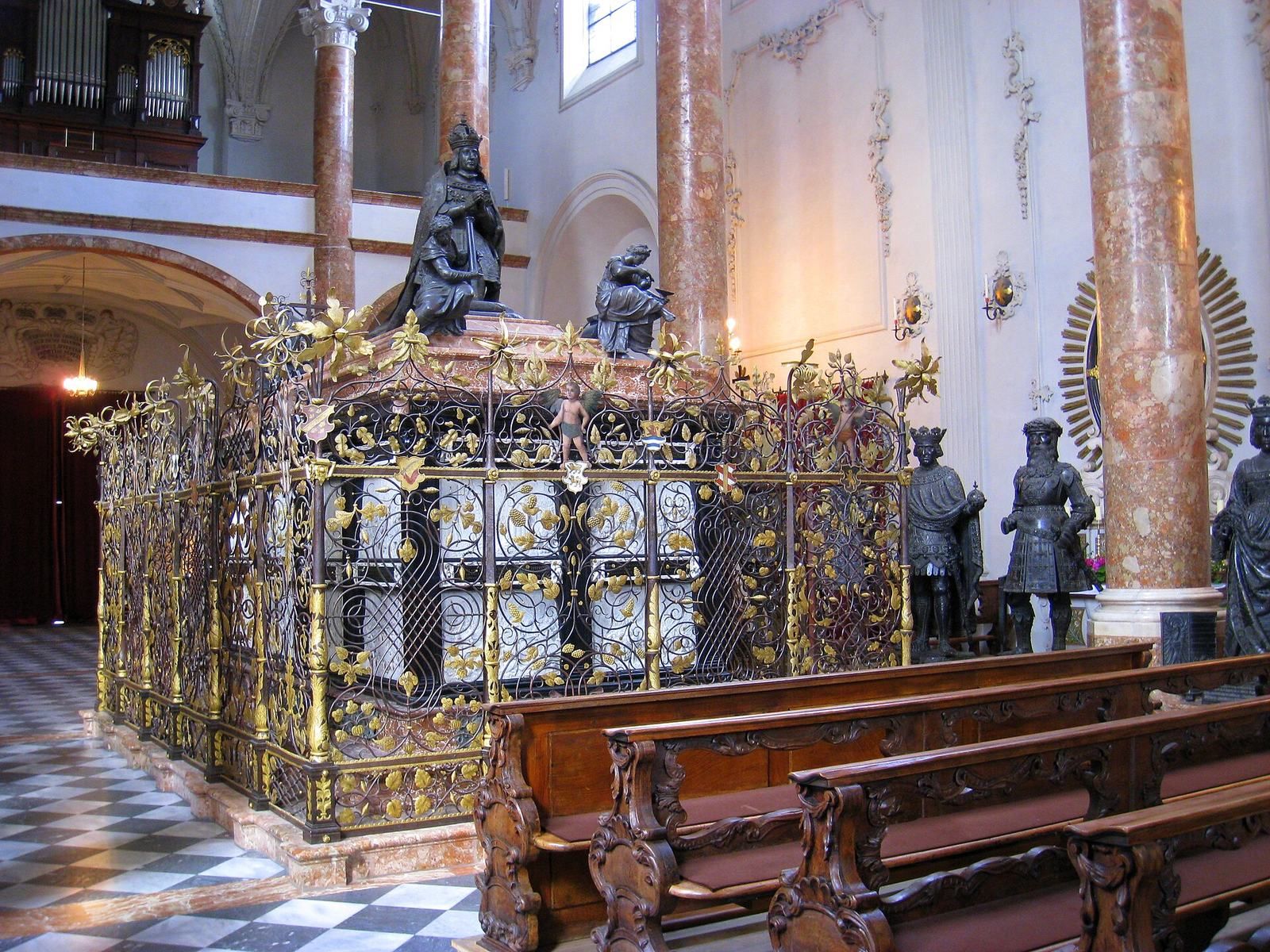
The black-marble cenotaph stands at the centre of the nave. Florian Abel of the Prague imperial court supplied a full-sized design in court Mannerist style, a form of Mannerist art associated with European courts. The Trento mason Hieronymus Longi directed the construction, which lasted more than 80 years. The sarcophagus was finished in 1572; in 1584, the kneeling emperor, four Virtues, and an iron grille were added. The base is Hagau marble, a Jurassic limestone from North Tyrol also used as building stone in western Austria.
Jörg Schmidhammer of the Prague court made the wrought-iron grille to a design by Innsbruck painter Paul Trabel. Above it are statues of the four Virtues and the kneeling emperor, cast at Mühlau from models by Alexander Colin.
Carved scenes and bronze frieze
A bronze band around the tomb displays trophies such as vases, armour, weapons, shields, and musical instruments. Above it, two rows of white-marble reliefs, carved scenes raised from their backgrounds, show episodes from Maximilian’s life and political world. Alexander Colin made the 24 reliefs, drawing on woodcuts from Albrecht Dürer’s Triumphal Arch. Four panels occupy each short end of the tomb and eight each long side. Their subjects range from Maximilian’s marriage to Mary of Burgundy in 1477 and his coronation as King of the Romans at Aachen in 1486 to the capture of Kufstein in 1504 and the defence of Verona in 1516.
Surrounding bronze figures
Twenty-eight bronze statues, each 200 to 250 centimetres tall, surround the cenotaph. They depict Maximilian’s ancestors, relatives, and admired historical figures. Artists made them between 1502 and 1555; contributors included Albrecht Dürer, Peter Vischer the Elder, Jörg Kölderer, Gilg Sesselschreiber, Veit Stoß, and Leonhart Magt. Three statues drew on Dürer’s designs. The figures include Arthur, Theoderic the Great, and Godfrey of Bouillon, alongside members of European ruling families. David Gass connected the inclusion of Arthur and Godfrey to Anna of Bohemia’s English heritage and her marriage to Ferdinand; both figures were regarded as among her ancestors.
Other sculptures and tombs
Gallery statues and Roman busts
The gallery contains 23 smaller statues, 66 to 69 centimetres tall, of saints associated with the Habsburg dynasty. Jörg Kölderer designed them around 1514 to 1515, and Leonhard Magt made versions first in wood and then in wax. The church once also held busts of Roman emperors. Twenty are now at Ambras Castle, and one is at the Bavarian National Museum in Munich.
Andreas Hofer’s tomb
Hofer’s tomb includes a statue by Johann Nepomuk Schaller and a relief called Swearing on the Flag by Josef Klieber, based on a sketch by Josef Martin Schärmer.