Basilica of Saint Justus: An Early Christian Church in Lyon
Site at a Glance
- Popularity
- Medium
- Country
- France
- Primary era
- Classical
- Eras represented
- Classical
- Civilizations
- Roman
- Site type
- Religious
- Remains
- Basilica
On this page13 sections
History
Early Christian foundations
The Basilica of Saint Justus was an early Christian funerary church in Lyon, France, within an ancient cemetery southwest of Roman Lugdunum, the Roman name for Lyon. The early Christian community established a church among the burial places, and successive buildings made it one of the city’s oldest and most powerful churches.
The church was first dedicated to the Maccabees, Jewish leaders remembered in biblical and later Jewish tradition, and later to Saint Just, Lyon’s thirteenth bishop. The date when Just’s body reached Lyon is uncertain. Antiochus, another bishop of Lyon, is said to have brought back the remains of Just and his disciple Viator.
Fifth-century accounts describe ceremonies held in Just’s honor. Sidonius Apollinaris recounts a day that began with a procession before dawn, followed by social gatherings and games before Mass in mid-morning. Gregory of Tours describes a vigil that lasted through the night before the saint’s feast. The August feast fell near Lughnasadh, an ancient harvest festival. One interpretation is that the Christian observance helped adapt local seasonal customs; the Maccabees’ feast had been celebrated on August 1.
Bishop Patient of Lyon directed construction of a second church around 470. The basilica’s chapter, an organized community of clergy, later grew in importance during the Carolingian period, named for the Frankish dynasty that included Charlemagne. The church was restored in the ninth century. From 868, a community of about twenty canons, or clergy attached to a church, served both Saint Just and nearby Saint Irenaeus. This arrangement probably continued until Archbishop Hugh of Die established a regular chapter at Saint Irenaeus in the eleventh century.
Medieval chapter and church
At least from the tenth century, an abbot headed the Saint Just chapter. Over time, an obedientiary, an officer responsible for a particular administrative duty, became its effective leader. A sacristan cared for church furnishings and sacred objects, while a choir master and a provost also served the community. The provost held judicial authority in the town of Saint Just. From 1290, the archbishop of Lyon routinely also held the title of abbot.
In the twelfth century the chapter rebuilt the church, which became a collegiate church, served by its organized body of clergy. It ranked as the city’s second-largest church after the cathedral. The suburbs of Saint Just and Saint Irenaeus were enclosed by a wall separate from Lyon’s city wall.
Pope Innocent IV lived in the Saint Just cloister, the church community’s enclosed precinct, during his seven years in Lyon from 1244 to 1251. At the First Council of Lyon, a gathering of church leaders, he excommunicated Holy Roman Emperor Frederick II in 1245. He also received William of Holland at the cloister and awarded the church a Golden Rose, a ceremonial papal honor, for the canons’ hospitality during the council. In 1248, Innocent blessed Louis IX of France and his brothers before their departure on the Seventh Crusade, an expedition to the eastern Mediterranean.
Pope Clement V was crowned at Saint Just on November 14, 1305, after his election at Perugia in June. During the ceremony, an old wall around the canons’ choir collapsed, killing several prominent people. People at the time regarded the disaster as a warning from God.
Late medieval use and destruction
The church received visits from Louis XI in 1483, Margaret of Austria in 1490, and Charles VIII and Anne of Brittany in 1497. During the Italian Wars, a series of conflicts involving France and other powers in Italy, Louise of Savoy stayed at Saint Just for two years while her son Francis I was held prisoner. Francis had been based in Lyon.
During the French Wars of Religion, sixteenth-century conflicts between Catholics and Protestants in France, Protestant troops commanded by Baron des Adrets entered Lyon on the night of April 30 to May 1, 1562. They took the suburb of Saint Just the next day and destroyed the basilica in September. Its stone was reused in other buildings. Reconstruction began in 1565 at a different site inside Lyon’s walls, where the church took the name Church of Saint Just.
Rediscovery
The remains were rediscovered during housing-development excavations in the 1970s. Archaeological work took place in 1971-74 and 1978-80. The city acquired the site for an archaeological garden, and it was classified as a historic monument in 1984.
Remains
Church complex
Layout and surviving fabric
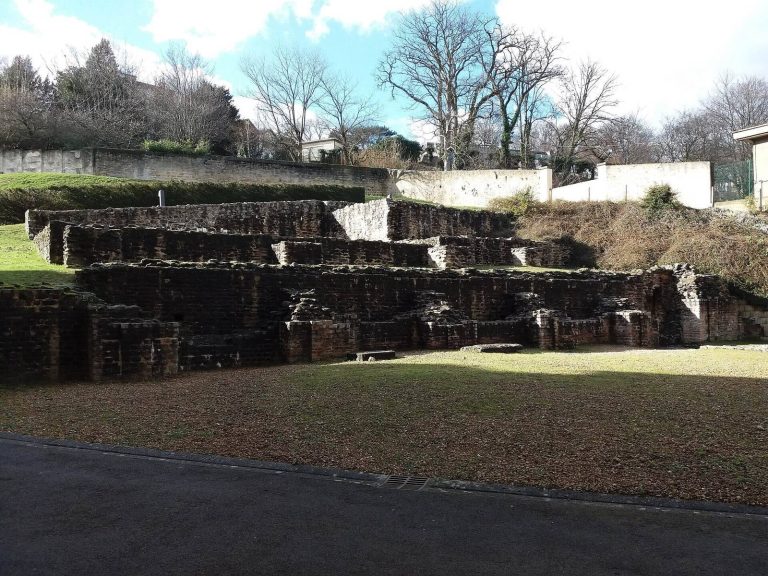
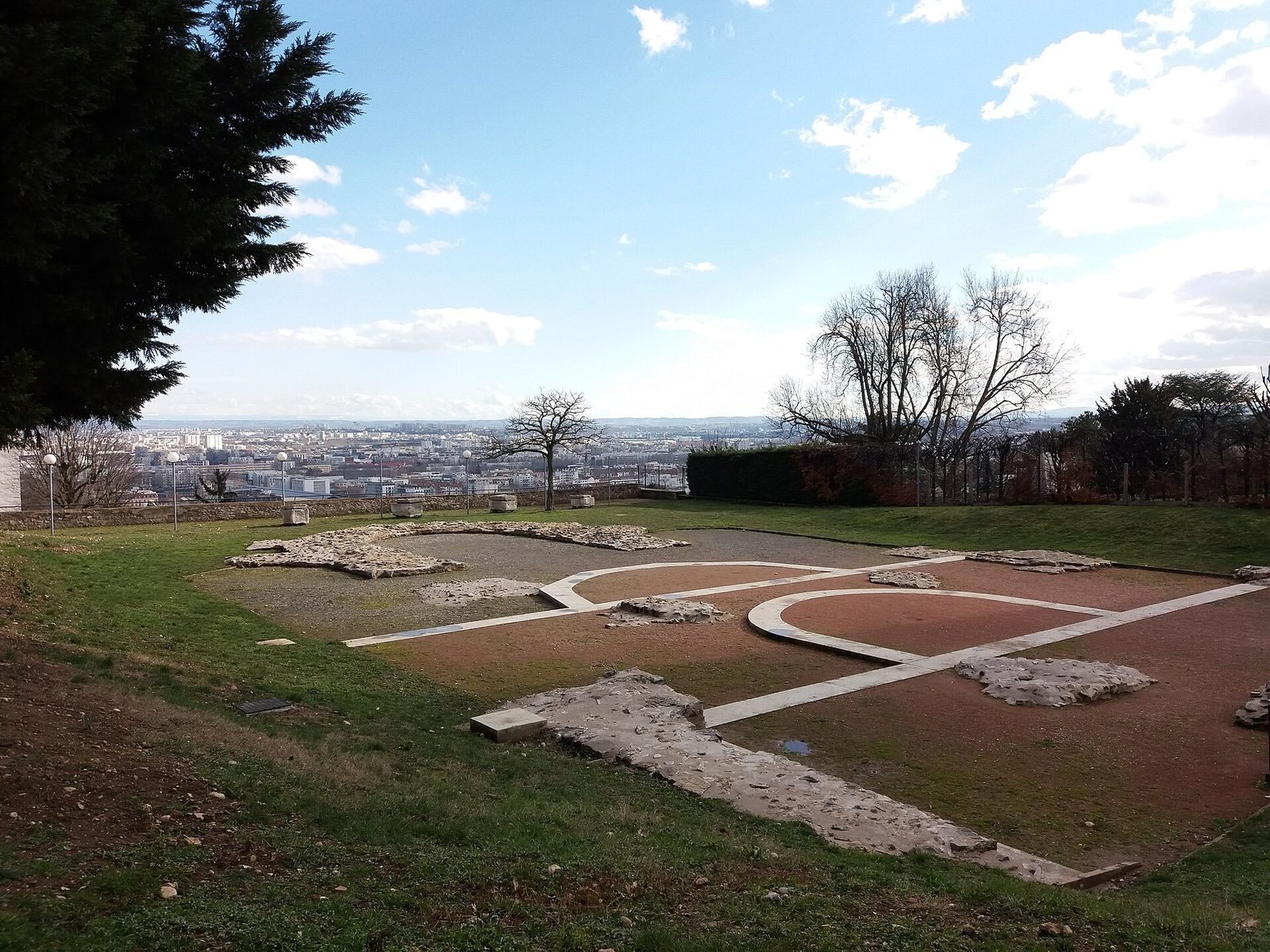
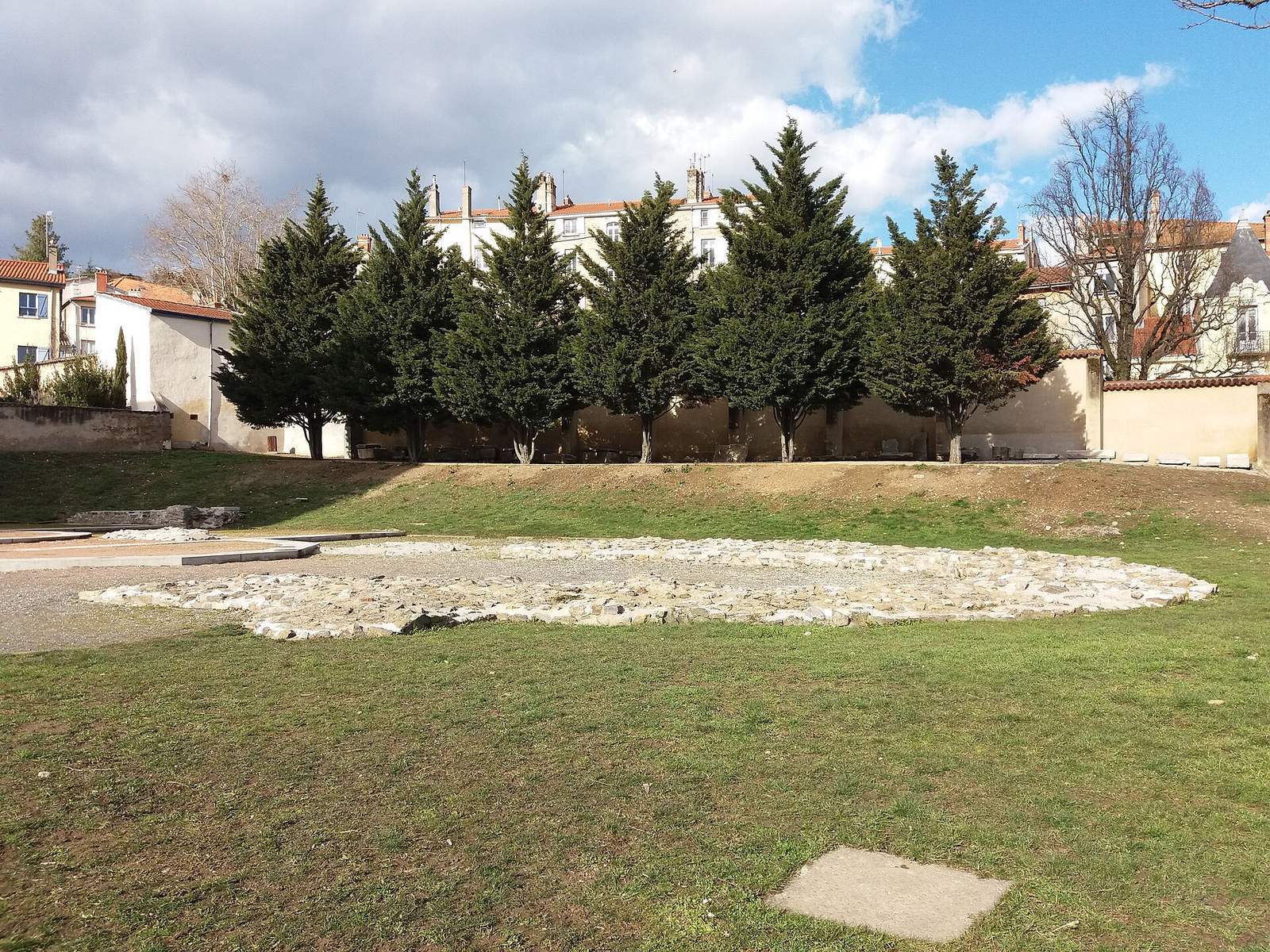
The excavated site at 13 Rue des Macchabées preserves successive church plans, from early Christian basilicas to a later Romanesque building, a medieval style associated with rounded arches and massive masonry. The visible remains consist chiefly of wall bases rising no more than about half a metre. Red and yellow markers indicate the footprints of the first two churches. The level difference between the street and the ruins exceeds what the hillside slope alone explains, reflecting a change in ground level since the sixteenth century. A painting on a house wall facing the site reproduces the section of Lyon’s 1550 Scenographic Plan, a detailed bird’s-eye view of the city, that depicts the basilica.
Early churches
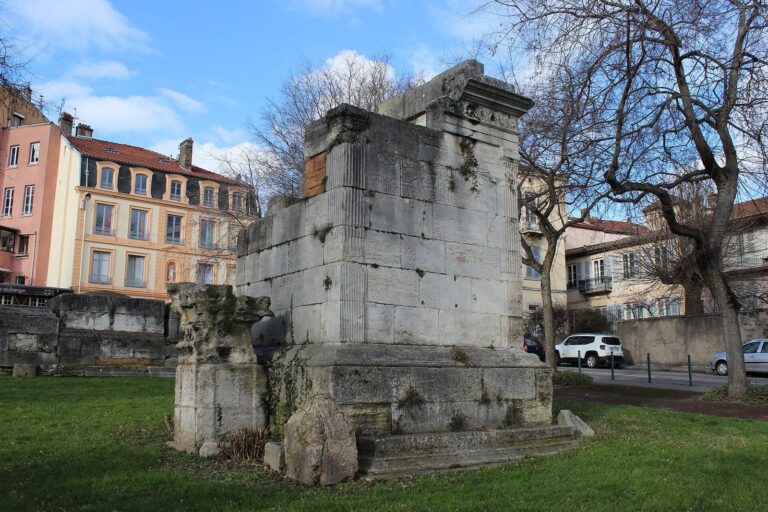
A Roman mausoleum, a monumental tomb, stood within the footprint of the later churches. Its apsidal form, meaning it had a rounded projecting end, measured 8 by 6 metres and dates to the fourth or fifth century. It was probably associated with a prominent member of Lyon’s early Christian community. Numerous coins found there were likely offerings, and a crypt, or chamber beneath a church, was later built at this location.
The first church followed soon after the mausoleum. Its surviving traces offer limited evidence for its form, but it was probably rectangular and divided into three parallel sections. A second church enlarged and covered the first. Its additions included a transept, the cross-arm of a church, and a new polygonal apse farther east. Galleries ran beside the nave, the church’s main body, and annexes were added, probably in several stages during the fifth century. Four rectangular crypts with vaulted ceilings lay beneath the upper church. Sidonius Apollinaris’s description mentions a dome, stained-glass windows, a marble floor and a marble colonnade in the atrium, the entrance court. Enclosed galleries surrounded the basilica, and the crowds could not all fit inside.
Romanesque church
Rebuilt in the twelfth and thirteenth centuries, the third church appears on Lyon’s 1550 Scenographic Plan as a large building with two towers on its front and a projecting transept. The plan provides a depiction of the church before its destruction in 1562.
Burials and mausoleums
Street burials
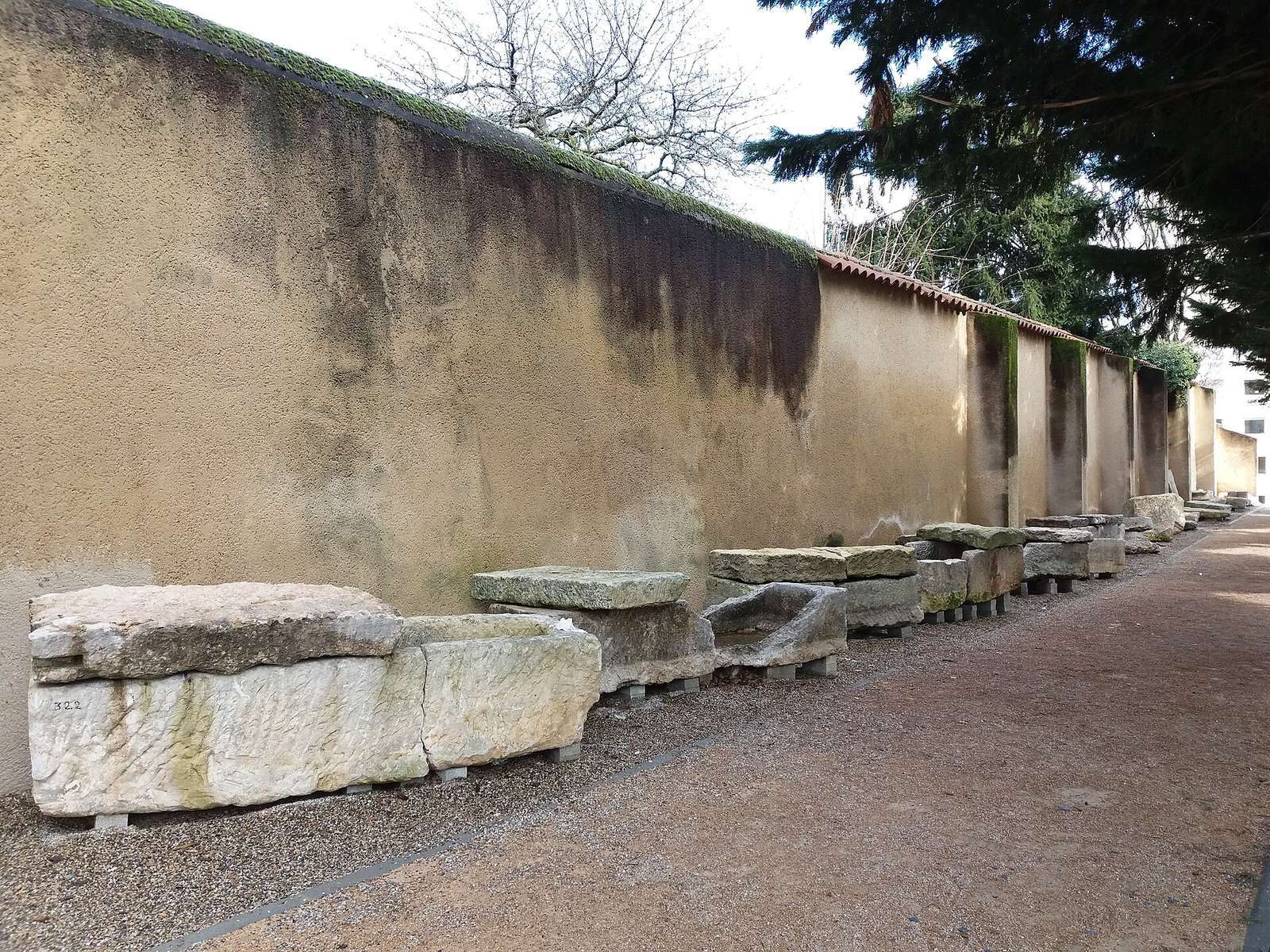
Sarcophagi recovered in 1903-04 during construction at 18 Rue des Macchabées point to the burial ground around the churches. Sewer work in 1950-51 exposed four trapezoidal sarcophagi and two Christian epitaphs, as well as a Merovingian cemetery. Two single-block stone sarcophagi were found in front of numbers 62 and 64. At number 82, several sarcophagi and an amphora, a large storage jar, were associated with the early Christian cemetery of Saint Irenaeus. Finds farther south indicate an early medieval cemetery.
Fourth- and fifth-century mausoleums
Excavations in 1972 and 1980 uncovered four mausoleums south of the basilicas. The most central measured 3.82 by 5 metres and contained a stone burial chest carved from one block, together with its lid. Another measured 5.80 by 6.10 metres and may have held two sarcophagi. A third contained a tomb built from large stone slabs. The fourth, excavated within the basilica, had an apse.